
How to Check a Financial Advisor in the US Before Hiring
Search BrokerCheck, the SEC adviser database and your state regulator, then read Form CRS and Form ADV for fees, conflicts and any disciplinary history.
By Redbison Dev · · 11 min read
To check a financial advisor in the US, search the person and the firm on FINRA BrokerCheck and on the SEC's Investment Adviser Public Disclosure site (adviserinfo.sec.gov), confirm the registration with your state securities regulator, and read two documents the firm must give you: Form CRS, the two-page relationship summary, and the Form ADV Part 2 brochure. Together they show registration, discipline, pay and the legal standard that applies. It is free and takes about half an hour.
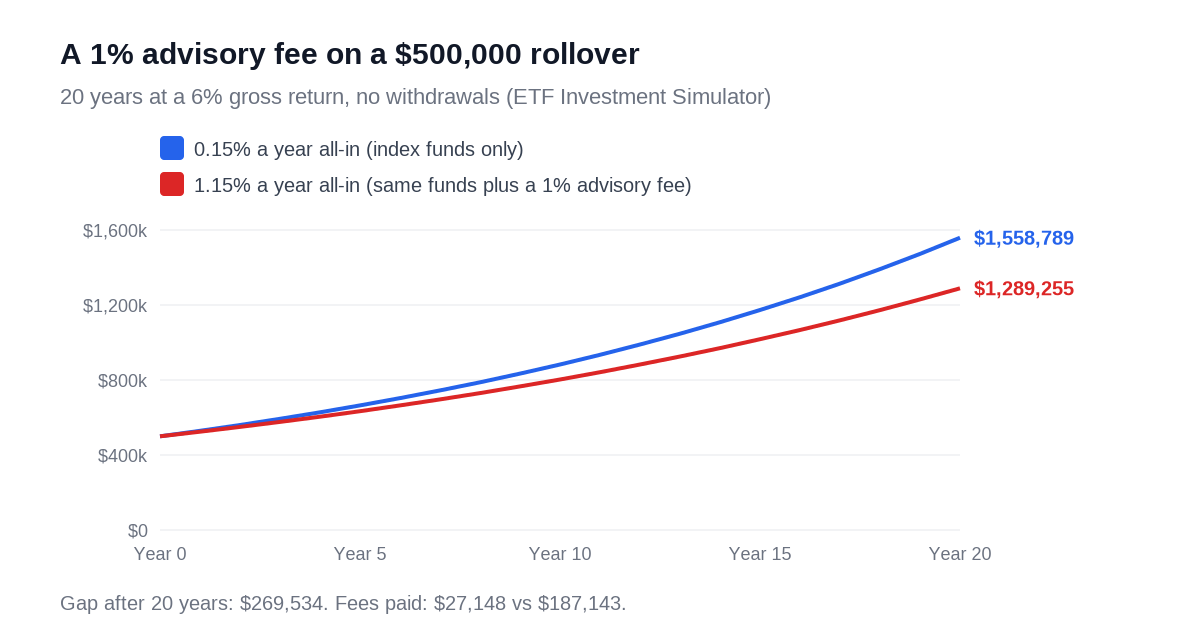
On a $500,000 rollover left invested for 20 years at a 6% gross return, the ETF Investment Simulator shows $1,558,789 at an all-in cost of 0.15% a year and $1,289,255 at 1.15%. That $269,534 difference is what a 1% advisory fee on top of low-cost funds costs, before asking whether the advice is any good. To repeat it, switch on Use Custom Returns, set Expected Annual Return to 6%, keep Reinvest Dividends on, enter Initial Investment 500,000, Monthly Contribution 0 and Investment Period 20, set Contribution Increase and Annual Salary Growth to 0, then run the Expense Ratio at 0.15 and at 1.15.
Broker, investment adviser or both: which database to search
US law splits "financial advisor" (the industry's spelling; the SEC writes "adviser") into roles with different regulators:
| Role | Registered with | Where to look it up | Standard when advising you |
|---|---|---|---|
| Broker (registered representative of a broker-dealer) | FINRA and the states | BrokerCheck | Regulation Best Interest for recommendations |
| Investment adviser firm and its representatives | The SEC, or the state if smaller | Investment Adviser Public Disclosure | Fiduciary duty under the Advisers Act, for the whole relationship |
| Dual registrant (both) | All of the above | Both databases | Depends on which hat they wear for each account |
| CFP professional | CFP Board (a certification, not a license) | CFP Board verify tool | CFP Board's fiduciary standard when giving financial advice |
Which regulator registers an adviser depends mainly on size. Under the SEC's rule 17 CFR 275.203A-1, an adviser with at least $100 million but under $110 million of assets under management may choose SEC registration, and one already registered need not withdraw until it falls below $90 million. Smaller advisers generally register with their state; adviserinfo.sec.gov shows those filings too. If a name is in neither database, ask why before anything else.
One person can hold both registrations, so search both databases by name and firm, and note the CRD number both systems share.
What BrokerCheck shows, and how to read a disclosure
FINRA builds BrokerCheck from the Central Registration Depository, the forms that firms, individuals and regulators file. For each person registered in the past 10 years, a report has:
- Registrations: every firm the person is or was registered with, and when.
- Qualifications: the licenses and exams passed (Series 7, Series 65 and so on).
- Employment history: the last 10 years, inside and outside the securities industry.
- Disclosures: customer disputes, regulatory and disciplinary events, criminal matters, and financial events such as bankruptcies.
FINRA keeps people on BrokerCheck for 10 years after their registration ends, and longer if they were, for example, the subject of a final regulatory action.
A disclosure is not a verdict. FINRA says brokers must report customer complaints alleging sales-practice misconduct "even if the allegations are without merit". Read each one for three things:
- Status. Denied means the firm contested it; settled means money was paid, often without an admission. A pending matter is unproven either way.
- Amounts. FINRA's own example: a $1 million claim settled for $750,000 says something different from one settled for $25,000. Check how much the individual contributed.
- Pattern. One complaint about a fund that fell in a crash differs from several about the same product type, such as variable annuities sold to retirees, over a few years. FINRA suggests weighing how many complaints there are and over what period.
Regulatory actions (a FINRA suspension, a state order) and terminations "for cause" matter more than a single denied complaint. Ask about any disclosure at the first meeting.
Form CRS: the two pages to read first
Every broker-dealer and SEC-registered adviser serving retail investors must give you Form CRS (the client or customer relationship summary), and an adviser must deliver it before or at the time you sign the advisory contract (17 CFR 275.204-5(b)(1)). It is also posted on the firm's website and attached to its IAPD record. The SEC's instructions cap it at two pages, or four for a dual registrant's combined summary.
Its headings are fixed, so firms compare side by side. Three sections matter most:
- Fees and costs. It must include this question for you to ask: "If I give you $10,000 to invest, how much will go to fees and costs, and how much will be invested for me?" At a 1% advisory fee on funds that cost 0.15%, the honest answer is about $115 in the first year.
- Legal obligations and conflicts. A broker writes that when it recommends something it must act in your best interest "and not put our interest ahead of yours", then lists how it makes money: commissions, revenue sharing, proprietary products.
- Disciplinary history. The heading asks: "Do you or your financial professionals have legal or disciplinary history?" The answer must be a plain Yes or No, followed by a pointer to Investor.gov/CRS. A Yes covers the firm and every professional there, so look the individual up yourself.
Form ADV Part 2: the brochure behind the summary
An investment adviser's Form ADV Part 2A brochure, available on adviserinfo.sec.gov, is longer and more specific than Form CRS. The items to read:
- Item 5, Fees and Compensation: the fee schedule, whether fees are negotiable, and whether you also pay fund expenses and trading costs on top.
- Item 9, Disciplinary Information: material legal or disciplinary events, generally for 10 years after the event.
- Item 10, Other Financial Industry Activities: an affiliated broker, insurance agency or fund company is a conflict you should hear about.
- Item 12, Brokerage Practices: how the adviser picks the brokers that trade for you and whether it receives research or services paid for with your commissions ("soft dollars"), a conflict it must explain.
- Item 15, Custody: who holds your money; if a qualified custodian sends you statements, compare them with the adviser's own reports.
- Item 14, Client Referrals and Other Compensation: payments for sending clients, or for being sent them.
Part 2B, the brochure supplement, covers the individual who will advise you: education, business experience and their own disciplinary history (Item 3).
Fiduciary or best interest: what the difference means in practice
Both standards use the words "best interest", so "Are you a fiduciary?" alone settles little.
- An investment adviser owes a fiduciary duty of care and loyalty under the Investment Advisers Act, as the SEC set out in its 2019 interpretation (Release IA-5248). It covers the whole advisory relationship and requires the adviser to eliminate conflicts or disclose them fully enough for you to give informed consent.
- A broker recommending a securities transaction, an investment strategy or an account type must, under Regulation Best Interest (17 CFR 240.15l-1), act in your best interest "at the time the recommendation is made" without putting its own interest ahead of yours. The rule names four obligations: disclosure, care, conflict of interest and compliance. It applies to each recommendation; the SEC's adopting release (Release 34-86031) confirms that it "does not impose a duty to monitor" your account afterwards.
The practical question is which hat applies to the account in front of you. A dual registrant can act as a broker for an annuity sale and as an adviser for a managed account. Ask in writing: "For this account, are you acting as my investment adviser or as my broker, and how are you paid on it?" The rule covers "account recommendations", and the adopting release says these include recommendations to roll a workplace retirement plan into an IRA, so a rollover pitch carries the same obligations.
The CFP Board requires a CFP professional to act as a fiduciary "at all times when providing Financial Advice to a Client" (Code of Ethics and Standards of Conduct, Standard A.1). That is a certification standard enforced by the CFP Board, not a license; the person still needs a broker or adviser registration to sell securities or charge for investment advice.
Your state regulator, and the seniors helpline
State securities regulators license investment adviser representatives and brokers working in their state, handle complaints and can tell you about actions not yet on the federal databases. Find yours through NASAA's contact your regulator map. FINRA also runs the Securities Helpline for Seniors at 844-574-3577 (weekdays, 9am to 5pm Eastern) for questions about a brokerage account or a pitch you are unsure of.
Who this does not fit: insurance agents selling only fixed annuities or life insurance are licensed by the state insurance department, not on BrokerCheck or IAPD, and banks' trust departments have their own regulators. For a decision with tax or estate consequences, a fee-only adviser you have checked this way, or a CPA or estate attorney, is the right next step.
Tools for this job
- ETF Investment Simulator: enter a balance, a return and the all-in cost (fund expense ratio plus advisory fee) to see what an adviser's fee costs over the years you will pay it.
- First Investment Account Checklist: fees, protections and scam warning signs to check before opening any account.
- Retirement Checklist: where choosing an adviser fits among the decisions that cannot be undone.
- US Retirement Records Checklist: the official US sites (SSA, Medicare, IRS, PBGC, FINRA) and what to check on each, as a list you can tick.
- Annuity Calculator: check the payout an annuity salesperson quotes against what the same lump sum pays at a stated rate.
For the fee arithmetic in more depth, read the ETF fees and dividends guide; for what to do with the accounts an adviser will manage, the 401(k), IRA and annuity guide. The other official US sites worth knowing before you retire are in the 11 US retirement websites to bookmark.
Frequently asked questions
What does it mean if a financial advisor has a disclosure on BrokerCheck?
It means a reportable event: a customer complaint, a regulatory action, a criminal matter, a termination or a financial event such as a bankruptcy. Brokers must report sales-practice complaints even when they lack merit, so read the status, the amounts and the dates, and look for a pattern. Regulatory actions and terminations for cause weigh more than one denied complaint.
Is a CFP the same as a fiduciary?
The CFP Board's standards require a CFP professional to act as a fiduciary whenever giving financial advice to a client, and the Board can sanction those who do not. It is a certification, not a government registration. Check the CFP Board's tool for the certification and BrokerCheck or IAPD for the registration that lets them sell or advise.
Why can't I find my advisor on adviserinfo.sec.gov?
They may be registered only as a broker (search BrokerCheck), registered with a state under a slightly different name, or only insurance-licensed, in which case your state insurance department holds the record. If they claim to give investment advice for a fee and appear nowhere, ask your state securities regulator before going further.
How much should a financial advisor cost?
Form CRS must show how you pay, whether an asset-based fee, an hourly or fixed fee, or commissions, and Form ADV Item 5 gives the schedule and says whether it is negotiable. Compare the all-in yearly cost, adviser fee plus fund expenses, in dollars: at 1.15% a $500,000 account pays about $5,750 in the first year.
Sources and further reading
- About BrokerCheck, FINRA. What reports contain, the data source and the 10-year rule.
- What To Do If Your Investment Professional Has a Customer Complaint on BrokerCheck, FINRA. How to read denied and settled complaints.
- Instructions to Form CRS, US Securities and Exchange Commission. Page limits, required headings and the conversation starters quoted above.
- Form ADV Part 2 instructions, US Securities and Exchange Commission. Brochure items 5, 9, 10, 12 and 14 and the brochure supplement.
- Commission Interpretation Regarding Standard of Conduct for Investment Advisers, US Securities and Exchange Commission. The adviser's fiduciary duty of care and loyalty.
- 17 CFR 240.15l-1, Regulation Best Interest, eCFR. The broker standard and its four obligations.
- Regulation Best Interest: The Broker-Dealer Standard of Conduct, Release 34-86031, US Securities and Exchange Commission. The adopting release: rollovers as account recommendations, and no duty to monitor.
- Code of Ethics and Standards of Conduct, CFP Board. The fiduciary standard for CFP professionals.