
How to Pay Off Your Mortgage Early and How Much It Saves
On a $400,000 loan at 7.28%, $200 a month extra ends it 5 years 10 months sooner and saves $135,371. Extra payments, biweekly, lump sums and refinancing.
By Redbison Dev · · 10 min read

You have a 30-year mortgage and some spare cash each month, and you want to know how much sooner it could be gone. On a $400,000 loan at 7.28%, Freddie Mac's 30-year average for the week of 19 November 2026, adding $200 a month ends the loan 5 years and 10 months early and saves $135,371 of interest. One extra payment a year saves $143,209 and 6 years 3 months; adding a twelfth of the payment every month saves $148,841 and ends the loan at payment 283.
Biweekly schedules land in the same place in the US, because what saves money is the extra principal, not how often you pay. Every figure below comes from the Mortgage Calculator with the inputs given, except the US biweekly and refinance comparisons, which run the same amortization separately. It covers fixed-rate loans; adjustable-rate and interest-only loans behave differently.
The example loan and the inputs to type
Open the Mortgage Calculator and enter a home price of 500000, a down payment of 20 (%), an interest rate of 7.28 and a loan term of 30 years. Set property tax, home insurance, PMI rate and HOA dues to 0 so the results show the loan alone. The required principal and interest payment is $2,736.85, and total interest over 30 years is $585,266.
The first payment explains why prepaying works. It carries $2,426.67 of interest (the $400,000 balance times 7.28% / 12) and only $310.18 of principal. Each extra dollar of principal stops that 0.607% monthly charge on itself for every remaining month, which is why the same dollar saves far more in year one than in year twenty. The mortgage maths guide derives the payment formula.
Every strategy on one loan
Type each extra into the Extra payments fields, one at a time:
| Strategy | What you type | Paid off in | Total interest | Interest saved |
|---|---|---|---|---|
| Required payment only | nothing | 30 years | $585,266 | none |
| $100 extra a month | Extra every month: 100 | 26 years 8 months | $507,033 | $78,233 |
| $200 extra a month | Extra every month: 200 | 24 years 2 months | $449,895 | $135,371 |
| One extra payment a year | Extra once a year: 2736.85 | 23 years 9 months | $442,057 | $143,209 |
| A twelfth extra each month | Extra every month: 228.07 | 23 years 7 months | $436,425 | $148,841 |
| $500 extra a month | Extra every month: 500 | 19 years 2 months | $341,253 | $244,013 |
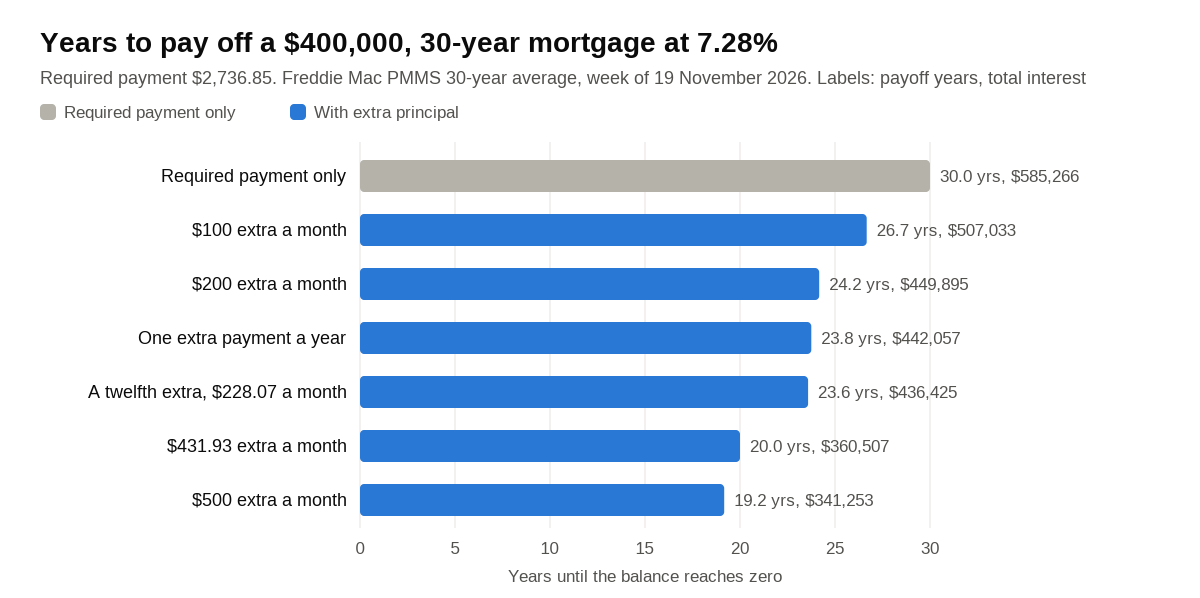
The twelfth beats the once-a-year payment by $5,632 although both add $2,736.85 a year, because the monthly version starts cutting interest eleven months sooner. The extra once a year is added to every 12th payment, so the first lands with payment 12.
To set a target date instead, find the payment that clears the loan in the years you want and subtract the required one. A 20-year finish needs $3,168.78 a month, so type 431.93 into Extra every month: the loan ends at payment 240 with $360,507 of interest, $224,759 less than the plain schedule.
Biweekly, weekly and monthly payments
An accelerated biweekly payment is half the monthly payment, $1,368.42, every two weeks. There are 26 two-week periods in a year, so you pay 13 monthly payments instead of 12. The 13th, $2,736.85 a year, is the whole effect. A true biweekly payment spreads the same 12 monthly payments over 26 periods, $2,736.85 × 12 ÷ 26 = $1,263.16, and adds no money at all.
What that is worth depends on when your servicer credits the money. Under Regulation Z, 12 CFR 1026.36(c), anything less than a full monthly payment is a partial payment. A servicer may hold it in a suspense account until a full payment builds up, then credit it as a payment. So half-payments on a US loan with monthly terms can sit unapplied for up to two weeks.
On a US loan that credits monthly. True biweekly saves next to nothing: $0 to $4,052, only because 26 two-week periods cover 364 days, so the payments creep a day ahead each year. Accelerated biweekly builds up one spare full payment a year in suspense. If the servicer then applies it to principal, the saving runs from $140,702 to $152,134, ending between payment 281 and 285, depending on which day of the month the first half-payment falls. That straddles the one-extra-payment-a-year row. If the servicer applies it as an early next payment instead, it saves nothing, so ask how it is handled.
If your servicer credits each half-payment when it arrives (standard in Canada, and what the calculator's Payment frequency menu models, following the Financial Consumer Agency of Canada's definitions):
| Payment frequency | Payment | Paid off in | Total interest | Interest saved |
|---|---|---|---|---|
| Every two weeks (true biweekly) | $1,263.16 | 29.8 years | $579,538 | $5,727 |
| Weekly | $631.58 | 29.8 years | $577,109 | $8,157 |
| Accelerated, every two weeks | $1,368.42 | 23.4 years | $432,838 | $152,427 |
| Accelerated weekly | $684.21 | 23.4 years | $431,312 | $153,954 |
Paid biweekly programs. In May 2015 the CFPB sued Nationwide Biweekly Administration, which charged a setup fee of up to $995 and $84 to $101 a year in processing fees. The Bureau calculated that a customer with the median loan needed nine years in the program just to recover the fees. Adding $228.07 a month yourself gets about the same result for free.
Lump sums: earlier beats bigger
A one-off sum, from a bonus or an inheritance, saves the most when it arrives early. Enter 20000 in One-time payment and change With payment number:
| $20,000 paid with payment | Paid off | Interest saved |
|---|---|---|
| 1 | 54 months sooner | $128,619 |
| 12 | 51 months sooner | $120,391 |
| 60 | 39 months sooner | $88,907 |
| 120 | 28 months sooner | $58,445 |
| 240 | 14 months sooner | $19,661 |
The same $20,000 saves more than six times as much on payment 1 as on payment 240. Waiting to build a larger lump sum rarely wins, unless the waiting money earns more than the loan rate. The amortization guide shows the same effect on smaller loans, and the EMI Calculator prints the month-by-month schedule behind it.
A lump sum shortens the loan but leaves the required payment unchanged. If you would rather lower the payment, ask the servicer about a recast before sending the money.
Refinancing to a shorter term
Five years into the example loan, the balance is $377,631.45. If 15-year rates are still 6.66% then (Freddie Mac's 15-year average for the week of 19 November 2026), refinancing into a 15-year loan makes the payment $3,322.88 and cuts total interest by $222,936. Paying the same $586.03 extra on the existing 7.28% loan saves $178,591 and ends 14 months later.
So the refinance is worth about $44,345 here before its closing costs, and it makes the higher payment compulsory. Run your quote through the Refinance Calculator for the break-even month; the 15-year versus 30-year comparison covers choosing the term at purchase.
Before you prepay
Prepaying earns exactly your mortgage rate and locks the money in the house. Settle these first:
- Employer 401(k) match. Contribute enough to get it; the 401(k) Calculator shows what it grows to.
- Higher-rate debt. The Federal Reserve's G.19 release puts the average credit card rate on accounts assessed interest at 22.36% for the third quarter of 2026 (a preliminary figure), three times this mortgage. The Debt Payoff Calculator orders your debts by rate.
- An emergency fund. Prepaid principal comes back only by selling, refinancing or borrowing against the house. Size the cushion with the Emergency Fund Calculator.
- Other uses for the money. Whether to invest instead depends on your after-tax rate and the risk you take; the Compound Interest Calculator shows what the money would grow to.
None of this is advice for your situation; a fee-only planner or a HUD-approved housing counselor can check your numbers.
Check the loan before sending extra money
- Prepayment penalty. Under the ability-to-repay rule, 12 CFR 1026.43(g), a penalty is allowed only on a fixed-rate qualified mortgage that is not higher-priced, only in the first three years, and at most 2% of the amount prepaid in years one and two and 1% in year three. A lender offering one must also offer a loan without it. The CFPB says penalties typically apply to paying off the whole balance, but some lenders also charge one for paying a large amount at once, so check before a big lump sum.
- Principal-only instructions. If Fannie Mae owns your loan, its Servicing Guide (C-1.2-01) requires the servicer to apply a payment you identify as additional principal immediately. That is why the instruction matters: mark extra money "principal only", then check the next statement. The 15-year versus 30-year guide covers where the Loan Estimate shows a penalty.
- PMI. Prepaying reaches 80% of the original value sooner, but automatic cancellation under the Homeowners Protection Act follows the original schedule, so you have to ask the servicer to remove PMI yourself.
Tools for this job
- Mortgage Calculator: every row in the first table, from extra monthly, yearly and one-time payments to the payoff date, plus the payment frequencies.
- EMI Calculator: the month-by-month schedule and the balance after any payment.
- Refinance Calculator: the break-even month for a shorter-term refinance with closing costs.
- Debt Payoff Calculator: whether higher-rate debts should be cleared first.
- Compound Interest Calculator: what the same money would grow to if invested instead.
- Emergency Fund Calculator and 401(k) Calculator: the two things to fund before the mortgage.
Frequently asked questions
How many years does $200 extra a month take off a 30-year mortgage?
On a $400,000 loan at 7.28%, $200 a month extra from the first payment ends the loan 5 years and 10 months early, after 290 payments instead of 360, and saves $135,371 of interest. On the same loan, $100 a month takes off 3 years 4 months and $500 a month takes off 10 years 10 months.
Do biweekly mortgage payments really save money?
Only if they add money. Accelerated biweekly, half the monthly payment every two weeks, adds one monthly payment a year. On a $400,000 loan at 7.28% that saves about $141,000 to $152,000 if the servicer applies the spare payment to principal. Splitting the same yearly total into 26 payments adds almost nothing: a US servicer that holds half-payments until a full one arrives credits at most a few thousand dollars of saving.
When is the best time to make a lump-sum mortgage payment?
As early as you can. $20,000 paid with the first payment of a $400,000 loan at 7.28% saves $128,619 and 54 months; the same sum with payment 120 saves $58,445, and with payment 240 only $19,661. The interest it stops would have been charged on every remaining month, so each month of delay costs you.
Can my lender charge a penalty for paying off my mortgage early?
Only if your loan documents say so. Under the federal ability-to-repay rule, a penalty is allowed only on certain fixed-rate qualified mortgages, only in the first three years, and is capped at 2% of the amount prepaid in the first two years and 1% in the third. It usually applies to a full payoff, sometimes to a large lump sum.
Sources and further reading
- Primary Mortgage Market Survey, Freddie Mac. Weekly US averages: 7.28% for 30-year and 6.66% for 15-year fixed loans, week of 19 November 2026.
- 12 CFR 1026.43, Minimum standards for transactions secured by a dwelling, eCFR. Paragraph (g): which loans may carry a prepayment penalty, the 2% and 1% caps and the three-year limit.
- 12 CFR 1026.36, Prohibited acts or practices and certain requirements for credit secured by a dwelling, eCFR. Paragraph (c): crediting payments on receipt and holding partial payments in suspense.
- C-1.2-01, Processing Additional Principal Payments, Fannie Mae Servicing Guide. Applying borrower-identified extra principal immediately on Fannie Mae loans.
- What is a prepayment penalty?, Consumer Financial Protection Bureau. When penalties apply, including to some large lump sums.
- CFPB files suit against Nationwide Biweekly, Consumer Financial Protection Bureau. Setup and yearly fees of a paid biweekly program, May 2015.
- Choosing a mortgage that is right for you, Financial Consumer Agency of Canada. Definitions of biweekly, weekly and accelerated payment frequencies.
- G.19 Consumer Credit, Federal Reserve. Credit card interest rates; 22.36% on accounts assessed interest, third quarter of 2026, preliminary.