
Term vs Whole Life vs Return-of-Premium Life Insurance (US)
What term, return-of-premium, whole and variable life cost and pay back, the real return on an ROP refund, and the MEC and death benefit tax rules.
By Redbison Dev · · 10 min read
You have two quotes for $500,000 of cover on a 35-year-old: plain 30-year term at $400 a year, and return-of-premium (ROP) term at $1,150 a year that refunds every premium if you outlive it. Term buys the most cover per dollar; ROP, whole life and variable life charge more and give money back, but the money back is a return on the extra premium, and it is usually low. In this example the $34,500 refund earns 2.63% a year on the extra $750, while investing that $750 each year at 5% leaves $52,321 after 30 years.
The premiums here are illustrations built for the arithmetic, not quotes. Real prices depend on age, health, state and insurer, so ask for your own pair and type them into the same calculators.
What you pay, what you are covered for, what you get back
| Policy | What you pay | The cover | What you get back |
|---|---|---|---|
| Term | The lowest premium, level for the term | The death benefit, for 10 to 30 years | Nothing; most term policies have no cash value (NAIC) |
| Return-of-premium term | More than term: $1,150 against $400 in this illustration | The same death benefit for the same term | Part or all of the premiums if you outlive the term (NAIC) |
| Whole life | A fixed premium on a set schedule, for life or a set number of years | A death benefit for life | Guaranteed cash value; dividends on a participating policy, which are not guaranteed (Texas Department of Insurance) |
| Universal life | A flexible premium, as long as it covers the policy's charges | A death benefit that lasts while the cash account covers the charges | Cash value credited with interest; non-variable policies often guarantee a minimum (NAIC) |
| Variable and variable universal life | Premiums invested in subaccounts you choose, after fees | A death benefit while the account covers the charges | Cash value that rises and falls with the funds; you can lose money (SEC) |
Variable life is the US counterpart of unit-linked insurance: an investment account and life cover in one contract. Because the account holds securities, it is sold with a prospectus (SEC), and in Texas the agent needs a federal securities license as well as an insurance license.
What the ROP refund really costs
The refund feels free because you get every dollar back. It is not: the extra $750 a year is a 30-year investment, and its return can be measured. To find it, open the NPV and IRR Calculator, set each period to one year and paste these cash flows: thirty extra premiums at the start of each year, then the refund at the end of year 30.
-750, -750, -750, -750, -750, -750, -750, -750, -750, -750, -750, -750, -750, -750, -750, -750, -750, -750, -750, -750, -750, -750, -750, -750, -750, -750, -750, -750, -750, -750, 34500
The IRR is 2.63% a year. That is the rate the refund pays on the extra premium, and only if you keep the policy for all 30 years and are alive at the end.
To see the alternative, open the Annuity Calculator, choose growth of deposits, starting balance 0, deposit per year 750, 30 years, annual payments made at the start of each period, and change the interest rate:
| Where the extra $750 a year goes | Value after 30 years |
|---|---|
| Extra premiums paid into the ROP policy | $22,500 |
| ROP refund (2.63% a year) | $34,500 |
| Invested at 3% | $36,752 |
| Invested at 5% | $52,321 |
| Invested at 7% | $75,805 |
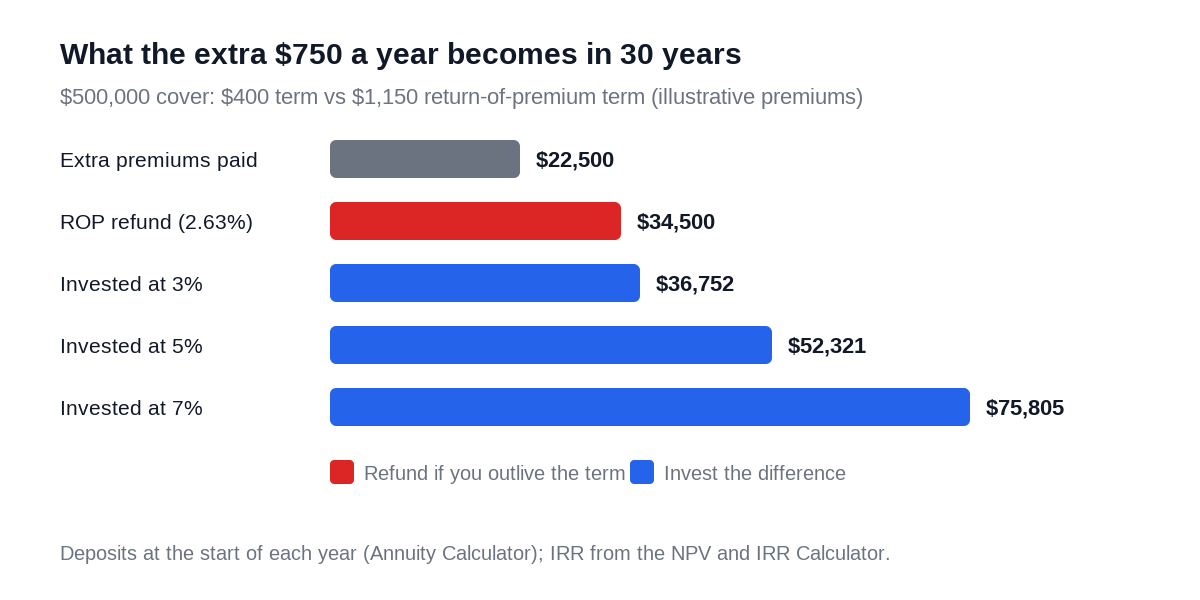
At 5% the refund costs you $17,821 against investing the difference. The break-even return is the IRR itself: if you could not earn more than 2.63% a year after tax, ROP wins. A 30-year Treasury bond, a high-yield savings account or a target-date fund is the honest comparison, not "money you would otherwise lose".
Two things work in ROP's favor. The refund is a return of premiums you paid, which is your investment in the contract, so it is not taxable income (26 U.S.C. 72(e)); investment gains in a taxable account are. And the refund forces the saving, where $750 a year left in a checking account earns nothing. Inside a Roth IRA the tax point disappears: qualified gains there are tax-free too.
Two work against it. If you drop the policy in year 15, the refund is whatever the contract's schedule says, which may be part of the premiums or nothing, so read that schedule before buying. And if you die during the term, your beneficiaries receive the $500,000 either way; the invested difference would have gone to them on top, the extra ROP premiums do not.
Whole life: reading the illustration
A whole life sale comes with an illustration, a table of premiums, cash values and death benefits by year. Read two columns: guaranteed and non-guaranteed. The NAIC buyer's guide tells you to ask what part of the premium or policy value is not guaranteed, and the Texas Department of Insurance states that dividends "aren't guaranteed" and that illustrations "aren't a promise of a policy's performance". Run your comparison on the guaranteed column; treat the rest as a scenario.
A worked case, with figures built for the arithmetic rather than taken from any policy: the same 35-year-old is offered $500,000 of whole life at $5,200 a year, with a guaranteed cash value of $190,000 at year 30. Against the $400 term, the extra is $4,800 a year. Paste the ROP cash flows above into the NPV and IRR Calculator with -750 replaced by -4800 and the final 34500 by 190000: the guaranteed column returns 1.73% a year on the extra premium. The same $4,800 a year invested at 5% (Annuity Calculator, as above) grows to $334,852. Whole life keeps two things this leaves out: cover after year 30, and dividends that, if paid, raise the return.
Then check three things the illustration shows but does not stress:
- Cash value in the early years. The NAIC notes that in some policies values are "low in the early years but build later on". Surrender early and you can get back less than you paid.
- Surrender charges. The Texas Department of Insurance warns of a surrender fee if you take the money out early; the SEC describes the charge as compensating the insurer for sales expenses it would not otherwise recover.
- The free-look period. You can return a new policy for a full refund within a short window, usually 10 days (NAIC); Texas policies give 10 to 20 days, and the SEC says variable life usually allows 10 to 30 days.
The case for whole life is real when you want cover that cannot run out at 65, such as funding an estate tax bill or providing for a dependent who will need support for life. For a household that needs cover only until the mortgage is paid and the children are grown, term does the job for a fraction of the premium.
Variable and universal life: the fees and the tax rules
The SEC's investor bulletin lists what a variable life policy charges, most of it every year: mortality and expense risk fees as a percentage of the account, sales fees on premiums, a cost of insurance that rises with age, administration fees, the underlying funds' own expense ratios, surrender charges, and fees for optional riders. If the cash value cannot cover the charges, because of fees, poor returns or loans, the policy lapses and pays no death benefit. The SEC adds that the seller's pay may depend on which policy you buy.
Compare that with buying term and investing in an index fund, where the fee is one expense ratio. To see what an extra percentage point a year costs over decades, run the same deposits through the ETF Investment Simulator at two expense ratios.
The tax rules are where cash-value insurance earns its keep, and where it can go wrong:
- Death benefit. Amounts paid "by reason of the death of the insured" are excluded from gross income (26 U.S.C. 101(a)), whether paid as a lump sum or not. A policy bought from someone else for value loses most of that exclusion (101(a)(2)), and the proceeds can still count toward an estate for estate tax.
- Growth inside the policy is tax-deferred. Withdrawals from a policy that is not a MEC are taxed only above your investment in the contract (72(e)(5)(C)), and loans are not taxed while the policy stays in force. If it lapses with a loan outstanding, the SEC warns, you may owe income tax on the loan.
- Modified endowment contracts (MECs). The 7-pay test runs through the first seven contract years: if at any point the premiums paid so far exceed the 7-pay premiums due by then (seven level annual premiums that would pay the policy up), it becomes a MEC (26 U.S.C. 7702A(b)). A material change, such as a higher death benefit, restarts the test (7702A(c)(3)). From then on, withdrawals and loans are taxed as income first (72(e)(10)), and a 10% additional tax applies before age 59½ unless an exception fits (72(v)). The death benefit stays income-tax-free.
The amount of cover is a separate question
Which type to buy and how much to buy are different decisions. Income multiples, such as 10 times salary, are rules of thumb with no regulator behind them; the NAIC's buyer's guide asks needs questions instead: who depends on your income, what debts must be repaid, and what else you want to fund. The NAIC also warns that group cover from work is usually less than you need and may not follow you when you leave the employer. Size the need first, then price that amount as term, ROP and whole life and compare them as above.
This is general information, not advice on a policy or insurer. If you are replacing an existing policy, funding a trust, or the estate could owe estate tax, have a fee-only planner or tax adviser look at the contract first.
Tools for this job
- NPV and IRR Calculator: the return an ROP refund or a whole life cash value pays on the extra premium.
- Annuity Calculator: what investing the difference grows to.
- Compound Interest Calculator: check a single lump sum's growth, such as a cash value from an illustration.
- ETF Investment Simulator: what policy and fund fees cost over decades.
- Insurance Review Checklist: the policies a household should check every year, life cover included.
- Estate Planning Checklist: beneficiary designations and the will that the death benefit has to fit.
The time value of money guide explains IRR and why two returns over different periods are not comparable, and the 401(k), Roth IRA and annuity guide covers the accounts where invested premium savings go first. Before buying a cash-value policy through an adviser, look them up with how to check a financial advisor.
Frequently asked questions
Is return-of-premium term life insurance worth it?
Only if you would not earn more than its implied return on the extra premium. On a $400 term versus $1,150 ROP illustration over 30 years, the refund returns 2.63% a year on the extra $750, and only if you keep paying to the end. Investing the same $750 a year at 5% would leave $52,321 against the $34,500 refund.
Are life insurance death benefits taxable?
Generally not. Federal law excludes amounts paid by reason of the insured's death from the beneficiary's gross income, whether paid as a lump sum or in installments, though interest added on installments is taxable. A policy bought from its previous owner for value loses most of the exclusion, and the proceeds may still count toward the insured's estate for estate tax.
What is a modified endowment contract?
It is a life insurance policy that fails the federal 7-pay test: at some point in its first seven contract years, premiums paid so far exceeded the level premiums due by then for a policy paid up in seven years. A material change restarts the test. The death benefit stays tax-free, but withdrawals and policy loans are taxed as gains first, with an extra 10% tax before age 59½.
Is variable life insurance the same as a ULIP?
They work the same way: premiums buy life cover and units in investment funds, after charges, and the cash value follows the funds. In the US it is sold as variable life or variable universal life, registered with the SEC and sold with a prospectus. Fees include mortality and expense charges, a cost of insurance, fund expenses and surrender charges.
Sources and further reading
- Life Insurance Buyer's Guide, National Association of Insurance Commissioners. Term versus cash value, illustrations, the free-look period and how much cover to buy.
- Life Insurance, National Association of Insurance Commissioners. Policy types, including the return-of-premium feature.
- Life insurance guide, Texas Department of Insurance. Dividends and illustrations are not guaranteed; Texas free-look periods.
- Variable Life Insurance, US Securities and Exchange Commission. Fees, lapse risk and tax consequences of variable life.
- 26 U.S.C. 101, Certain death benefits, Legal Information Institute. The death benefit exclusion and the transfer-for-value rule.
- 26 U.S.C. 7702A, Modified endowment contract defined, Legal Information Institute. The 7-pay test.
- 26 U.S.C. 72, Annuities; certain proceeds of endowment and life insurance contracts, Legal Information Institute. Basis-first withdrawals, MEC treatment and the 10% additional tax.