
Healthy BMI and Waist Size in Australia: What They Mean
The healthdirect BMI ranges, the 80, 88, 94 and 102 cm waist levels, who BMI misreads, and a healthy weight range in kg for heights from 150 to 190 cm.
By Redbison Dev · · 6 min read
Australia edition. Metric throughout, with the healthdirect adult BMI ranges and waist risk levels, the groups healthdirect says BMI is less accurate for, and ABS National Health Survey 2022 figures. US edition
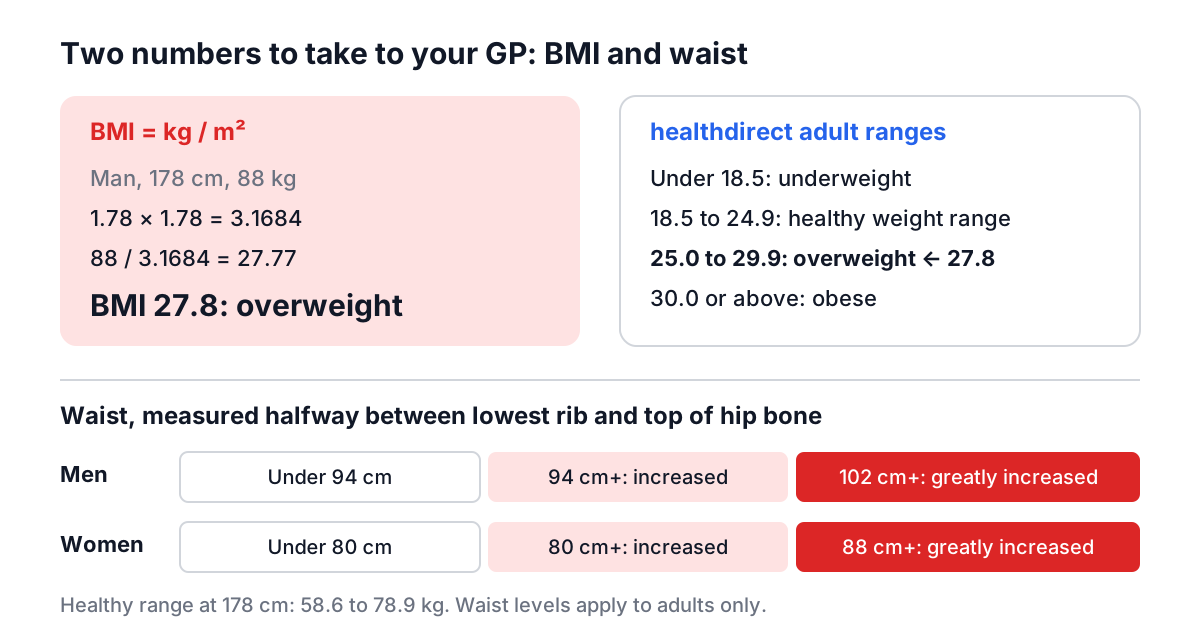
In Australia a healthy adult BMI is 18.5 to 24.9, the range healthdirect uses, and a waist under 94 cm for men or under 80 cm for women. A 178 cm man who weighs 88 kg has a BMI of 27.8, which is overweight; whether that matters for his health depends a great deal on the tape measure. He would have plenty of company: in the ABS National Health Survey 2022, 65.8% of Australian adults were overweight or obese and 67.9% had a waist measurement linked to increased risk. This guide shows how to work out both numbers, what the ranges mean, and who should read them with care.
It is general information. Your GP can put the numbers in context with your blood pressure, blood glucose and family history.
Working out your BMI in kilograms and centimetres
Australia weighs and measures in metric, so BMI is one step:
BMI = weight (kg) / (height in m × height in m)
For 178 cm and 88 kg:
1.78 × 1.78 = 3.1684
88 / 3.1684 = 27.77, shown as 27.8
The Australian BMI calculator does this in kg and cm by default. If an older relative gives their height in feet and inches, convert first: 5 feet 7 inches is 67 inches, and 67 × 2.54 = 170.2 cm.
The ranges healthdirect uses
| BMI | healthdirect description |
|---|---|
| Under 18.5 | Underweight |
| 18.5 to 24.9 | Healthy weight range |
| 25.0 to 29.9 | Overweight |
| 30.0 or above | Obese |
These are the World Health Organization adult ranges. They are drawn at round numbers where risk of type 2 diabetes, high blood pressure and heart disease rises across a population; risk does not jump at 25.0.
Healthy weight range for your height
The healthy range is 18.5 to 24.9 times your height in metres squared. For common heights:
| Height | Healthy weight range | Overweight from | Obese from |
|---|---|---|---|
| 150 cm | 41.6 to 56.0 kg | 56.3 kg | 67.5 kg |
| 155 cm | 44.4 to 59.8 kg | 60.1 kg | 72.1 kg |
| 160 cm | 47.4 to 63.7 kg | 64.0 kg | 76.8 kg |
| 165 cm | 50.4 to 67.8 kg | 68.1 kg | 81.7 kg |
| 170 cm | 53.5 to 72.0 kg | 72.3 kg | 86.7 kg |
| 175 cm | 56.7 to 76.3 kg | 76.6 kg | 91.9 kg |
| 180 cm | 59.9 to 80.7 kg | 81.0 kg | 97.2 kg |
| 185 cm | 63.3 to 85.2 kg | 85.6 kg | 102.7 kg |
| 190 cm | 66.8 to 89.9 kg | 90.3 kg | 108.3 kg |
The range is wide on purpose: at 170 cm it spans 18.5 kg. Frame, muscle and age decide where in it you sit comfortably.
Waist: the measure that adds the most
healthdirect gives two risk levels for adult waist size:
| Increased risk | Greatly increased risk | |
|---|---|---|
| Women | 80 cm or more | 88 cm or more |
| Men | 94 cm or more | 102 cm or more |
Measure directly on the skin, halfway between your lowest rib and the top of your hip bone, after breathing out normally, with the tape snug but not squeezing. healthdirect notes that these waist levels apply only to adults, and not to pregnant people, people with a very enlarged abdomen, or people from some non-European backgrounds, who may have a different body shape.
The waist matters because fat stored around the organs is linked to diabetes and heart disease more closely than fat elsewhere, and BMI cannot see where fat sits. In the ABS survey, 67.9% of adults had a waist in one of the two risk categories (72.1% of women and 63.5% of men), slightly more than the 65.8% who were overweight or obese by BMI. The waist-to-hip ratio calculator for Australia uses the same tape measurements and shows these levels too.
Three Australian readers
Each was run through the calculator on the standard ranges.
Man, 178 cm, 88 kg: BMI 27.8, overweight. The top of his healthy range is 78.9 kg, about 9 kg away. With a waist under 94 cm, a good part of that may be muscle, which BMI cannot tell apart from fat. With a waist over 102 cm his risk is greatly increased whatever the BMI.
Woman, 163 cm, 70 kg: BMI 26.3, overweight. Losing about 3.8 kg would bring her to 24.9. Her waist decides how urgent that is: under 80 cm, this is a borderline result to watch; over 88 cm, worth a GP visit.
Man of Indian background, 170 cm, 68 kg: BMI 23.5. That is in the healthy range on the standard table. On the lower action points that a WHO expert consultation proposed for Asian populations (overweight from 23, obesity from 27.5), it is overweight. Australia does not publish separate ranges, but healthdirect does list South Asian people among those for whom BMI is less accurate, and healthdirect says its waist levels do not apply to every non-European background either, so a GP check of blood glucose, blood pressure and cholesterol is the better guide for him than the "healthy" label.
Who BMI misreads
healthdirect lists groups for whom BMI is a less accurate test:
- Aboriginal and/or Torres Strait Islander peoples, Pacific Islanders and Maori people;
- South Asian, Chinese and Japanese people;
- some high-performance athletes, body builders and weightlifters;
- pregnant women, people with a physical disability, and people under 18.
healthdirect does not set separate ranges for these groups. For people of Asian background, the 2004 WHO consultation found health risks appearing at a lower BMI; for athletes, muscle is counted as if it were fat. For these groups a GP check carries more weight than the BMI band; healthdirect also says its waist levels may not apply to people from some non-European backgrounds.
Children and teenagers
The adult ranges do not apply under 18. healthdirect advises keeping children and teenagers within the weight range for their age and sex and points to a separate healthy weight calculator for them. The ABS survey found 27.7% of children aged 5 to 17 were overweight or obese (19.5% overweight, 8.3% obese) and 7.6% underweight.
Reading the national figures
The ABS figures above come from the National Health Survey 2022, released in December 2023. Obesity among adults rose from 27.5% in 2011-12 to 31.7%. One caution the ABS gives: 41.8% of adults did not have their height or weight measured and 39.4% did not have their waist measured, so values were imputed for them. The trend is clear; the exact decimal is less certain than it looks.
Next steps
If your BMI or waist points to a change, the kilojoule and calorie calculator works out your daily energy need in kJ against the 8,700 kJ label average, and the Australian edition of the guide to BMR, TDEE and kilojoule needs explains how that estimate is built and how to correct it. The ideal weight calculator for Australia compares several formulas with the healthy BMI range in kg.
Frequently asked questions
What is a healthy weight for my height in Australia?
Multiply your height in metres squared by 18.5 and by 24.9. At 165 cm that gives 50.4 to 67.8 kg, and at 180 cm 59.9 to 80.7 kg. The table above covers heights from 150 to 190 cm.
Is a 94 cm waist bad for a man?
healthdirect describes a waist of 94 cm or more in an adult man as increased risk of chronic disease, and 102 cm or more as greatly increased. For women the levels are 80 cm and 88 cm. It is a reason to talk to your GP rather than a diagnosis.
Is BMI accurate for Aboriginal and Torres Strait Islander people?
healthdirect lists Aboriginal and/or Torres Strait Islander peoples among the groups for whom BMI is a less accurate test, along with Pacific Islanders, Maori people and people of South Asian, Chinese and Japanese background. Its waist levels may not apply either, so ask your GP or Aboriginal Medical Service for a health check instead of relying on either number.
How many Australians are overweight?
In the ABS National Health Survey 2022, 65.8% of adults were overweight or obese, and 31.7% were obese. Among children aged 5 to 17, 27.7% were overweight or obese.
Can I use BMI during pregnancy?
Not as a guide to your current weight. healthdirect lists pregnant women among those for whom BMI is less accurate. Ask your midwife or GP how much weight gain suits you.
Sources and further reading
- Body mass index (BMI) and waist circumference, healthdirect (Australian Government). Adult ranges, waist risk levels, how to measure and the groups for whom BMI is less accurate.
- Waist circumference and BMI, Australian Bureau of Statistics. National Health Survey 2022 results for adults and children.
- Kilojoules, healthdirect (Australian Government). The 8,700 kJ average adult figure.
- Appropriate body-mass index for Asian populations and its implications for policy and intervention strategies, The Lancet, 2004. The WHO expert consultation behind the 23 and 27.5 action points.
- Obesity and overweight, World Health Organization. The international adult classification.
More Fitness Calculators
Every tool in the Fitness Calculators section, free and in your browser.
- BMI Calculator
- Calorie Calculator
- Protein Calculator
- Hydration Calculator
- Calorie Deficit Planner
- Body Fat Calculator
- Ideal Weight Calculator
- Running Pace Calculator
- Target Heart Rate Calculator
- One Rep Max Calculator
- Barbell Plate Calculator
- RPE Calculator
- Interval Timer
- Calories Burned Calculator
- Body Surface Area Calculator
- Waist-to-Hip Ratio Calculator
- VO2 Max Calculator
- Steps to Distance & Calories Calculator