
Normal BMI for Indians: Asian Cut-offs, Waist and Children
Why Indian doctors call a BMI of 23 overweight and 25 obese, how to work it out from feet and kg, the 90 and 80 cm waist limits, and IAP charts for children.
By Redbison Dev · · 6 min read

India edition. Uses the Asian Indian cut-offs (overweight from 23, obesity from 25) applied in ICMR-INDIAB, the 90 and 80 cm waist limits, IAP growth charts for children and ICMR-NIN dietary guidance, with heights in feet converted to cm. US edition
For an Indian adult, a normal BMI is 18.5 to 22.9, not the 18.5 to 24.9 printed on most international charts. Indian clinicians and the ICMR-INDIAB national survey use the Asian cut-offs: 23 to 24.9 is overweight and 25 or more is obesity. So someone 5 feet 5 inches tall (165 cm) who weighs 65 kg has a BMI of 23.9, which a website built for Americans calls healthy and a doctor in India calls overweight. This guide explains why the lines are lower, how to work out your number when you know your height in feet and your weight in kilograms, and what to check after the BMI.
It is general information, not a diagnosis. A BMI above the Indian cut-offs is a reason to see a doctor for blood sugar, blood pressure and cholesterol checks.
Working it out from feet and kilograms
Most Indians know their height in feet and inches and their weight in kilograms from a clinic or gym scale. BMI needs both in metric, so convert the height first:
Height in cm = feet × 30.48 + inches × 2.54
BMI          = weight (kg) / (height in m × height in m)
For 5 feet 5 inches and 65 kg:
5 × 30.48 + 5 × 2.54 = 152.4 + 12.7 = 165.1 cm, about 165 cm
1.65 × 1.65 = 2.7225
65 / 2.7225 = 23.88, shown as 23.9
The BMI calculator for Indians opens with the Asian Indian cut-offs selected. In metric mode it takes cm and kg; the imperial option takes feet and inches but then wants pounds, so converting your height to cm and staying in metric is usually simpler.
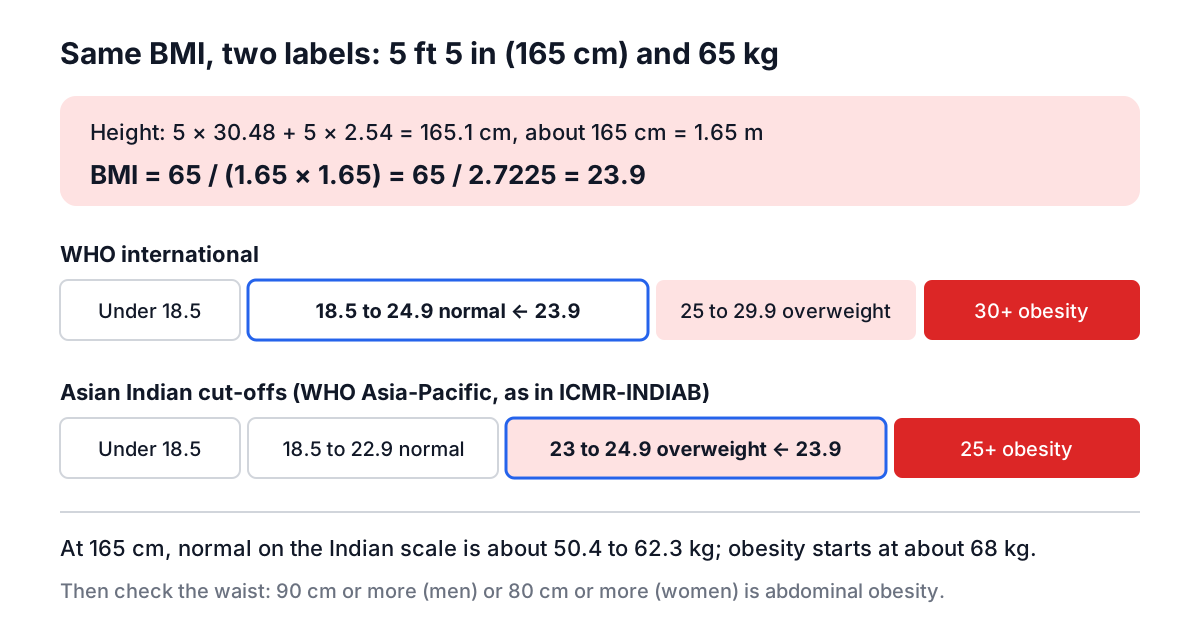
Indian cut-offs against the WHO table
| BMI | WHO international | Asian Indian (as used in ICMR-INDIAB) |
|---|---|---|
| Under 18.5 | Underweight | Underweight |
| 18.5 to 22.9 | Normal | Normal |
| 23 to 24.9 | Normal | Overweight |
| 25 to 29.9 | Overweight | Obesity |
| 30 and over | Obesity | Obesity |
The Indian bands are the WHO Asia-Pacific cut-offs (2000), which Indian practice adopted in a 2009 consensus: 23 for overweight and 25 for obesity. The ICMR-INDIAB study used the same WHO Asia-Pacific guidelines in its national survey. A 2004 WHO expert consultation in The Lancet later confirmed that many Asian populations face a high risk of type 2 diabetes and heart disease at BMIs below 25, because at the same weight they carry more body fat and more of it around the abdomen. It proposed action points at 23 and 27.5, leaving countries to choose.
The UK's NICE guidance uses 23 and 27.5 for people of South Asian background living there, so an Indian adult in London and one in Pune may hear different labels for the same 26. The calculator offers all three scales so you can see each.
Your weight at each line
Heights below are given in feet and inches and in centimetres; weights are in kilograms at each cut-off.
| Height | Normal from (18.5) | Top of normal (22.9) | Obesity from (25) | WHO obesity from (30) |
|---|---|---|---|---|
| 5 ft 0 in (152.4 cm) | 43.0 kg | 53.2 kg | 58.1 kg | 69.7 kg |
| 5 ft 2 in (157.5 cm) | 45.9 kg | 56.8 kg | 62.0 kg | 74.4 kg |
| 5 ft 4 in (162.6 cm) | 48.9 kg | 60.5 kg | 66.1 kg | 79.3 kg |
| 5 ft 6 in (167.6 cm) | 52.0 kg | 64.4 kg | 70.3 kg | 84.3 kg |
| 5 ft 8 in (172.7 cm) | 55.2 kg | 68.3 kg | 74.6 kg | 89.5 kg |
| 5 ft 10 in (177.8 cm) | 58.5 kg | 72.4 kg | 79.0 kg | 94.8 kg |
| 6 ft 0 in (182.9 cm) | 61.9 kg | 76.6 kg | 83.6 kg | 100.3 kg |
At 5 ft 4 in, the normal range on the Indian scale ends at about 60.5 kg and obesity begins at about 66 kg: a gap of under 6 kg between "normal" and "obesity".
Four Indian readers
All four were run through the calculator on the Asian Indian scale.
| Reader | Height and weight | BMI | Indian scale | WHO scale |
|---|---|---|---|---|
| Office worker | 165 cm, 65 kg | 23.9 | Overweight | Normal |
| Woman after two children | 158 cm, 58 kg | 23.2 | Overweight | Normal |
| Teacher | 160 cm (about 5 ft 3 in), 62 kg | 24.2 | Overweight | Normal |
| Sales manager | 172 cm, 75 kg | 25.4 | Obesity | Overweight |
The pattern is the point. Three of the four are "normal" on an international chart and overweight here, and the fourth jumps a whole category. The woman at 158 cm is less than 1 kg above the 22.9 line (57.2 kg at her height). For her the waist measurement says more than the BMI: under 80 cm with normal blood sugar, the risk is low; above it, the Dietary Guidelines for Indians advice on diet and activity applies now rather than later. The sales manager needs to lose only about 1.2 kg to drop below 25, but would have to lose about 7 kg to reach the 22.9 line.
The waist: 90 cm for men, 80 cm for women
ICMR-INDIAB defined abdominal obesity as a waist of 90 cm or more in men and 80 cm or more in women. Measure midway between the lowest rib and the top of the hip bone, after breathing out, with the tape level and snug.
The survey's own results show why the waist matters in India. In Phase I, covering Tamil Nadu, Maharashtra, Jharkhand and Chandigarh, abdominal obesity was more common than generalised obesity (BMI 25 or more) in every region:
| Region | Generalised obesity (BMI 25+) | Abdominal obesity (waist 90 / 80 cm) |
|---|---|---|
| Tamil Nadu | 24.6% | 26.6% |
| Maharashtra | 16.6% | 18.7% |
| Jharkhand | 11.8% | 16.9% |
| Chandigarh | 31.3% | 36.1% |
Extrapolated to the whole country, the authors estimated 135 million people with generalised obesity and 153 million with abdominal obesity, while noting that the figures come from three states and one union territory. Urban residents had higher rates than rural residents in all four regions.
The newer staged definition
In 2025 an expert group led by Anoop Misra published a revised definition of obesity for Asian Indians, replacing the 2009 consensus that relied on BMI alone. It describes two stages:
- Stage 1: BMI above 23 with no visible effect on organ function or daily activities.
- Stage 2: BMI above 23 plus a large waist or high waist-to-height ratio, together with a related illness or a limit on daily activities.
BMI stays the entry point; the staging adds the waist and the health picture around it. The calculator keeps the 23 and 25 bands, and the waist check above covers the main addition.
Children: IAP charts, not adult bands
Children are not measured against the adult table. The Indian Academy of Pediatrics revised its growth charts in 2015 for children aged 5 to 18, built from data on more than 33,000 children in 14 Indian cities. To define overweight and obesity it recommends the lines on those charts that correspond to an adult BMI of 23 and 27, and it recommends the WHO growth standards for children under 5. A paediatrician will plot your child's BMI on the right chart; do not read a child's number off the adult bands.
What the national guidelines say to do
The ICMR-NIN Dietary Guidelines for Indians (2024) address weight in Guideline 9: prevent abdominal obesity, overweight and overall obesity, and aim for slow and steady reduction in body weight, because extreme approaches can harm health. The same guideline advises cutting down sugar, salt, refined oil and deep-fried food, preferring whole grains and millets, and getting 6 to 8 hours of sleep. Guideline 10 asks adults for at least 30 to 45 minutes of brisk walking or other moderate activity a day, and children for 60 minutes.
If you plan a change, the daily calorie calculator for India estimates your energy needs against the ICMR-NIN figures, and the India edition of the guide to calorie needs, BMR and TDEE explains why those figures are lower than many apps show. The waist-to-hip ratio calculator and body fat calculator add a second view from a tape measure, and the ideal weight calculator gives a target range in kg for your height.
Frequently asked questions
Is a BMI of 24 overweight for an Indian adult?
Yes. On the Asian Indian cut-offs used in India, 23 to 24.9 is overweight. It is not a diagnosis, but it is the range where a waist check and a fasting blood sugar test are sensible, especially if a parent has diabetes.
What is the ideal weight for 5 feet 5 inches in kg?
At about 165 cm, the normal BMI range on the Indian scale (18.5 to 22.9) is roughly 50.4 to 62.3 kg. On the WHO scale the upper end would be about 67.8 kg. Muscle, frame and waist size shift where you should sit within the range.
Why is the obesity cut-off 25 in India but 30 abroad?
Asian Indians tend to have more body fat, and more of it around the abdomen, at the same BMI as Europeans, and diabetes and heart disease appear at lower weights. Indian practice therefore uses the WHO Asia-Pacific cut-offs, which start obesity at 25. ICMR-INDIAB used these definitions in its national survey.
Do Indian children use the same BMI cut-offs?
No. For ages 5 to 18 the Indian Academy of Pediatrics recommends its 2015 BMI charts, using the lines equivalent to an adult BMI of 23 and 27 to define overweight and obesity. Under 5, the WHO growth standards are used.
Is BMI accurate for muscular people such as wrestlers?
Not very. BMI cannot tell muscle from fat, so a wrestler or weightlifter can score in the obesity band with little fat. The waist measurement (under 90 cm for men, 80 cm for women) is a better check in that case.
Sources and further reading
- Prevalence of generalized and abdominal obesity in urban and rural India: the ICMR-INDIAB study, Indian Journal of Medical Research, 2015. Definitions (BMI 23 and 25, waist 90 and 80 cm) and the Phase I results by region.
- Dietary Guidelines for Indians, ICMR-National Institute of Nutrition, 2024. Guidelines 9 (overweight and abdominal obesity) and 10 (physical activity).
- Nutrient Requirements for Indians: brief note, ICMR-National Institute of Nutrition, 2020. Reference body weights and energy needs for Indian adults.
- Revised definition of obesity in Asian Indians living in India, Diabetes and Metabolic Syndrome: Clinical Research and Reviews, 2025. The stage 1 and stage 2 definition.
- Revised IAP growth charts for height, weight and body mass index for 5- to 18-year-old Indian children, Indian Pediatrics, 2015. The adult-equivalent 23 and 27 lines.
- Appropriate body-mass index for Asian populations and its implications for policy and intervention strategies, The Lancet, 2004. The WHO expert consultation.
More Fitness Calculators
Every tool in the Fitness Calculators section, free and in your browser.
- BMI Calculator
- Calorie Calculator
- Protein Calculator
- Hydration Calculator
- Calorie Deficit Planner
- Body Fat Calculator
- Ideal Weight Calculator
- Running Pace Calculator
- Target Heart Rate Calculator
- One Rep Max Calculator
- Barbell Plate Calculator
- RPE Calculator
- Interval Timer
- Calories Burned Calculator
- Body Surface Area Calculator
- Waist-to-Hip Ratio Calculator
- VO2 Max Calculator
- Steps to Distance & Calories Calculator