
Reading Food Labels in Australia: NIP, kJ, Health Stars
Read an Australian food label: the nutrition information panel per serve and per 100 g in kJ, Health Star Ratings, claim rules and the bold PEAL allergens.
By Redbison Dev · · 6 min read
Australia edition. Australian edition built on the Food Standards Code as FSANZ explains it: the nutrition information panel in kilojoules, Schedule 4 conditions for claims such as "low sugar" and "good source of fibre", the voluntary Health Star Rating and Plain English Allergen Labelling from 25 February 2024. US edition
On an Australian pack, read the per 100 g column of the nutrition information panel (NIP) first: it lets you compare brands whatever serve size each one chooses, and FSANZ points out that per-100 g figures double as percentages (20 g of fat per 100 g means the food is 20% fat). Energy is in kilojoules, salt is shown as sodium in milligrams, and sugars include fruit and milk sugars as well as added sugar. The Health Star Rating on the front is a voluntary half-star-to-five-star summary for comparing similar foods, and since 25 February 2024 allergens appear in bold, in plain English, with a "Contains" summary.
This edition follows the Australia New Zealand Food Standards Code as Food Standards Australia New Zealand (FSANZ) explains it. The Food Labeling Guide covers individual claims and logos, but it does not calculate Health Star Ratings. The US version of this article is here.
The nutrition information panel
FSANZ says a NIP shows the average quantity per serving and per 100 g (or 100 mL for liquids), for energy and a standard set of nutrients: protein, fat, saturated fat, carbohydrate, sugars and sodium. Energy is given in kilojoules, or in kilojoules and kilocalories. If a pack makes a claim about another nutrient, such as fibre, that nutrient must be added to the panel.
Three habits make the panel more useful:
- Use per 100 g to compare two products, and per serve only to see what you actually eat. Serve sizes are set by the manufacturer and differ between brands.
- Sugars are total sugars. FSANZ notes that the total includes sugar naturally present in the food as well as sugar added as an ingredient, so a "no added sugar" product can still show a high sugars figure.
- Sodium, not salt. The panel gives sodium in mg, which is what the "low salt" claim conditions are written in too.
Worked example: a granola's panel and its claims
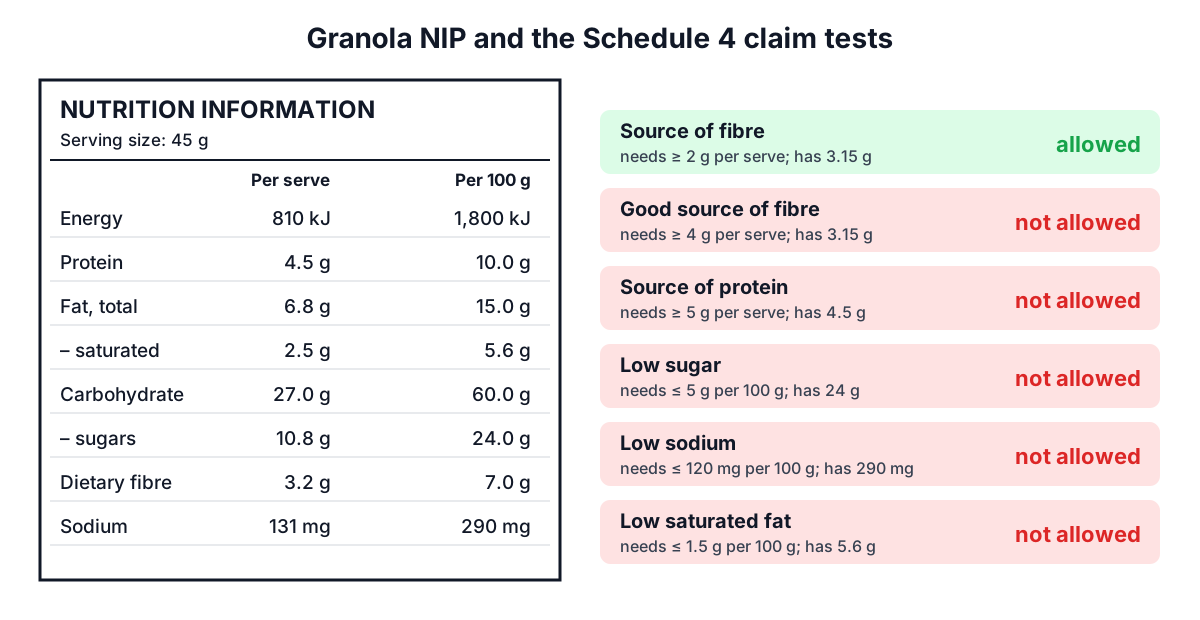
Here is a hypothetical granola with a 45 g serve, set out the way an Australian NIP is:
| Per 45 g serve | Per 100 g | |
|---|---|---|
| Energy | 810 kJ | 1,800 kJ |
| Protein | 4.5 g | 10.0 g |
| Fat, total | 6.8 g | 15.0 g |
| – saturated | 2.5 g | 5.6 g |
| Carbohydrate | 27.0 g | 60.0 g |
| – sugars | 10.8 g | 24.0 g |
| Dietary fibre | 3.2 g | 7.0 g |
| Sodium | 131 mg | 290 mg |
Per serve figures are per-100 g × 0.45, so 810 kJ, 3.15 g fibre (shown as 3.2) and 130.5 mg sodium (131). The per-100 g column reads directly as percentages: this granola is 24% sugars and 15% fat.
Now test the front-of-pack claims a marketer might want against Schedule 4 of the Code:
| Claim | Schedule 4 condition | This granola | Allowed? |
|---|---|---|---|
| "Source of fibre" | at least 2 g dietary fibre per serve | 3.15 g | yes |
| "Good source of fibre" | at least 4 g per serve | 3.15 g | no |
| "Source of protein" | at least 5 g protein per serve | 4.5 g | no |
| "Low sugar" | no more than 5 g per 100 g (solid food) | 24 g | no |
| "Low salt" or "low sodium" | no more than 120 mg sodium per 100 g | 290 mg | no |
| "Low saturated fat" | no more than 1.5 g saturated plus trans fat per 100 g | 5.6 g | no |
Two points follow. Fibre and protein claims are judged per serve, so a bigger serve size can unlock a claim; sugar, sodium and fat claims are judged per 100 g, so they cannot be gamed that way. And a granola may legitimately say "source of fibre" on the front while being 24% sugars.
Health Star Rating: what the stars do and do not tell you
FSANZ describes the HSR as a voluntary front-of-pack system that rates a packaged food's overall nutritional profile from ½ to 5 stars, as a quick way to compare similar packaged foods. The algorithm counts energy, saturated fat, total sugars and sodium against protein, fibre, and fruit, vegetable, nut and legume content, and turns the score into stars. The official calculator and industry guide sit on the Health Star Rating System website.
What that means at the shelf:
- Compare stars within a category (cereal against cereal), not across categories.
- A missing rating says nothing: the system is voluntary.
- Stars summarise; the per-100 g column still tells you which nutrient drives the result. For the granola above, the algorithm would count its sugars and saturated fat against it and its fibre in its favour.
This guide does not compute a Health Star Rating for the granola, because the stars depend on the official algorithm's points tables and the food's category; use the official calculator for an actual rating.
Allergens: Plain English Allergen Labelling
From 25 February 2024, FSANZ's Plain English Allergen Labelling (PEAL) rules require allergens to be declared in the ingredient list in bold, using set names: wheat, fish, crustacean, mollusc, egg, milk, lupin, peanut, soy, sesame, the individual tree nuts (almond, Brazil nut, cashew, hazelnut, macadamia, pecan, pistachio, pine nut, walnut), barley, oats and rye if they contain gluten, and sulphites added at 10 mg/kg or more. A separate bold summary starting with "Contains" must sit near the ingredient list, and gluten-containing cereals must also be named there with the word "gluten".
Food packaged and labelled before 25 February 2024 could be sold in the old format until 25 February 2026, so that transition is now over. "May contain" statements are different: FSANZ describes them as voluntary precautionary statements that the Food Standards Code does not regulate.
Dates
Use-by dates are for safety: food cannot legally be sold after them. Best-before dates are about quality, and food can be sold after them if it is still fit to eat. Bread with a shelf life under seven days may carry a baked-on or baked-for date instead, and foods that keep for two years or more do not need a best-before date.
Frequently asked questions
What does per 100 g mean on an Australian food label?
The amount of each nutrient in 100 g of the food, which is also its percentage: 24 g of sugars per 100 g means the food is 24% sugars. Use this column to compare brands, because serve sizes differ.
How many grams of sugar is "low sugar" in Australia?
No more than 5 g per 100 g for solid food, or 2.5 g per 100 mL for liquids, under Schedule 4 of the Food Standards Code.
Is the Health Star Rating compulsory?
No. FSANZ describes it as a voluntary system. Where it appears, use it to compare similar products, such as two breakfast cereals.
What changed with Plain English Allergen Labelling?
Since 25 February 2024 allergens must be in bold in the ingredient list with standard names, tree nuts and cereals named individually, and a bold "Contains" summary statement near the ingredients. The two-year sell-through period for older labels ended on 25 February 2026.
Are "may contain" warnings required?
No. FSANZ says these precautionary statements are voluntary and not regulated by the Food Standards Code, so their absence does not guarantee a food is free of an allergen.
Sources and further reading
- Nutrition information panels, Food Standards Australia New Zealand.
- Health Star Rating System, Food Standards Australia New Zealand. Voluntary, ½ to 5 stars, the components counted.
- Allergen labelling for consumers, Food Standards Australia New Zealand. PEAL names, bold format, "Contains" statement and dates. Last updated 26 November 2025.
- Food Standards Code, Schedule 4: Nutrition, health and related claims, Federal Register of Legislation. Conditions for fibre, protein, sodium, saturated fat and sugar claims.
- Sugar labelling, Food Standards Australia New Zealand.
- Use-by and best-before dates, Food Standards Australia New Zealand.
More Nutrition Tools
Every tool in the Nutrition Tools section, free and in your browser.