
How to Read UK Food Labels: Traffic Lights, %RI, Allergens
Read a UK food label: red, amber and green thresholds per 100 g, reference intakes, kJ and kcal, salt from sodium, the 14 allergens and Natasha's Law.
By Redbison Dev · · 6 min read
United Kingdom edition. UK edition built on the Department of Health and Social Care and FSA front-of-pack guidance (traffic light thresholds and reference intakes), retained Regulation 1169/2011 as applied by the Food Information Regulations 2014, and Natasha's Law for PPDS food. US edition
On a UK pack, the quickest test is the traffic light panel on the front: red means more than 17.5 g fat, 5 g saturates, 22.5 g sugars or 1.5 g salt per 100 g of food, and green means 3 g, 1.5 g, 5 g or 0.3 g or less. The back of the pack gives the full nutrition declaration, always per 100 g, and the percentages beside it are reference intakes (%RI) for an average adult, not the US "% Daily Value". Allergens are picked out in the ingredients list in bold or another emphasis, and since 1 October 2021 that also applies to sandwiches and salads packed in the shop that sells them.
This edition follows the UK rules: the Food Information Regulations 2014, which enforce the retained version of EU Regulation 1169/2011 in England, and the voluntary front-of-pack scheme published by the Department of Health with the Food Standards Agency (FSA). The Food Labeling Guide explains individual claims and logos; the US version of this article is here.
The back of the pack: the nutrition declaration
Retained Regulation 1169/2011 requires energy, fat, saturates, carbohydrate, sugars, protein and salt, given per 100 g or 100 ml. Per-portion figures may be added but cannot replace the per-100 g column, which is what makes two brands comparable whatever serving size each chooses.
Two details trip people up:
- Energy is shown twice, in kilojoules and kilocalories, and each is worked out from the nutrients with its own conversion factors in Annex XIV (fat 37 kJ or 9 kcal per gram, carbohydrate and protein 17 kJ or 4 kcal, fibre 8 kJ or 2 kcal). So kJ ÷ kcal on a label is close to 4.2 but rarely exactly 4.184.
- Salt, not sodium. Annex I defines salt as sodium × 2.5. A product with 0.4 g of sodium per 100 g declares 1.0 g of salt.
The front of the pack: traffic lights and %RI
Front-of-pack labelling in the UK is voluntary, but where a business uses it the DHSC and FSA guidance (updated November 2016) sets the colours. For food, per 100 g:
| Nutrient | Green (low) | Amber (medium) | Red (high) | Red per portion, if portion over 100 g |
|---|---|---|---|---|
| Fat | 3.0 g or less | over 3.0 g to 17.5 g | over 17.5 g | over 21 g |
| Saturates | 1.5 g or less | over 1.5 g to 5.0 g | over 5.0 g | over 6.0 g |
| Sugars (total) | 5.0 g or less | over 5.0 g to 22.5 g | over 22.5 g | over 27 g |
| Salt | 0.3 g or less | over 0.3 g to 1.5 g | over 1.5 g | over 1.8 g |
Drinks have their own, lower thresholds per 100 ml: red above 8.75 g fat, 2.5 g saturates, 11.25 g sugars or 0.75 g salt. Energy is never colour-coded.
The %RI figures use the reference intakes in Part B of Annex XIII: 8,400 kJ (2,000 kcal) of energy, 70 g fat, 20 g saturates, 90 g sugars and 6 g salt. The guidance notes that those for fat, saturates, sugars and salt are maximums, based on an average-sized woman doing an average amount of activity.
Worked example: a granola, traffic-lighted
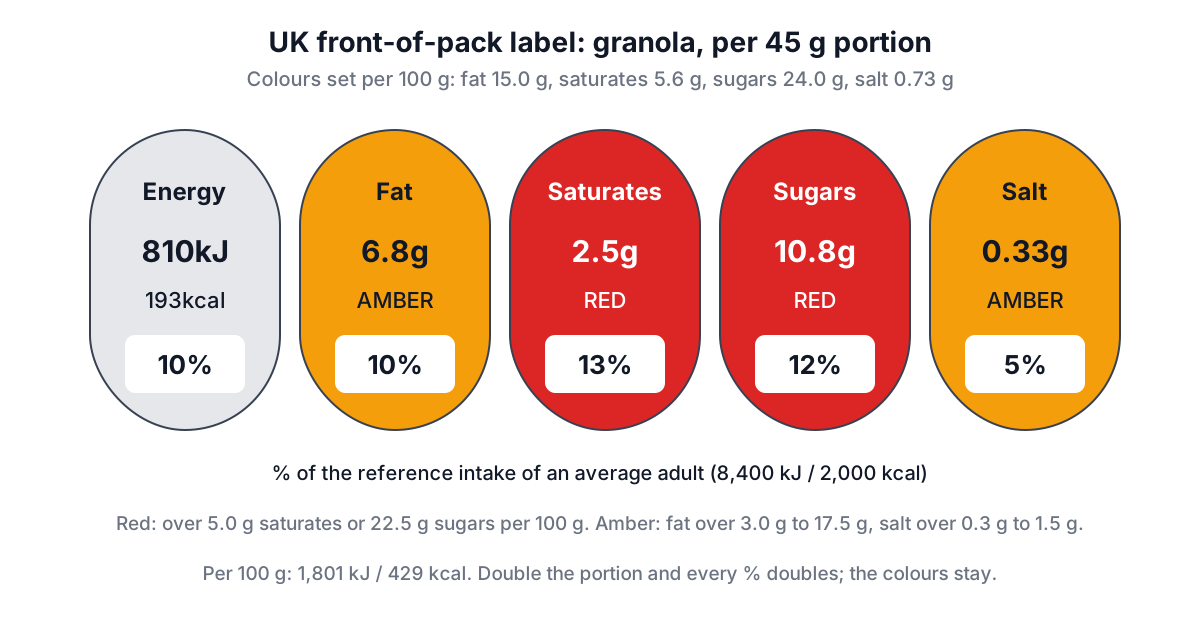
Take a granola with these values per 100 g: fat 15.0 g, of which saturates 5.6 g; carbohydrate 60 g, of which sugars 24.0 g; fibre 7 g; protein 10 g; salt 0.73 g (that is 0.29 g of sodium × 2.5, rounded).
Energy. Using the Annex XIV factors: 37 × 15 + 17 × 60 + 17 × 10 + 8 × 7 = 1,801 kJ, and 9 × 15 + 4 × 60 + 4 × 10 + 2 × 7 = 429 kcal per 100 g.
Colours (per 100 g, because a 45 g portion is under 100 g):
| Nutrient | Per 100 g | Colour |
|---|---|---|
| Fat | 15.0 g | amber (between 3.0 and 17.5) |
| Saturates | 5.6 g | red (over 5.0) |
| Sugars | 24.0 g | red (over 22.5) |
| Salt | 0.73 g | amber (between 0.3 and 1.5) |
Per 45 g portion and %RI:
| Amount | %RI | |
|---|---|---|
| Energy | 810 kJ / 193 kcal | 10% |
| Fat | 6.8 g | 10% |
| Saturates | 2.5 g | 13% |
| Sugars | 10.8 g | 12% |
| Salt | 0.33 g | 5% |
So the same bowl shows two reds and modest-looking percentages. That is not a contradiction: the colour judges the food per 100 g, the %RI judges the portion. If you pour 90 g rather than 45 g, every percentage doubles while the colours stay put.
Note that the sugars figure is total sugars, including those from fruit and milk. UK labels have no separate "added sugars" line, so check the ingredients list for sugar, honey, syrups and fruit juice concentrates.
Allergens and Natasha's Law
Retained Regulation 1169/2011 (Annex II) lists 14 allergens that must be emphasised in the ingredients list: cereals containing gluten, crustaceans, eggs, fish, peanuts, soybeans, milk, nuts (almonds, hazelnuts, walnuts, cashews, pecans, Brazil nuts, pistachios, macadamias), celery, mustard, sesame, sulphur dioxide and sulphites above 10 mg/kg, lupin and molluscs.
Since 1 October 2021, food prepacked for direct sale (PPDS) must carry the name of the food and a full ingredients list with those allergens emphasised. The FSA's introduction gives examples: sandwiches and bakery items packed on site before you choose them, burgers kept under a hot lamp, salads and pasta pots, sausages packed by the butcher, and PPDS food in schools, care homes and hospitals. Food packed after you order it, or sold loose, does not need the label, but allergen information must still be available, and can be given orally.
"May contain" statements about cross-contamination are separate from the 14-allergen emphasis rule; an allergen that is an ingredient must be emphasised in the list itself.
Common mistakes on UK labels
- Comparing per-portion figures between brands that use different portions. Use the per-100 g column.
- Reading a %RI as a target. For fat, saturates, sugars and salt it is a maximum.
- Assuming green on every light makes a food healthy; energy and fibre are not colour-coded at all.
For calorie counting with label figures, the Calorie Calculator (UK) estimates your daily needs; the UK guide to TDEE and calories explains how.
Frequently asked questions
What counts as high sugar on a UK food label?
More than 22.5 g of total sugars per 100 g of food is red (high), and 5 g or less is green (low), under the DHSC and FSA front-of-pack guidance. For drinks the red threshold is more than 11.25 g per 100 ml.
What is a reference intake?
A guide amount for an average adult, used for the %RI on labels: 8,400 kJ or 2,000 kcal of energy, 70 g fat, 20 g saturates, 90 g sugars and 6 g salt. For fat, saturates, sugars and salt these are maximum daily amounts, not targets.
How do I convert sodium to salt on a UK label?
Multiply sodium by 2.5, the formula in Annex I of retained Regulation 1169/2011. UK labels must declare salt, so 0.29 g of sodium per 100 g appears as 0.73 g of salt.
What is Natasha's Law?
The rule, in force since 1 October 2021, that food prepacked for direct sale, such as a sandwich packed in the café that sells it, must show the name of the food and a full ingredients list with the 14 allergens emphasised.
Why are a label's colours red when the percentages are low?
The colours are set per 100 g; the percentages describe one portion. A granola with 24 g sugars per 100 g is red for sugars even though a 45 g portion supplies only 12% of the reference intake.
Sources and further reading
- Front of pack nutrition labelling guidance, Department of Health and Social Care with the FSA. Annex 2 (reference intakes) and Annex 3 (colour thresholds).
- The Food Information Regulations 2014, legislation.gov.uk.
- Regulation (EU) No 1169/2011, Annex II: substances or products causing allergies or intolerances, legislation.gov.uk (retained version).
- Regulation (EU) No 1169/2011, Annex XIV: conversion factors, legislation.gov.uk (retained version). Annex I defines salt as sodium × 2.5.
- Introduction to allergen labelling for PPDS food, Food Standards Agency. Natasha's Law and what counts as PPDS.
- Food allergen labelling and information requirements: technical guidance, Food Standards Agency.
More Nutrition Tools
Every tool in the Nutrition Tools section, free and in your browser.