
Reading Food Labels in Canada: % DV and "High in" Symbol
How to read a Canadian Nutrition Facts table and the mandatory "High in" magnifying-glass symbol: thresholds, the 5% and 15% rule, and priority allergens.
By Redbison Dev · · 6 min read
Canada edition. Canadian edition built on Health Canada's front-of-package nutrition symbol rules (mandatory from January 1, 2026), the Canadian daily values behind the % DV, the 2025 interim policy for granola and other dense cereals, and Canada's priority allergens. US edition
In Canada the fastest check is now on the front of the box: a black-and-white magnifying glass reading "High in" followed by Sat fat, Sugars or Sodium. Health Canada requires it on most prepackaged foods that reach 15% of the daily value for any of those three nutrients in the quantity assessed (10% for foods with a reference amount of 30 g or 30 mL or less, 30% for main dishes), and products must carry it from January 1, 2026; stock packaged before then may still be sold. On the back, the Nutrition Facts table's % DV column follows Health Canada's own rule of thumb: 5% DV or less is a little, 15% DV or more is a lot.
This edition follows the Food and Drug Regulations as Health Canada explains them to consumers and industry. The Food Labeling Guide covers individual claims and logos; the US version of this article is here.
The Nutrition Facts table, Canadian style
The table lists nutrients for a stated serving, with a % DV beside most of them. Three things differ from what a reader of US labels expects:
- Sugars has a % DV, and it is for total sugars. The daily value Health Canada uses for sugars is 100 g, for adults and children four and over. There is no separate "added sugars" line, so read the ingredient list to see where the sugar comes from.
- Saturated and trans fat share one % DV, against a combined daily value of 20 g.
- Sodium's daily value is 2,300 mg. Salt is not declared; sodium is.
Health Canada's consumer guidance gives the reading rule: compare % DV using the same serving, and treat 5% or less as a little and 15% or more as a lot.
The "High in" symbol: who gets it and why
The industry guide to the front-of-package (FOP) symbol sets three thresholds, expressed as a % of the daily value:
| Type of product | Symbol required at |
|---|---|
| Most prepackaged foods (reference amount over 30 g or 30 mL) | 15% DV or more |
| Small reference amounts (30 g or 30 mL or less) | 10% DV or more |
| Main dishes (reference amount of 200 g or more; 170 g or more for foods solely for children 1 to 4) | 30% DV or more |
The quantity tested is the serving size or the product's reference amount, whichever is greater (subsection B.01.350(2)). The saturated fat percentage is calculated on saturated fat alone, against the 20 g combined daily value.
Some foods are exempt even when they cross a threshold: fruits and vegetables without added saturated fat, sugars or sodium; plain milk, plain yogurt and cheese, for their calcium; raw single-ingredient meat, poultry and fish; and butter, sugar and salt themselves, among others. So the absence of a symbol on butter does not mean it is low in saturated fat.
Worked example: why granola got its own rule
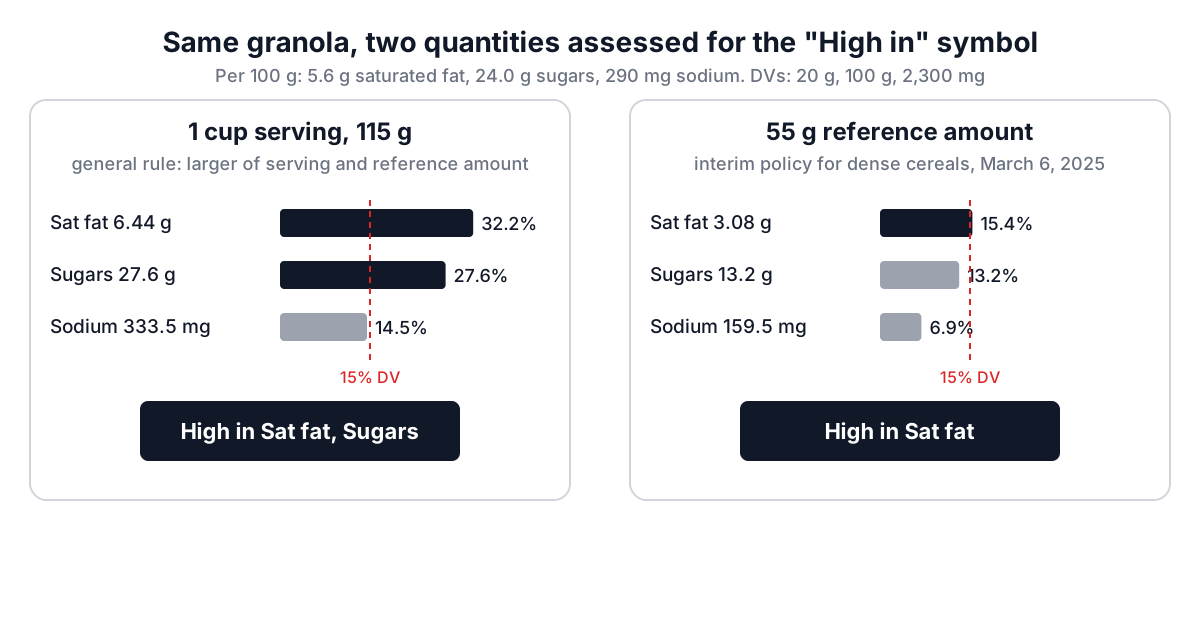
Take a granola with, per 100 g: 5.6 g saturated fat (no trans fat), 24.0 g sugars and 290 mg sodium. Granola must declare a serving of 1 cup in the Nutrition Facts table, and Health Canada's interim policy statement notes that 1 cup of some granolas weighs 115 g, more than twice the 55 g reference amount.
Under the general rule (the greater of serving size and reference amount), the 115 g cup is tested:
| Nutrient | Per 115 g | % DV | 15% threshold |
|---|---|---|---|
| Saturated fat | 6.44 g | 32.2% (of 20 g) | high |
| Sugars | 27.6 g | 27.6% (of 100 g) | high |
| Sodium | 333.5 mg | 14.5% (of 2,300 mg) | below |
That would mean "High in Sat fat, Sugars". The interim policy published March 6, 2025 lets dense ready-to-eat cereals (43 g or more per 250 mL) be assessed on the 55 g reference amount instead, the amount typically eaten at one sitting:
| Nutrient | Per 55 g | % DV | 15% threshold |
|---|---|---|---|
| Saturated fat | 3.08 g | 15.4% | high |
| Sugars | 13.2 g | 13.2% | below |
| Sodium | 159.5 mg | 6.9% | below |
The same product now carries "High in Sat fat" only. Two lessons for shoppers: the symbol depends on the quantity assessed as well as the recipe, and a product without a sugars symbol can still be fairly sweet, as 24 g of sugars per 100 g shows. Compare cereals per 100 g if the box gives it, or scale the Nutrition Facts figures to the same weight.
Priority allergens
Health Canada and the CFIA list the priority food allergens: eggs, milk, mustard, peanuts, crustaceans and molluscs, fish, sesame seeds, soy, sulphites, tree nuts, and wheat and triticale. Health Canada's labelling rules require these, plus gluten sources and added sulphites, to be identified on pre-packaged food by their common names, so that people can recognize them on the label.
Mustard is on the list (Health Canada has published separate advice on mustard allergy and canola protein), and Canada names wheat and triticale specifically alongside gluten sources.
Common mistakes on Canadian labels
- Comparing % DV across products with different serving sizes. Two cereals can list ¾ cup and 1 cup.
- Reading no symbol as "healthy". Exempt foods and foods just under a threshold carry none.
- Treating the sugars % DV like the US added-sugars % DV. Canada's is against 100 g of total sugars.
- Ignoring the 10% threshold: foods with a small reference amount (30 g or 30 mL or less) get the symbol at a lower % DV.
For daily calorie needs, the Calorie Calculator (Canada) gives an estimate to set the % DV figures against.
Frequently asked questions
What does the "High in" magnifying glass mean on Canadian food?
It means the product meets or exceeds Health Canada's threshold for saturated fat, sugars or sodium: 15% of the daily value for most foods, 10% for small reference amounts and 30% for main dishes, in the larger of the serving size and the reference amount.
When did the front-of-package symbol become mandatory?
The regulations came into force on July 20, 2022 with a transition period ending December 31, 2025. From January 1, 2026, labels following the old requirements are no longer compliant, though products packaged before then can still be sold.
What is 5% and 15% on a Nutrition Facts table?
Health Canada's guide: 5% DV or less of a nutrient is a little, and 15% DV or more is a lot. Use it to compare products after making sure the servings are similar.
Why does Canada's sugars % DV differ from the US?
Canada's daily value is 100 g of total sugars; the US label sets a % DV for added sugars against 50 g. The same 12 g of sugar is 12% DV in Canada.
Which allergens must be on Canadian food labels?
The priority allergens (eggs, milk, mustard, peanuts, crustaceans and molluscs, fish, sesame, soy, sulphites, tree nuts, wheat and triticale), plus gluten sources and added sulphites, identified by their common names.
Sources and further reading
- Front-of-package nutrition symbol labelling guide for industry, Health Canada. Thresholds (Table 4.1), the quantity assessed (4.3), daily values and the January 1, 2026 compliance date.
- Nutrition labelling: Front-of-package nutrition symbol, Health Canada. What the symbol looks like and which foods are exempt.
- Interim policy statements on certain front-of-package nutrition labelling requirements, Health Canada. Ready-to-eat cereals assessed on the 55 g reference amount.
- Percent daily value, Health Canada. The 5% and 15% rule.
- Nutrition labelling: Table of daily values, Health Canada. Part 1: 20 g saturated plus trans fat, 100 g sugars and 2,300 mg sodium for adults and children four and over.
- Food allergies, Health Canada. The priority allergens.
- Labelling requirements for food, Canadian Food Inspection Agency.
More Nutrition Tools
Every tool in the Nutrition Tools section, free and in your browser.