
Pay Off Your Home Loan Faster: Extra Repayments vs Offset
Extra repayments, offset and redraw on an A$600,000 home loan at 6.2%: what each saves, the limits on fixed loans, break costs and fortnightly repayments.
By Redbison Dev · · 10 min read
Australia edition. Written for Australian borrowers: A$ examples at the RBA's new-loan variable rate, extra repayments versus offset and redraw, fixed-rate caps and break costs, and the exit fee ban on loans since July 2011. US edition
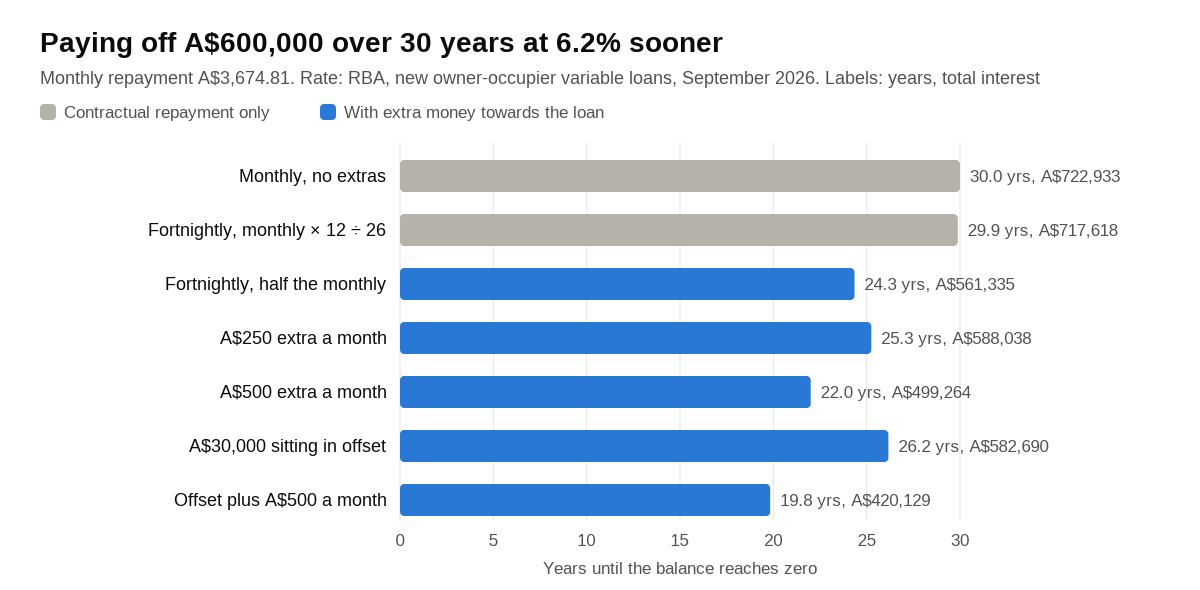
You have a spare A$500 a month, or A$30,000 sitting in savings, and a variable home loan at 6.2%. On a A$600,000 loan over 30 years, A$500 a month in extra repayments takes 8 years off and saves A$223,669 of interest if the rate held. The same money parked in an offset account saves almost exactly the same, but you can take it back out. What stops you is usually the loan type: a variable loan takes extra money freely and has no exit fee, while a fixed loan caps extra repayments and can charge a break cost.
The figures come from the Mortgage Calculator, opened here with the example loan already filled in. If you start from a blank calculator, set the currency to AUD, mortgage insurance to none, and both property tax and home insurance to 0, because it opens with US defaults of 1.1% property tax and $1,800 insurance (council rates and building insurance are separate bills here).
The example loan
The RBA's housing lending rates table puts the average rate on new owner-occupier variable loans at 6.2% in September 2026 (table F6, published 6 November 2026). Take a A$750,000 home with a 20% deposit and a A$600,000 principal and interest loan over 30 years. Enter a home price of 750000, a down payment of 20%, a rate of 6.2 and a term of 30, with property tax and home insurance at 0.
- Monthly repayment: A$3,674.81.
- First month: A$600,000 × 6.2% ÷ 12 = A$3,100 of interest, so A$574.81 comes off the loan.
- Total interest over 30 years at 6.2%: A$722,932.99.
Your lender's statement may differ from this monthly model by a few dollars, depending on how it accrues interest.
Extra repayments
Type the amount into Extra every month, or a lump sum into One-time payment:
| A$600,000 over 30 years at 6.2% | Paid off after | Total interest | Interest saved | Time saved |
|---|---|---|---|---|
| Minimum repayment only | 360 months | A$722,932.99 | none | none |
| A$250 extra a month | 303 months | A$588,037.81 | A$134,895.19 | 4 years 9 months |
| A$500 extra a month | 264 months | A$499,264.17 | A$223,668.82 | 8 years |
| A$1,000 extra a month | 212 months | A$387,015.05 | A$335,917.95 | 12 years 4 months |
| A$30,000 lump sum with the first repayment | 314 months | A$583,467.39 | A$139,465.60 | 3 years 10 months |
On a variable loan the extra usually becomes redraw: CommBank, for example, says a redraw facility lets you access additional payments you have made, with no fee to redraw. Two limits come with it. Available redraw may reduce over time so that it reaches zero with the loan, and withdrawing from redraw may cause your repayments to increase.
Offset, redraw or straight repayment
An offset account is a transaction account whose balance is taken off the loan before interest is charged. With the repayment unchanged, a balance that stays put has exactly the effect of repaying that amount on the day it went in:
- A$30,000 kept in offset from the start saves A$155 of interest in the first month. The loan you pay interest on clears after 314 months, 3 years 10 months early, saving A$140,243.37; the A$30,000 then pays out what is left. That is slightly more than the A$30,000 lump sum above (A$139,465.60), because the offset works from day one rather than after the first repayment.
- Add A$500 a month into the offset and leave it there, and the loan is effectively cleared after 238 months with A$420,128.58 of interest, A$302,804.41 less than the minimum.
The three differ in access, not in arithmetic:
| Interest saving | Getting the money back | |
|---|---|---|
| Offset account | Same as repaying, while the money stays | Spend it like any transaction account |
| Redraw | Same as repaying | Withdraw from available redraw; it may shrink over time and can raise your repayments |
| Extra repayments with no redraw | Same as repaying | Only by refinancing or selling |
So the choice turns on what the offset costs. Offset accounts often come in a package with an annual fee, and a fee only pays off if the balance is large enough; the Comparison Rate Calculator shows what a package fee does to the effective rate. Money that only passes through, such as pay waiting for the bills, also cuts interest for as long as it sits in the offset.
These figures are for a home you live in. On an investment loan, or one that may become an investment loan if you later rent the home out, the choice also affects tax: interest is generally deductible according to what the borrowed money is used for, so money redrawn for private spending can leave part of the loan's interest non-deductible, while money taken out of an offset is your own savings and leaves the loan unchanged. Check with a registered tax agent before redrawing on an investment loan.
Fortnightly repayments
Paying fortnightly helps only when the lender sets the fortnightly amount at half the monthly repayment. Westpac describes 26 half-payments a year as equivalent to 13 monthly payments. At 6.2%, A$1,837.41 a fortnight clears the A$600,000 loan in about 24.3 years and saves A$161,598; a fortnightly amount worked out as monthly × 12 ÷ 26 (A$1,696.07) saves just A$5,315. Pick the frequency in Payment frequency to compare, and see how home loans work in Australia for the full comparison.
Fixed rates: repayment caps and break costs
A fixed rate usually limits extra repayments. CommBank lets fixed-rate borrowers pay up to A$10,000 for each year of the fixed loan without an Early Repayment Adjustment and administrative fee, and those payments are not available through redraw until the fixed term ends. Westpac warns that fixed loans may limit extra repayments and that going over the limit can trigger break costs.
The National Consumer Credit Protection Regulations define a break fee narrowly: it may relate only to early repayment under a fixed rate loan, only to the portion that is fixed, and only to the part of the lender's loss that comes from differences in interest rates. So a break cost arises mainly when rates have fallen since you fixed.
A split loan handles this: fix part, keep part variable, and send extra repayments and the offset to the variable side. If A$500 a month is your plan, A$6,000 a year would fit under CommBank's A$10,000 cap even on the fixed portion, but a larger lump sum belongs on the variable split.
Variable loans and exit fees. Under regulation 79A, a fee charged on terminating a home loan entered into on or after 1 July 2011 is prohibited unless it is a break fee or a discharge fee, which may only reimburse the lender's reasonable administrative cost of terminating the contract. ASIC's RG 220 describes the same ban and confirms that break fees are not prohibited. On a variable loan written since then, the discharge fee is the only termination fee the lender may charge.
Before you put extra money in
Every dollar off the loan earns your loan rate, 6.2% here, with no tax on the saving. Check these first:
- Dearer debt such as credit cards and car loans; the Debt Payoff Calculator orders them by rate.
- An emergency fund. An offset account can double as one; size it with the Emergency Fund Calculator.
- Investing instead. Compare after-tax returns with the Compound Interest Calculator.
This is general information, not advice on your loan. A licensed mortgage broker or financial adviser can look at your full position.
Tools for this job
- Mortgage Calculator: extra monthly, yearly and one-off repayments in A$, payment frequencies and the full schedule.
- Comparison Rate Calculator: whether an offset package fee is worth paying.
- Refinance Calculator: whether refinancing, including any break cost or discharge fee, pays off.
- Debt Payoff Calculator, Emergency Fund Calculator and Compound Interest Calculator: what to sort out before paying the loan down.
Frequently asked questions
How much does an extra A$500 a month save on a home loan?
On a A$600,000, 30-year principal and interest loan at 6.2%, A$500 a month extra from the start clears it in 264 months instead of 360, 8 years early, and saves A$223,669 of interest if the rate stays at 6.2%.
Is it better to put money in an offset account or make extra repayments?
The interest saving is the same while the money stays in the offset: A$30,000 in offset on A$600,000 at 6.2% saves A$140,243 over the loan. The offset keeps the money available, so it wins unless its package fee or a higher rate outweighs that flexibility.
Can I make extra repayments on a fixed rate home loan?
Usually up to a limit. CommBank allows up to A$10,000 for each year of the fixed loan without an Early Repayment Adjustment, and the money cannot be redrawn until the fixed term ends. Above the limit a break cost can apply, so put larger sums on a variable split.
Is there a fee for paying off a variable home loan early?
Not an exit fee, on loans entered into from 1 July 2011. The national credit regulations prohibit termination fees on home loans except break fees on fixed portions and a discharge fee limited to the lender's reasonable administrative cost.
Sources and further reading
- F6 Housing lending rates, Reserve Bank of Australia. New owner-occupier variable loans at 6.2% in September 2026, published 6 November 2026.
- National Consumer Credit Protection Regulations 2010, Federal Register of Legislation. Regulation 79A: termination fees banned from 1 July 2011, with break fee and discharge fee defined.
- RG 220 Early termination fees for residential loans, ASIC. The 2011 prohibition and fees it does not cover, such as break fees.
- Fixed rate home loans, Commonwealth Bank. Up to A$10,000 extra for each fixed year; no redraw until the fixed term ends.
- Home loan redraw, Commonwealth Bank. Redraw on variable loans, no redraw fee, reducing available redraw and higher repayments after withdrawals.
- How to pay off your home loan faster, Westpac. Fortnightly half-payments equal 13 monthly payments; limits and break costs on fixed loans.