
Pay Off Your Mortgage Faster in Canada: Prepayments
Prepayment privileges, accelerated bi-weekly payments and penalties on a CA$500,000 mortgage at 4.66%: what each saves and what breaking the term costs.
By Redbison Dev · · 10 min read
Canada edition. Written for Canadian borrowers: CA$ examples with half-yearly compounding, lump-sum and payment-increase prepayment privileges, accelerated payments, and the 3 months' interest or IRD penalty. US edition
A closed Canadian mortgage lets you pay it down faster only through the doors your contract opens: a yearly lump sum, a higher regular payment, or an accelerated payment schedule. Go past those prepayment privileges during the term and you pay a penalty. On a CA$500,000 mortgage at 4.66% over a 25-year amortization, accelerated bi-weekly payments save CA$53,259 of interest and end the mortgage 3.4 years sooner; a CA$10,000 lump sum on each anniversary saves CA$126,489 and takes 8 years 5 months off, if rates stayed at 4.66% through every renewal.
Every figure here comes from the Mortgage Payment Calculator (Canada), which compounds fixed rates half-yearly, as fixed-rate lenders quote them under the Interest Act, and has a Payment frequency menu for bi-weekly and accelerated schedules.
The example mortgage
The Bank of Canada's data on new lending by chartered banks put the average rate on new uninsured fixed mortgages of five years or more at 4.66% in September 2026. Take a CA$625,000 home with 20% down, so there is no CMHC premium, and a CA$500,000 mortgage amortized over 25 years.
In the calculator enter a home price of 625000, a down payment of 20%, a rate of 4.66, an amortization of 25 and half-yearly compounding:
- Monthly payment: CA$2,812.01. The 4.66% compounded half-yearly is 4.6154% compounded monthly, which is what each payment is charged.
- Total interest over 25 years if 4.66% held throughout: CA$343,603.70.
- Owing when the five-year term ends: CA$440,136.74, after CA$108,857.48 of interest.
The long-run savings below assume you renew at the same rate. What you control within this term is the balance you renew with, so each table shows it.
Payment frequency: accelerated or not
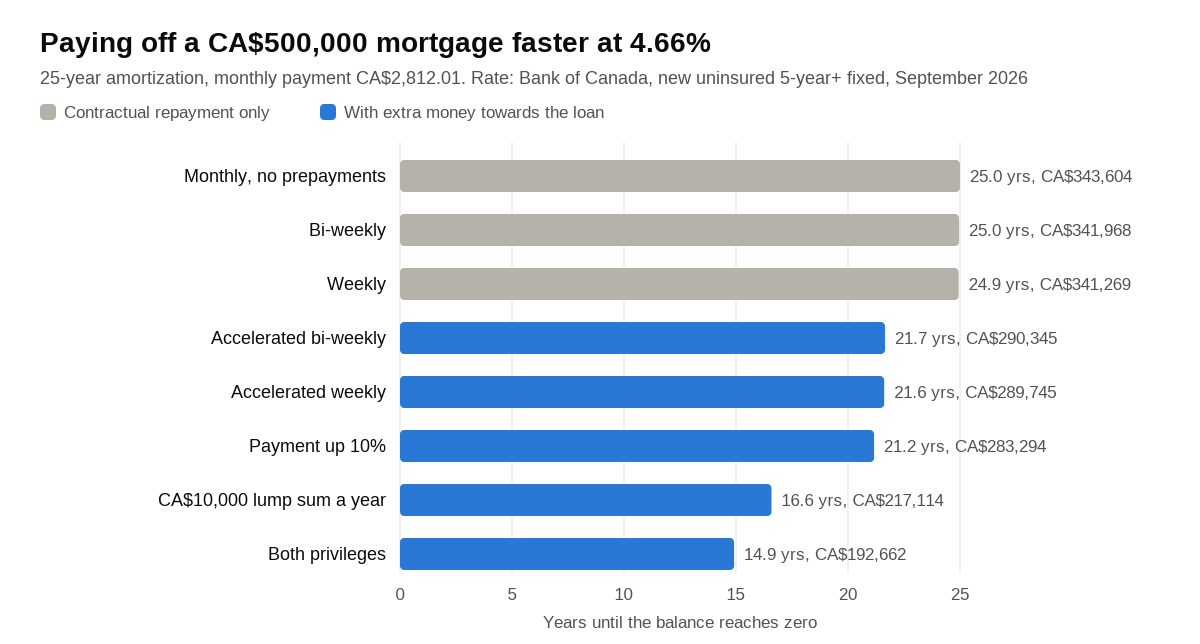
Choose a frequency in Payment frequency. The Financial Consumer Agency of Canada (FCAC) explains that accelerated weekly or bi-weekly payments add the equivalent of one extra monthly payment a year. Plain bi-weekly and weekly payments spread the same yearly total over more payments and add almost nothing:
| CA$500,000 at 4.66%, 25 years | Payment | Paid off in | Total interest | Interest saved |
|---|---|---|---|---|
| Monthly | CA$2,812.01 | 25.0 years | CA$343,603.70 | none |
| Bi-weekly (monthly × 12 ÷ 26) | CA$1,297.85 | 24.96 years | CA$341,967.99 | CA$1,635.71 |
| Weekly (monthly × 12 ÷ 52) | CA$648.93 | 24.94 years | CA$341,268.53 | CA$2,335.17 |
| Accelerated bi-weekly (monthly ÷ 2) | CA$1,406.01 | 21.65 years | CA$290,344.78 | CA$53,258.91 |
| Accelerated weekly (monthly ÷ 4) | CA$703.00 | 21.62 years | CA$289,744.85 | CA$53,858.84 |
The calculator charges interest each period at the rate equivalent to 4.66% compounded half-yearly; a lender accruing daily will differ by a few dollars. Accelerated bi-weekly raises what you pay each year by about one monthly payment, about CA$2,812; ask your lender whether you can change frequency during the term and whether it counts against your privileges.
Prepayment privileges: lump sums and payment increases
The FCAC says a closed mortgage may limit how much you can put toward it each year, as a lump sum or by increasing your payments, and that once you increase your payments you normally cannot lower them until the end of the term. The limits are set by each lender, and your annual statement shows the dollar amount you can prepay without a charge, if your lender follows the code of conduct on mortgage prepayments. Two big-bank examples:
- TD (closed terms): up to 15% of the original principal once a year, CA$75,000 on this mortgage, and an increase of up to 100% of the original principal and interest payment.
- RBC: using all its prepayment options fully could prepay as much as 20% or more of the original balance a year, with some options usable only once a year.
Put a payment increase in Extra every month and an anniversary lump sum in Extra once a year, which the calculator adds with every 12th payment:
| CA$500,000 at 4.66%, 25 years | Paid off in | Total interest | Interest saved | Owing at end of 5-year term |
|---|---|---|---|---|
| No prepayments | 25 years | CA$343,603.70 | none | CA$440,136.74 |
| Payment up 10% (CA$281.20 more) | 21 years 2 months | CA$283,294.04 | CA$60,309.65 | CA$421,199.92 |
| CA$10,000 lump sum each anniversary | 16 years 7 months | CA$217,114.29 | CA$126,489.41 | CA$385,194.92 |
| Both | 14 years 11 months | CA$192,661.97 | CA$150,941.72 | CA$366,258.10 |
| One CA$50,000 lump sum with payment 12 | 21 years | CA$256,032.88 | CA$87,570.82 | CA$380,020.23 |
Two things to know about the yearly limits. Using the privilege every year also shrinks any later penalty: the FCAC's advice is to prepay each year because future penalties are then based on a lower balance. And a payment increase is close to permanent for the term, so set it at a level you could keep through a bad year; a lump sum leaves you free to skip a year.
Prepayment penalties: 3 months' interest or the IRD
Paying more than your privileges allow, or paying off the mortgage early to sell or switch lenders, triggers a prepayment penalty on a closed mortgage. The FCAC says it is usually the higher of three months' interest on what you still owe and the interest rate differential (IRD), and that lenders generally use the IRD when your rate is above today's rate for the rest of your term and you signed less than five years ago. RBC, for example, charges fixed-rate borrowers the greater of the two and variable-rate borrowers three months' interest.
On the example mortgage, three years in, you owe CA$465,747.55 with two years of the term left:
- Three months' interest: CA$465,747.55 × 4.66% × 3 ÷ 12 ≈ CA$5,426.
- IRD, if the lender's two-year rate is one point lower: CA$465,747.55 × 1% × 2 years ≈ CA$9,315, so the IRD applies.
- IRD, if it is half a point lower: ≈ CA$4,657, so three months' interest applies.
That is the simplified method the FCAC uses in its own example; lenders differ in which rates they compare. Some compare posted rates, which sit well above what most people pay: the Bank of Canada's weekly series for the chartered banks' posted five-year conventional mortgage rate was 6.19% for the week of November 18, 2026. Ask your lender for the exact figure before you act, and consider waiting until renewal, when you can repay any amount without penalty.
Terms longer than five years. Under section 10 of the Interest Act, when a mortgage is not payable until more than five years after it was made, a borrower can repay it after those five years with three months' further interest in lieu of notice. So on a seven- or ten-year term, the IRD stops applying after year five. The section does not cover mortgages given by a corporation.
Before you prepay
Prepaying earns your mortgage rate with no tax on the saving, but the money is locked in the house. Check these first:
- Dearer debt such as credit cards; the Debt Payoff Calculator ranks yours by rate.
- An emergency fund sized with the Emergency Fund Calculator, since prepaid principal comes back only by refinancing or selling.
- Registered accounts. Compare what the money would grow to in a TFSA or RRSP with the Compound Interest Calculator.
This is not advice for your situation. Your lender's annual statement and a mortgage professional can confirm your privileges.
Tools for this job
- Mortgage Payment Calculator (Canada): half-yearly compounding, every payment frequency, payment increases, anniversary lump sums and the balance at the end of the term.
- Mortgage Refinance and Renewal Calculator: whether breaking a term and paying the penalty is recovered by a lower rate.
- Debt Payoff Calculator: whether other debts should be cleared first.
- Emergency Fund Calculator: how much to keep in cash before prepaying.
- Compound Interest Calculator: the alternative of investing the same money.
For terms, amortization and the stress test, read how mortgages work in Canada; for choosing a 25- or 30-year amortization, see 25 vs 30 year amortization.
Frequently asked questions
Is a payment increase or a yearly lump sum better for paying down a mortgage?
For the same money, the payment increase wins slightly because it goes in sooner. On CA$500,000 at 4.66% over 25 years, CA$281.20 more a month saves CA$60,310 of interest, while the same CA$3,374.40 paid once a year saves CA$57,785. The lump sum is easier to skip in a bad year.
How much can I prepay on my mortgage without a penalty?
It depends on your lender and is set out in your mortgage agreement. TD allows up to 15% of the original principal once a year on closed terms plus payment increases up to 100%. Lenders that follow the code of conduct show the dollar amount on your annual statement.
How is a mortgage prepayment penalty calculated?
On a closed fixed-rate mortgage it is usually the higher of three months' interest on what you owe and the interest rate differential. On CA$465,748 at 4.66% with two years left, three months' interest is about CA$5,426, and the IRD is about CA$9,315 if the lender's two-year rate is one point lower.
Can I pay off a 10-year mortgage after five years without the IRD?
Yes. Section 10 of the Interest Act lets you repay a mortgage that runs for more than five years once five years have passed, with three months' further interest in lieu of notice. It does not apply to mortgages given by a corporation.
Sources and further reading
- Interest rates for new and existing lending by chartered banks, Bank of Canada. 4.66% on new uninsured fixed mortgages of five years or more, September 2026.
- Posted interest rates offered by chartered banks, Bank of Canada. Five-year conventional mortgage rate of 6.19%, week of November 18, 2026.
- Paying off your mortgage faster, Financial Consumer Agency of Canada. Lump sums, payment increases and accelerated payments.
- Mortgage fees: Prepayment penalties, Financial Consumer Agency of Canada. Three months' interest or IRD, and how the IRD is worked out.
- Mortgage prepayment: know your rights, Financial Consumer Agency of Canada. Information box, annual statement and the code of conduct on mortgage prepayments.
- Interest Act, R.S.C. 1985, c. I-15, Justice Laws Website. Section 6 (rate stated yearly or half-yearly) and section 10 (repayment after five years).
- Flexible mortgage payment features, TD Canada Trust. 15% lump sum and 100% payment increase on closed terms.
- Understanding mortgage prepayment charges, RBC Royal Bank. Fixed-rate and variable-rate charge methods.