
How Much Super Do You Need to Retire in Australia?
Build a super target from your spending, the 12% Super Guarantee, preservation age 60 and the means-tested Age Pension, and see which inputs change it most.
By Redbison Dev · · 6 min read
Australia edition. Australian edition in Australian dollars, built around super (12% Super Guarantee, 15% contributions tax, the concessional cap), preservation age 60 and the Age Pension at 67. US edition
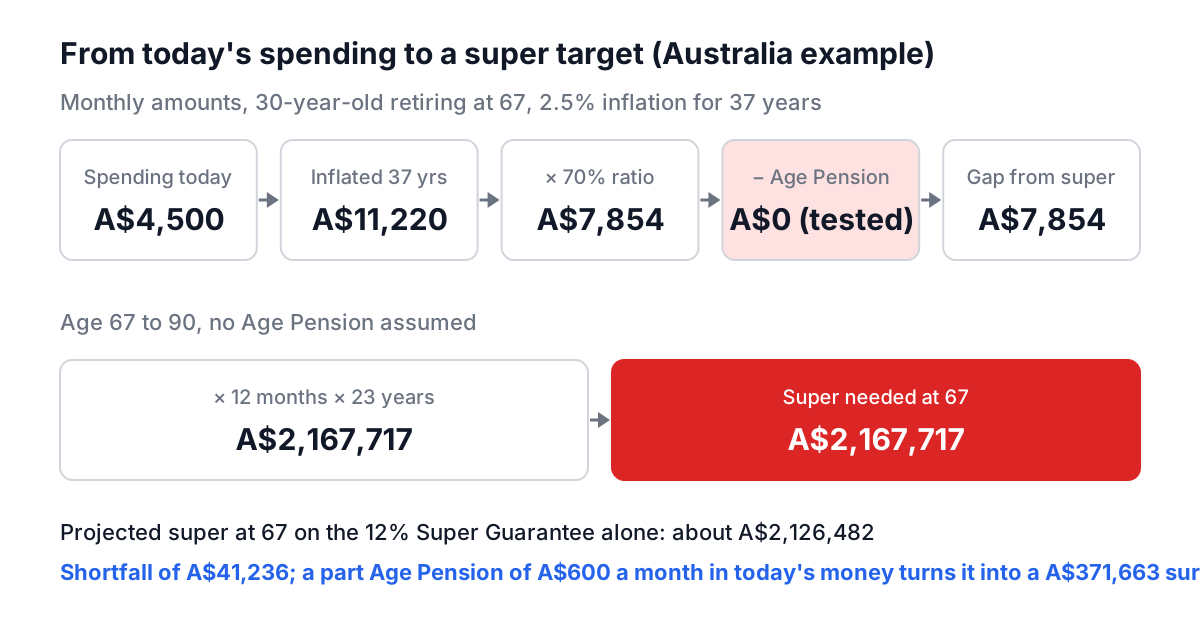
A 30-year-old on A$90,000 who spends A$4,500 a month today, expects to need 70% of that in retirement and counts on no Age Pension needs about A$2.17 million of super at 67. That figure is in the dollars of 2063; at today's prices it is about A$869,000. The 12% Super Guarantee alone, with A$40,000 already in the fund, is on course for A$2.13 million, a A$41,236 shortfall. A modest salary sacrifice or a small part Age Pension turns that into a surplus.
This edition builds that target step by step with the Retirement and Super Calculator (Australia) and its default inputs. It explains a planning method, not financial advice. A licensed financial adviser is worth consulting before big decisions such as a lump-sum contribution, starting an account-based pension, or structuring assets for the Age Pension means test.
Step 1: Inflate today's spending
Start from what your household spends now. Your salary includes super, tax and a mortgage that you will probably have paid off by 67, so it overstates what retirement costs.
spending at retirement = spending today × (1 + inflation)^years
A$4,500 × 1.025^37 = A$11,220 a month at 67. The calculator uses 2.5% inflation by default, the midpoint of the Reserve Bank's 2 to 3% target band. At 3.5% the target jumps from A$2.17 million to A$3.10 million, which is why this input deserves a second run.
The calculator then applies 70% for the costs that fall away in retirement, giving A$7,854 a month. Medicare covers public hospital and much medical care, so the health field starts at zero; add private health insurance if you plan to keep it.
Step 2: Allow for the Age Pension
The Age Pension starts at 67 for anyone born on or after 1 January 1957, subject to residence rules and an income test and an assets test. A large super balance can reduce it or remove it entirely, which is why the calculator leaves it at zero by default. That is cautious: many homeowners with a few hundred thousand dollars of super still get a part pension for at least some of their retirement.
If you expect one, use Services Australia's estimators, enter the amount at today's rate and tick the inflation box. The effect is large:
| Age Pension assumed (today's dollars) | Super needed at 67 | Result against A$2,126,482 projected |
|---|---|---|
| None | A$2,167,717 | short A$41,236 |
| A$600 a month | A$1,754,819 | surplus A$371,663 |
| A$1,000 a month | A$1,479,553 | surplus A$646,929 |
Pension rates are indexed twice a year and the means test thresholds change with them, so check the current figures on Services Australia rather than relying on an old estimate.
Step 3: Multiply by the years in retirement
super needed = (spending − Age Pension) × 12 × years in retirement
With no Age Pension: A$7,854 × 12 × 23 = A$2,167,717 for a retirement from 67 to 90.
The calculator assumes your super earns roughly what inflation takes away once you retire, so a dollar of spending costs a dollar of super. Account-based pensions often hold growth assets and may earn more than inflation, which would lower the target; a run of poor returns early in retirement would raise it.
Step 4: Project your super
Your employer pays the Super Guarantee at 12% of ordinary time earnings. On A$90,000 that is A$900 a month, and after the fund deducts 15% contributions tax, A$765 is invested. Since 1 July 2026 employers have to pay it with each pay cycle under Payday Super, rather than quarterly.
The calculator grows the balance at the expected return and adds contributions that rise with pay:
balance next year = balance × (1 + return) + 12 × monthly contributions × (1 + return ÷ 2)
With A$40,000 in super, A$765 a month rising 3% a year and a 6% return after fees, the fund reaches A$2,126,482 at 67, about A$852,862 at today's prices.
Salary sacrifice. Adding A$300 a month before tax (A$255 after contributions tax) lifts the balance to A$2,720,161, a A$552,444 surplus. Salary sacrifice and the employer's 12% both count towards the concessional contributions cap, which is A$32,500 for 2026-27. In the example they total A$14,400 a year, well inside it. Unused cap amounts from the previous five years can be carried forward if your total super balance was under A$500,000.
Step 5: The years before you can reach super
You can generally access super once you reach preservation age, which is 60 for anyone born after 30 June 1964, and retire, or at 65 whether or not you have retired. The Age Pension cannot start before 67, so a 60-year-old retiree funds seven years from super alone.
| Retire at | Years before Age Pension age | Super needed | Super projected | Result |
|---|---|---|---|---|
| 60 | 7 | A$2,378,642 | A$1,274,949 | short A$1,103,693 |
| 62 | 5 | A$2,332,456 | A$1,480,499 | short A$851,957 |
| 65 | 2 | A$2,242,679 | A$1,843,071 | short A$399,608 |
| 67 | 0 | A$2,167,717 | A$2,126,482 | short A$41,236 |
| 68 | 0 | A$2,125,305 | A$2,282,297 | surplus A$156,992 |
| 70 | 0 | A$2,029,908 | A$2,625,152 | surplus A$595,244 |
Retiring at 60 instead of 67 costs seven years of contributions and growth and adds seven years of spending, so the gap widens to more than A$1.1 million. Anyone planning to stop before 60 also needs savings outside super, because super cannot be reached until preservation age.
Which assumptions move the answer most
Each row changes one input from the default plan:
| Change | Super needed | Super projected | Result |
|---|---|---|---|
| Default | A$2,167,717 | A$2,126,482 | short A$41,236 |
| Return 5% after fees | A$2,167,717 | A$1,699,932 | short A$467,786 |
| Return 7% after fees | A$2,167,717 | A$2,683,363 | surplus A$515,646 |
| Inflation 3.5% | A$3,104,650 | A$2,126,482 | short A$978,168 |
| Plan to 95 | A$2,638,960 | A$2,126,482 | short A$512,479 |
| Need 60% of spending | A$1,858,043 | A$2,126,482 | surplus A$268,438 |
| No yearly rise in contributions | A$2,167,717 | A$1,548,814 | short A$618,903 |
One point of net return is worth about half a million dollars over 37 years. Fees and the investment option are where that point is usually won or lost, so compare your fund's long-term net return and fees with others in the ATO's YourSuper comparison tool before changing contributions.
Tax once you retire
Withdrawals from a taxed super fund after 60 are generally tax-free, whether as a lump sum or as an account-based pension. Earnings on money moved into the retirement phase are also untaxed, up to the transfer balance cap, which rose to A$2.1 million on 1 July 2026. Account-based pensions carry minimum yearly drawdowns that rise with age. Because withdrawals are tax-free, the calculator's results need no allowance for income tax on withdrawals for most retirees over 60.
How this compares with the 4% rule
The 4% rule comes from William Bengen's 1994 study of US markets: withdraw 4% of the starting balance, raise it with inflation, and it lasted 30 years in every period he tested. For the A$7,854 monthly gap it asks for 25 × A$7,854 × 12, about A$2.36 million, more than the calculator's A$2.17 million because it is built for a 30-year retirement rather than 23. In Australia the Age Pension acts as a floor that rises as super runs down, which softens the risk of outliving the money but does not remove it.
A practical routine
- Check your super balance, fees and investment option in your fund's app or through myGov.
- Run the Retirement and Super Calculator with your own spending and balance, and an Age Pension estimate if you expect one.
- Re-run it with a return one point lower, inflation one point higher and retirement three years earlier.
- If there is a gap, test salary sacrifice within the concessional cap.
- If you plan to stop before 60, add up the savings you hold outside super.
For aggressive early-retirement plans the FIRE Planner (Australia) splits super from other savings, and the compound interest calculator shows the growth maths on its own.
Frequently asked questions
Is A$1 million in super enough to retire?
Often, for a homeowner who also gets a part Age Pension. Spread over 23 years with returns roughly matching inflation, A$1 million pays about A$3,600 a month, and a part pension can add to that as the balance falls. Renters, early retirees and anyone with high spending may need more.
Can I retire at 60 and live on super until the Age Pension?
Yes, if your super can fund the seven years from 60 to 67 on its own and still last. In the default example that needs A$2.38 million at 60 against A$1.27 million projected, so a 30-year-old on the Super Guarantee alone would need to save much more or work longer.
How much salary sacrifice can I make?
Up to the concessional contributions cap, A$32,500 for 2026-27, minus what your employer already pays. Contributions above the cap are taxed at your marginal rate. If your total super balance was below A$500,000, you can also use unused cap amounts from the previous five years.
Should I count my partner's super?
For a couple, enter combined spending and combined super, or run each person separately and add the results. The Age Pension income and assets tests apply to the couple together.
What return should I use for super?
A return after fees and investment tax. Growth and balanced options have historically returned more than conservative ones over long periods, but with larger swings. Test at least two rates, because one point of return changes the result by about half a million dollars in the default example.
Sources and further reading
- Super guarantee, Australian Taxation Office. 12% of ordinary time earnings from 1 July 2025.
- Contributions caps, Australian Taxation Office. Concessional cap of A$32,500 for 2026-27.
- Super withdrawal options, Australian Taxation Office. Preservation age and conditions of release.
- General transfer balance cap indexation on 1 July 2026, Australian Taxation Office.
- Who can get Age Pension, Services Australia. Age 67, residence, income and assets tests.
- Determining withdrawal rates using historical data, Journal of Financial Planning. William Bengen's 1994 study behind the 4% rule.
Open the Retirement Calculator
More Calculators
Every tool in the Calculators section, free and in your browser.
- Investment Calculator
- Compound Interest Calculator
- Simple Interest Calculator
- Interest Calculator
- EMI Calculator
- Retirement Calculator
- Time-Weighted Return Calculator
- Savings Goal Calculator
- Inflation Calculator
- CAGR Calculator
- ROI Calculator
- Present and Future Value Calculator
- NPV and IRR Calculator
- 401(k) Calculator
- Roth IRA Calculator
- APY and CD Calculator
- SIP Calculator
- Annuity Calculator
- Bond Price and Yield Calculator
- Currency Converter
- Dividend Calculator
- Stock Average Calculator
- RMD Calculator