
Retirement Corpus: How Much Do You Need in India?
Build an Indian retirement corpus from today's expenses: 6% inflation, EPF, PPF and NPS, children's goals, and the assumptions that change the number most.
By Redbison Dev · · 6 min read

India edition. India edition in rupees with lakh and crore, Indian inflation, retirement at 60 with no state pension, EPF, PPF and NPS rules, and children's education and marriage goals. US edition
A 30-year-old household spending ₹50,000 a month today needs a retirement corpus of about ₹7.24 crore at 60 to keep the same lifestyle until 85, if inflation averages 6%. That sounds impossible until you convert it back: ₹7.24 crore in 2056 is worth about ₹1.26 crore at today's prices. The number is large because thirty years of Indian inflation multiplies everything by 5.7, and because most salaried Indians have no state pension to cover part of it.
This edition builds that corpus the way the Retirement Corpus Calculator does, one input at a time, with its default figures. It explains a planning method, not investment advice. A SEBI-registered investment adviser can test the plan against your own EPF passbook, NPS statement and fund holdings, and should if you are within ten years of retiring.
Step 1: Inflate this month's expenses to the year you retire
Start with household expenses today, not salary. Salary includes EPF, tax and EMIs that end before or at retirement; expenses are what has to continue.
expenses at retirement = expenses today × (1 + inflation)^years
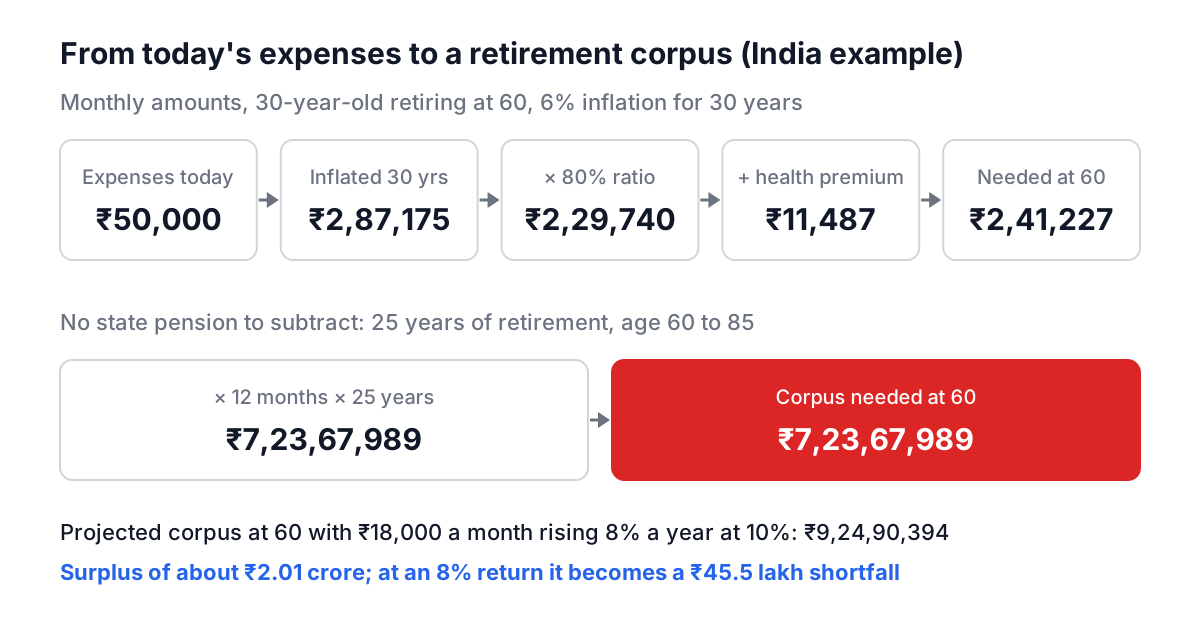
₹50,000 × 1.06^30 = ₹2,87,175 a month at 60.
Why 6%? The inflation target the Government has set for the RBI is 4%, within a band of 2% to 6%, notified in March 2026 for April 2026 to March 2031. Household costs that matter in retirement, especially health care and services, have often risen faster than the headline index, so many planners use 6% for a 30-year horizon. The choice is not minor: at 5% the corpus falls to about ₹5.45 crore, and at 7% it rises to about ₹9.59 crore.
Step 2: Trim for retirement, add health cover
Some costs fall away once you stop working: commuting, work clothes, and the SIPs and EPF contributions themselves. The calculator applies 80% to the inflated expenses, giving ₹2,29,740.
Health insurance is handled separately and is not trimmed. A ₹2,000 monthly premium today becomes ₹11,487 by 60 at 6%, and it is not unusual for it to rise faster. Group cover from an employer usually ends when you leave, so price a personal family floater well before retirement and enter that premium.
Total monthly need at 60: ₹2,41,227.
Step 3: Subtract any pension, which for most people is little or nothing
There is no universal state pension for private sector employees. What exists:
- Employees' Pension Scheme (EPS). Part of the employer's EPF contribution (8.33% of pay, up to a wage ceiling) goes to EPS, which pays a monthly pension after at least ten years of service. It is modest, so many planners leave it out or enter a small figure.
- NPS. It builds a corpus rather than paying a set pension. Under PFRDA's December 2025 amendments to the exit regulations, a non-government subscriber can take up to 80% as a lump sum at normal exit and must use at least 20% to buy an annuity. A corpus of ₹8 lakh or less can be taken entirely, and entry and exit ages now go up to 85.
- A defined benefit pension from government service or an older scheme, if you have one.
The calculator's EPS or Other Pension field takes any of these. In the default plan it is zero, so the whole ₹2,41,227 has to come from savings.
Step 4: Multiply by the years of retirement
corpus = monthly need × 12 × years in retirement + one-off goals
₹2,41,227 × 12 × 25 = ₹7,23,67,989.
The calculator assumes your corpus earns roughly what inflation takes away after you retire, so each rupee of spending costs a rupee of corpus. A corpus invested in debt instruments that beat inflation by a point or two would need less; one sitting in a savings account would need more.
Step 5: Add your children's goals
Many Indian families save for a child's higher education and marriage from the same pool as retirement. Tick the children box and the calculator inflates education at 5% a year to age 18 and the marriage fund at general inflation to age 25.
For one child aged 3, ₹20 lakh of education and ₹15 lakh of marriage costs at today's prices become ₹95,63,162. The corpus needed rises to ₹8,19,31,151, and the surplus in the default plan halves from ₹2.01 crore to ₹1.06 crore. If these goals are real for you, include them now; they arrive 15 to 20 years before retirement and often drain the savings meant for it.
Step 6: Project what your savings will grow to
The default plan has ₹5 lakh saved, ₹15,000 a month of your own (EPF share plus SIPs) and ₹3,000 from the employer, contributions rising 8% a year with salary, and a 10% return. The calculator grows each year's balance at the return and credits contributions mid-year:
corpus next year = corpus × (1 + return) + 12 × monthly saving × (1 + return ÷ 2)
That reaches ₹9,24,90,394 at 60, a surplus of about ₹2.01 crore over the ₹7.24 crore needed.
Where the money usually sits:
| Product | What to know for the projection |
|---|---|
| EPF and VPF | Rate declared yearly by EPFO; 8.25% for 2025-26. Enter your share, VPF and the employer's EPF share. |
| PPF | 7.1% for October to December 2026, reset every quarter; 15-year account, deposits up to ₹1.5 lakh a year. |
| NPS | Market-linked; at least 20% of the corpus buys an annuity at exit for non-government subscribers. |
| Equity mutual funds (SIP) | Market-linked with no guaranteed rate; long-term gains above ₹1.25 lakh a year are taxed at 12.5%. |
A blended return between 8% and 10% is a common planning range for a mix of EPF, PPF and equity over 30 years. It is an assumption, not a forecast, which is why the next section matters.
Which assumptions move the corpus most
Each row changes one input from the default plan:
| Change | Corpus needed | Corpus projected | Result |
|---|---|---|---|
| Default | ₹7.24 crore | ₹9.25 crore | surplus ₹2.01 crore |
| Return 8% | ₹7.24 crore | ₹6.78 crore | short ₹45.46 lakh |
| Return 11% | ₹7.24 crore | ₹10.89 crore | surplus ₹3.65 crore |
| Inflation 7% | ₹9.59 crore | ₹9.25 crore | short ₹34.24 lakh |
| No yearly step-up in saving | ₹7.24 crore | ₹4.60 crore | short ₹2.63 crore |
| Retire at 55 | ₹6.49 crore | ₹5.06 crore | short ₹1.43 crore |
| Retire at 58 | ₹6.96 crore | ₹7.29 crore | surplus ₹33.53 lakh |
| Plan to 95 | ₹10.13 crore | ₹9.25 crore | short ₹88.25 lakh |
The step-up row is the one most Indian plans miss. Saving a flat ₹18,000 a month for 30 years ends ₹2.63 crore short; raising it 8% a year with increments turns the same start into a surplus. Contributions in the last year of the default plan are about nine times the first year's.
Retiring early hurts twice: five fewer years of saving and five more years of spending. Living longer than planned does the same quietly, which is why 85 is a floor, not a forecast.
The 4% rule and Indian inflation
The 4% rule comes from William Bengen's 1994 study of US market history: withdraw 4% of the corpus in the first year and raise it with inflation, and it lasted 30 years in every period he tested. Turned around, you need 25 times a year's expenses: 25 × ₹2,41,227 × 12 = ₹7.24 crore, the same as the calculator's figure here because both cover 25 years.
Bengen's data came from a market with lower inflation than India's. With expenses rising 6% a year, a corpus that earns little more than inflation in retirement cannot fund an inflation-linked withdrawal for long beyond its planned years. If your plan only works at 4% and to age 85, treat it as tight and test it at 90 or 95.
Mistakes worth avoiding
- Counting the house as corpus. A home you live in pays no bills unless you sell it or take a reverse mortgage.
- Forgetting the step-up. A flat SIP for 30 years buys far less than a SIP that grows with salary.
- Withdrawing EPF on job changes. Money taken out stops compounding for retirement; transfer the account instead.
- Leaving health cover to the end. Premiums and waiting periods are lower when you buy younger.
- Using a single return for every product. Fixed-income parts and equity parts behave differently; check the plan at two or three rates.
A practical routine
Run the Retirement Corpus Calculator with your real expenses and balances once a year, after your increment. Then run it three more times: return two points lower, inflation one point higher, and retirement two years earlier. If the plan survives all three, you have room. For the SIP side, the SIP calculator shows what a step-up does to one fund, and the PPF calculator shows a 15-year PPF account. The inflation calculator turns any future figure back into today's rupees.
Frequently asked questions
Is ₹1 crore enough to retire in India?
It depends on when. Spent evenly over 25 years with returns matching inflation, ₹1 crore supports about ₹33,333 a month. For someone retiring today with modest expenses and their own home, that can work. For a 30-year-old planning to retire in 2056, ₹33,333 a month then is worth only about ₹5,804 today at 6% inflation, which is why long-range corpus figures run to several crore.
How much should I save each month for retirement?
Work backwards from the corpus. In the default plan, ₹18,000 a month rising 8% a year at a 10% return is enough for ₹50,000 of expenses today. If the calculator shows a shortfall, its Strategy tab gives the extra monthly saving that closes it, already allowing for growth.
Can I take my whole NPS corpus at 60?
Not as a non-government subscriber with more than ₹8 lakh. Under the December 2025 rules you can take up to 80% as a lump sum and at least 20% must buy an annuity. Up to ₹8 lakh can be taken entirely, and between ₹8 lakh and ₹12 lakh there are options to take up to ₹6 lakh with the rest paid out over at least six years or as an annuity.
Should I count EPF in my retirement corpus?
Yes. Enter the current EPF balance under current savings, your own EPF share and any VPF under monthly contribution, and the employer's EPF share under employer contribution. Keep the EPF account when you change jobs so the balance keeps compounding.
What retirement age should I plan for?
Sixty is common in private and government jobs, but the corpus is very sensitive to it. In the default plan retiring at 58 still leaves a ₹33.53 lakh surplus, while 55 leaves a ₹1.43 crore shortfall, because those five years cut saving and add spending.
Sources and further reading
- Key amendments in PFRDA (Exits and Withdrawals under the NPS) Regulations, 2015, Pension Fund Regulatory and Development Authority, 19 December 2025. Lump sum and annuity shares at exit, ₹8 lakh and ₹12 lakh thresholds, exit age 85.
- Employees' Provident Fund Organisation, Ministry of Labour and Employment. EPF interest rate, EPS pension and member passbook.
- Public Provident Fund Account, National Savings Institute, Ministry of Finance. Deposit limits, tenure and the current rate.
- National Pension System, Pension Fund Regulatory and Development Authority.
- Determining withdrawal rates using historical data, Journal of Financial Planning. William Bengen's 1994 study behind the 4% rule.
- 22.1 Tracking Inflation, OpenStax. Nominal and real values.
Open the Retirement Calculator
More Calculators
Every tool in the Calculators section, free and in your browser.
- Investment Calculator
- Compound Interest Calculator
- Simple Interest Calculator
- Interest Calculator
- EMI Calculator
- Retirement Calculator
- Time-Weighted Return Calculator
- Savings Goal Calculator
- Inflation Calculator
- CAGR Calculator
- ROI Calculator
- Present and Future Value Calculator
- NPV and IRR Calculator
- 401(k) Calculator
- Roth IRA Calculator
- APY and CD Calculator
- SIP Calculator
- Annuity Calculator
- Bond Price and Yield Calculator
- Currency Converter
- Dividend Calculator
- Stock Average Calculator
- RMD Calculator