
How Much Pension Do I Need to Retire in the UK?
Work out a UK pension target from your spending, the State Pension and your State Pension age, with the gap years, tax and the assumptions that move it most.
By Redbison Dev · · 6 min read
United Kingdom edition. UK edition in pounds, built around the new State Pension, State Pension age, auto-enrolment, the minimum pension age of 57 from April 2028 and UK income tax. US edition
For most people in the UK the answer is smaller than the headline figures suggest, because the State Pension pays a large share of a modest retirement. A 35-year-old who spends £2,500 a month today, wants 70% of that in retirement and will get the full new State Pension needs a pot of about £390,000 at 67 in the money of that year. The auto-enrolment minimum, with £40,000 already saved, is on course for about £417,000. Stop work at 60 instead and the target rises to £580,538 while the pot reaches only £272,880.
This edition walks through that number one input at a time, using the UK Pension Calculator with its default inputs, so you can see which assumptions carry the weight. It explains a planning method, not personal advice. If you have a defined benefit pension, a pension transfer to consider or a complicated tax position, a regulated financial adviser is worth paying for, and Pension Wise gives free guidance on defined contribution pots from age 50.
Start from what you spend, not what you earn
Rules of thumb such as "two thirds of your salary" are easy to quote and hard to use. Your spending is a better anchor because it already excludes the things that stop at retirement: pension contributions, National Insurance, commuting and, for many people, the mortgage.
Pensions UK publishes the Retirement Living Standards, three yearly budgets for a retired household that owns its home outright. The figures on its site in November 2026 are:
| Standard | One person | Two people |
|---|---|---|
| Minimum | £13,900 | £22,500 |
| Moderate | £32,700 | £45,400 |
| Comfortable | £45,400 | £62,700 |
These are spending, not income. Income tax comes on top, and renting or still paying a mortgage pushes the cost up. They are useful as a sense check: if your own estimate for one person sits well below £13,900 a year, something is probably missing.
The calculator takes your monthly spending and an inflation rate. At 2% a year, £2,500 a month today becomes £4,711 by the time a 35-year-old reaches 67. Taking 70% of that gives £3,298 a month of spending at retirement, in the pounds of that year.
What the State Pension covers
The full new State Pension is £241.30 a week in the 2026 to 2027 tax year, which is £12,547.60 a year or about £1,046 a month. You need 35 qualifying years on your National Insurance record for the full amount and at least 10 for any of it. With 25 qualifying years you would get 25/35 of the full rate, about £747 a month.
It is uprated every April, so the calculator enters it at today's rate and raises it with inflation: £1,046 now becomes about £1,971 a month by 67. That alone covers 60% of the £3,298 spending in the example, leaving £1,327 a month for the pot to provide.
Two checks change the result more than any investment choice:
- Your forecast. Check your State Pension forecast and National Insurance record. Gaps can sometimes be filled with voluntary contributions, and each extra qualifying year adds 1/35 of the full rate for life.
- Your State Pension age. It is rising from 66 to 67 between 2026 and 2028, and under current law it is 68 for anyone born on or after 6 April 1978, with a phased rise for those born in the year before. The default in the calculator is 68, the age that applies to a 35-year-old today.
Losing ten qualifying years matters. Enter £747 instead of £1,046 and the pot needed at 67 rises from £389,829 to £538,587, a shortfall of £121,244.
The years before your State Pension starts
Every year between stopping work and State Pension age has to be paid entirely from savings. The calculator handles this with the State Pension Age field: in those bridge years the pot covers the full spending, not just the gap.
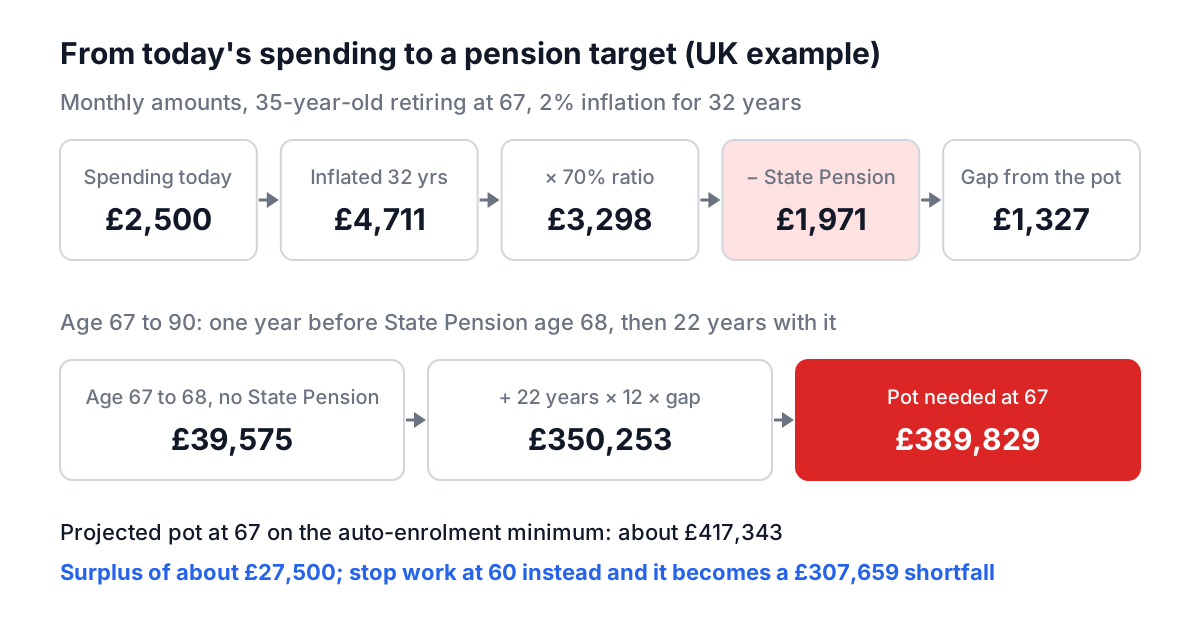
In the default plan the saver retires at 67 but the State Pension starts at 68, so that one year costs £39,575, about a tenth of the whole target. Retiring earlier stretches the bridge quickly:
| Stop work at | Bridge years | Pot needed | Pot projected | Result |
|---|---|---|---|---|
| 57 | 11 | £644,451 | £225,587 | short £418,863 |
| 60 | 8 | £580,538 | £272,880 | short £307,659 |
| 62 | 6 | £532,303 | £308,870 | short £223,433 |
| 65 | 3 | £450,768 | £370,511 | short £80,258 |
| 67 | 1 | £389,829 | £417,343 | surplus £27,514 |
| 68 | 0 | £357,258 | £442,660 | surplus £85,402 |
The minimum age matters too. You can normally take a workplace or personal pension from 55, but the normal minimum pension age rises to 57 on 6 April 2028, so anyone born on or after 6 April 1973 should plan on 57 unless their scheme gives a protected pension age. Money in an ISA has no age limit, which is why people aiming to stop before 57 usually build an ISA alongside the pension to cover the first years. The UK FIRE Planner splits the two pots and checks that bridge directly.
How the pot grows under auto-enrolment
Most employees are enrolled in a workplace pension with a legal minimum of 8% of qualifying earnings, at least 3% from the employer, on earnings between £6,240 and £50,270 a year. On a £35,000 salary the qualifying band is £28,760, so the minimum is about £120 a month from you (including basic-rate tax relief) and £72 from your employer. Those are the calculator's defaults.
The projection grows the pot each year at the expected return and adds contributions that rise with pay:
pot next year = pot × (1 + return) + 12 × monthly contributions × (1 + return ÷ 2)
With £40,000 saved, £192 a month going in, 2% annual rises and a 5% return, the pot reaches £417,343 at 67. At today's prices that is about £221,456, a useful reminder that a six-figure pot decades away buys less than it sounds.
Raising your own contribution from £120 to £300 a month lifts the pot to £629,916. The extra £180 costs you £144 after basic-rate relief. Many employers match higher contributions or offer salary sacrifice, so check what is on offer before paying more into an ISA instead.
Which assumptions move the answer most
Changing one input at a time against the default plan (retire at 67, 5% return, 2% inflation, plan to 90):
| Change | Pot needed | Pot projected | Result |
|---|---|---|---|
| Default | £389,829 | £417,343 | surplus £27,514 |
| Return 4% | £389,829 | £331,092 | short £58,736 |
| Return 6% | £389,829 | £529,196 | surplus £139,367 |
| Inflation 3% | £532,671 | £417,343 | short £115,329 |
| Plan to 95 | £469,432 | £417,343 | short £52,089 |
| Need 80% of spending | £519,862 | £417,343 | short £102,519 |
| No yearly rise in contributions | £389,829 | £368,423 | short £21,405 |
One point of return or one point of inflation flips the result either way. The share of spending you expect to need matters just as much, because the State Pension is fixed and every extra pound of spending falls on the pot.
Tax on the way out
Results are before tax, and in the UK that matters more than people expect. Up to 25% of a pension can usually be taken tax-free, capped at £268,275 across all your pensions. The rest is taxed as income when you draw it.
The Personal Allowance is £12,570 for 2026 to 2027 and the full State Pension is £12,547.60, so the State Pension uses almost all of it. Nearly every taxable pound you draw from a pension on top is taxed at 20% or more. A £1,327 monthly gap from the pot therefore needs about £1,659 a month of gross drawdown if all of it is taxed at 20%, or about £1,561 if a quarter of each withdrawal comes out tax-free. ISA withdrawals are tax-free, which makes an ISA pound worth more than a pension pound once you are retired, though pension tax relief usually makes up for that on the way in.
How this compares with the 4% rule
The 4% rule comes from William Bengen's 1994 study of US markets: withdraw 4% of the starting pot and raise it with inflation, and it lasted 30 years in every period he tested. Applied to the £1,327 gap it asks for 25 × £1,327 × 12 = £398,016, close to the calculator's £389,829. The two agree here because a 23-year retirement with a one-year bridge happens to land near 25 times the yearly gap. UK retirees face different returns, currency and annuity rates from Bengen's US data, so treat both figures as a guide. A lifetime annuity removes the risk of outliving the pot at the cost of flexibility; the annuity calculator shows what a given pot pays.
A routine worth running once a year
- Get your State Pension forecast and State Pension age on GOV.UK.
- Gather every pension pot, including old workplace schemes; the Pension Tracing Service finds lost ones.
- Run the UK Pension Calculator with your own spending, then again with a return one point lower and inflation one point higher.
- If you plan to stop before State Pension age, check the bridge years, and before 57 check what your ISA can cover.
- Look at the employer contribution on offer before choosing between more pension and more ISA.
For the growth maths underneath the projection, see the compound interest guide.
Frequently asked questions
Is the State Pension enough to live on?
For one person it roughly matches the Retirement Living Standards minimum: £12,547.60 a year at the full rate against £13,900 of spending for a homeowner. It falls well short of the moderate standard of £32,700, so most people need a private or workplace pension on top, and anyone renting needs more.
Can I retire at 55 in the UK?
You can draw most private pensions from 55 until 5 April 2028, and from 57 after that unless your scheme gives you a protected pension age. The State Pension cannot be taken early, so retiring at 55 means funding 12 or 13 years from savings alone. In the default example that pushes the pot needed above £680,000.
How much pension pot do I need for £30,000 a year?
Subtract the State Pension first. At the full rate, £30,000 of spending leaves about £17,450 a year for the pot to cover, before tax. Over 23 years of retirement that is about £401,000 in the money of the year you retire, more if you stop work before State Pension age or plan beyond 90.
Does my ISA count towards retirement savings?
Yes, if you mean to spend it in retirement. Add it to current savings in the calculator. ISA withdrawals are tax-free and can be taken at any age, which makes an ISA the usual way to fund the years before you can draw a pension.
What happens to the target if I have gaps in my National Insurance record?
Each missing qualifying year cuts the State Pension by 1/35 of the full rate for life, roughly £30 a month at today's rate, and the pot has to make up the difference. In the example, ten missing years raise the pot needed at 67 by about £149,000.
Sources and further reading
- The new State Pension: what you'll get, GOV.UK. Full rate of £241.30 a week; 35 qualifying years for the full amount.
- Check your State Pension age, GOV.UK. State Pension age by date of birth.
- Increasing normal minimum pension age, HM Revenue and Customs. The rise from 55 to 57 on 6 April 2028 and protected pension ages.
- Workplace pensions: what you, your employer and the government pay, GOV.UK. The 8% minimum on £6,240 to £50,270.
- Income Tax rates and Personal Allowances, GOV.UK. £12,570 Personal Allowance for 2026 to 2027.
- Retirement Living Standards, Pensions UK. Minimum, moderate and comfortable budgets for one and two people.
- Determining withdrawal rates using historical data, Journal of Financial Planning. William Bengen's 1994 study behind the 4% rule.
Open the Retirement Calculator
More Calculators
Every tool in the Calculators section, free and in your browser.
- Investment Calculator
- Compound Interest Calculator
- Simple Interest Calculator
- Interest Calculator
- EMI Calculator
- Retirement Calculator
- Time-Weighted Return Calculator
- Savings Goal Calculator
- Inflation Calculator
- CAGR Calculator
- ROI Calculator
- Present and Future Value Calculator
- NPV and IRR Calculator
- 401(k) Calculator
- Roth IRA Calculator
- APY and CD Calculator
- SIP Calculator
- Annuity Calculator
- Bond Price and Yield Calculator
- Currency Converter
- Dividend Calculator
- Stock Average Calculator
- RMD Calculator