
How Much Does a Meeting Cost a Canadian Employer?
Work out a meeting's cost in Canadian dollars from salaries plus employer CPP and EI, provincial payroll tax and benefits, per minute, per meeting and per year.
By Redbison Dev · · 9 min read
Canada edition. Canadian edition in CA$, with employer CPP and EI on-costs from the CRA's 2026 rates and maximums, notes on Quebec's QPP and QPIP and Ontario's Employer Health Tax, and 2,080 or 1,950 paid hours a year. US edition
A 90-minute weekly coordination meeting at an engineering firm, with four engineers on CA$105,000, two technologists on CA$72,000 and a project manager on CA$125,000, costs the employer about CA$521.72 each time, or CA$5.80 a minute. Over 48 weeks that is CA$25,042.50 and 504 person-hours a year. Those figures use the Meeting Cost Calculator with a 1.05 multiplier for the employer's share of Canada Pension Plan contributions and Employment Insurance premiums, the two payroll costs every employer outside Quebec pays on every salary.
This edition works through how those on-costs are built in Canada, why they shrink as salaries rise, and what to add for benefits and provincial payroll taxes.
Salary to hourly cost
Divide the salary by the paid hours in a year. The calculator uses 2,080 (40 hours x 52 weeks); many offices work 37.5-hour weeks, which gives 1,950.
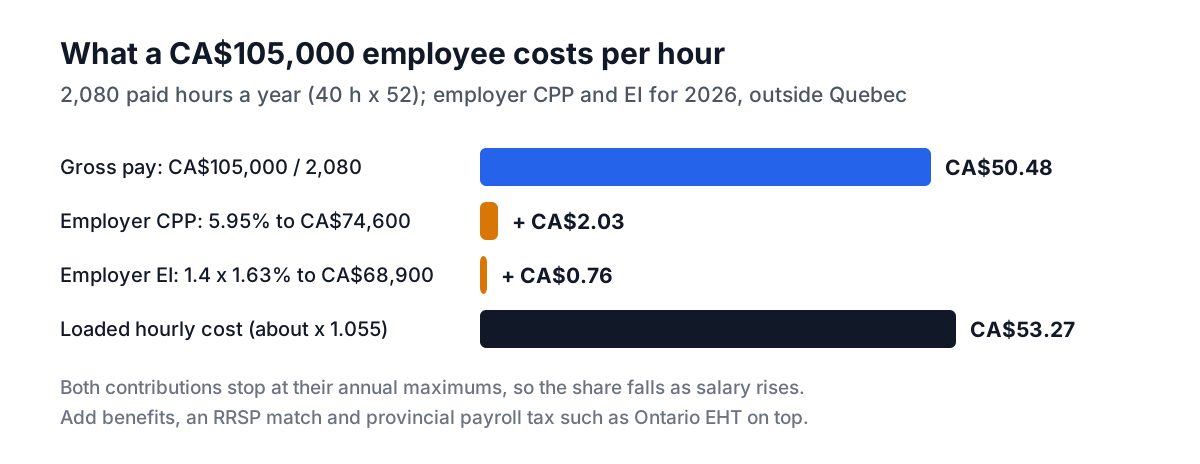
CA$105,000 / 2,080 = CA$50.48 an hour
CA$105,000 / 1,950 = CA$53.85 an hour
Vacation and statutory holidays are paid, so they stay in the divisor. The choice matters: the coordination meeting above costs CA$556.50 on 1,950 hours, 6.7% more than on 2,080.
Employer CPP and EI for 2026
The CRA publishes the rates each year. For 2026:
| Item | Rate | Earnings it applies to | Employer maximum |
|---|---|---|---|
| CPP (employer share) | 5.95% | between the CA$3,500 basic exemption and CA$74,600 | CA$4,230.45 |
| EI (employer premium) | 1.4 x 1.63% = 2.282% | up to CA$68,900 insurable earnings | CA$1,572.30 |
For a CA$105,000 engineer both are at their maximums:
CPP = 5.95% x (74,600 - 3,500) = CA$4,230.45
EI  = 1.4 x 1.63% x 68,900     = CA$1,572.30
on-cost = 5,802.75 / 105,000   = 5.5%
Because both contributions stop at an annual maximum, the share falls as pay rises:
| Salary | Employer CPP + EI | Share of pay |
|---|---|---|
| CA$55,000 | CA$4,319.35 | 7.9% |
| CA$72,000 | CA$5,648.05 | 7.8% |
| CA$85,000 | CA$5,802.75 | 6.8% |
| CA$105,000 | CA$5,802.75 | 5.5% |
| CA$125,000 | CA$5,802.75 | 4.6% |
For the coordination meeting's mix of salaries the weighted share is 5.9%, so 1.05 to 1.06 is the statutory floor. The worked example rounds down to 1.05, the conservative end; at 1.06 the coordination meeting costs CA$526.69. There is a second additional CPP contribution (CPP2) on earnings above CA$74,600 up to a second ceiling; it adds a little more for the higher earners and is not in this simple floor.
Quebec is different
In Quebec, employers deduct Quebec Pension Plan contributions instead of CPP, and Quebec Parental Insurance Plan premiums alongside a lower EI rate, with QPP and QPIP remitted to Revenu Québec, as the CRA's employer's guide to payroll deductions explains. The 2026 Quebec employee EI rate is 1.30%, so the employer premium is lower than elsewhere, but QPP and QPIP add their own employer shares. Use the Revenu Québec rates to set the multiplier for a Quebec team.
Provincial payroll taxes and benefits
Some provinces add a payroll tax. Ontario's Employer Health Tax runs from 0.98% to 1.95% of Ontario payroll, with the first CA$1 million exempt for eligible employers; groups with more than CA$5 million of payroll get no exemption. Some other provinces have their own employer health or payroll taxes; check your province's finance ministry.
Then add what your company pays by choice: group health and dental benefits, an RRSP or pension match, and the cost of a desk and laptop. These vary far more than the statutory costs. If benefits and a 4% RRSP match bring the multiplier to 1.20, the coordination meeting costs CA$596.25 each time and CA$28,620 a year.
Worked examples
The weekly coordination meeting
| Who | Salary | Loaded hourly cost at 1.05 | Cost for 90 minutes |
|---|---|---|---|
| 4 engineers | CA$105,000 | CA$53.00 each | CA$318.03 |
| 2 technologists | CA$72,000 | CA$36.35 each | CA$109.04 |
| Project manager | CA$125,000 | CA$63.10 | CA$94.65 |
| Total | CA$521.72 |
Per year at 48 weeks: CA$25,042.50 and 504 person-hours, the equivalent of about a quarter of one person's working year.
The daily stand-up
Six developers on CA$85,000, 15 minutes, five days a week, 48 weeks, at 1.06:
| Measure | Value |
|---|---|
| Cost per stand-up | CA$64.98 |
| Cost per minute | CA$4.33 |
| Per year | CA$15,594.23 and 360 person-hours |
Cutting it to three days a week saves about CA$6,240 a year; that is the kind of number worth showing a team before you change a routine.
Weeks a year a meeting runs
The calculator uses 48 weeks for a recurring meeting: 52 weeks less vacation and statutory holidays. Minimum vacation is set by your province's employment standards act (or the Canada Labour Code for federally regulated employers), and statutory holidays come on top. If your team takes four weeks of vacation, 46 is closer.
What the cost leaves out
- Preparation and follow-up. Reading, travel between sites and the time lost getting back to focused work.
- Billable time. For consultants and engineers who bill by the hour, the lost revenue can be several times the salary cost.
- Everyone's attention. A meeting with cameras off and email open still costs the full figure.
Salary data
Salaries are personal information under federal and provincial privacy law. Share meeting costs using pay bands or role averages rather than individual salaries. The calculator runs in your browser and does not send the figures anywhere.
Tools for this job
- Meeting Cost Calculator: cost per meeting, minute and year in CA$ from salaries or hourly pay.
- Salary Calculator: convert a salary to hourly, weekly and monthly pay.
- Time Card Calculator: hours worked across a week.
- The US meeting cost guide uses US benefit and payroll tax figures.
Frequently asked questions
How much does a one-hour meeting cost in Canada?
Add each attendee's salary divided by 2,080 hours, times about 1.05 to 1.08 for employer CPP and EI, then multiply by the length. Six people averaging CA$95,000 cost about CA$290 for an hour before benefits. Your own figure depends on salaries, hours and benefits.
What does an employee cost on top of salary in Canada?
The statutory minimum is the employer's CPP contribution (5.95% between CA$3,500 and CA$74,600 in 2026, up to CA$4,230.45) and EI premium (1.4 times 1.63% on up to CA$68,900, up to CA$1,572.30). That is 7.9% of a CA$55,000 salary and 4.6% of CA$125,000. Benefits and provincial payroll taxes come on top.
How many paid hours are in a year?
2,080 on a 40-hour week and 1,950 on a 37.5-hour week, since vacation and statutory holidays are paid. Use the one that matches the contracts of the people in the meeting.
Does a stand-up meeting cost more than a weekly meeting?
Over a year it can. Six developers in a 15-minute daily stand-up cost CA$15,594.23 a year, while the 90-minute weekly coordination meeting for seven costs CA$25,042.50. Per minute, the stand-up is cheaper; in total, frequency adds up.
Is the Ontario Employer Health Tax included?
Not at 1.05. If your Ontario payroll is above the exemption, add 0.98% to 1.95% to the multiplier, for example 1.07 or 1.08.
Sources and further reading
- CPP contribution rates, maximums and exemptions, Canada Revenue Agency. 2026 rate 5.95%, CA$3,500 exemption, CA$74,600 maximum, CA$4,230.45 employer maximum.
- EI premium rates and maximums, Canada Revenue Agency. 2026 rates of 1.63% (Quebec 1.30%), CA$68,900 maximum and the 1.4 employer multiplier.
- Employers' guide: payroll deductions and remittances (T4001), Canada Revenue Agency. QPP and QPIP in Quebec.
- Employer Health Tax, Government of Ontario. Rates by payroll size and the CA$1 million exemption.
- Employer costs for employee compensation, US Bureau of Labor Statistics. The US benchmark for total compensation, for comparison.
Open the Meeting Cost Calculator
More Team & Productivity
Every tool in the Team & Productivity section, free and in your browser.