
Long-Term Care in Ontario: Co-Payments and Tax Credits
Ontario's long-term care co-payment by room type, what three years cost, income-based fees elsewhere, and the CRA disability and medical expense credits.
By Redbison Dev · · 11 min read
Canada edition. Canadian edition in CAD: Ontario's long-term care co-payment rates from July 1, 2026, B.C.'s income-based rate for contrast, and the CRA disability and medical expense credits under the 2025 tax-year rules. US edition
Your father has been approved for a long-term care home in Ontario and you have to choose between a basic (ward) room, semi-private and private. He pays a co-payment, the resident's share that covers accommodation and meals, set by the Ministry of Long-Term Care. From July 1, 2026, the maximum is $70.00 a day ($2,129.17 a month) for basic accommodation and $100.01 a day ($3,041.97 a month) for a private room in a newer bed. Over three years, with the rate rising by the largest increase the formula allows, that is about $78,600 for basic and $112,300 for private, and a federal medical expense credit can give back about $3,450 of a year's basic fees under the 2026 rules.
Other provinces charge differently, mostly by income rather than a flat rate, so the Ontario figures are a worked example, not a national price. The father's income below is an illustration.
What Ontario charges by room type
The ministry's spring 2026 bulletin to residents sets the maximum daily co-payment by room type and the date the resident was admitted to the bed:
| Room (newer bed, admitted on or after July 1, 2015) | Daily | Monthly |
|---|---|---|
| Basic | $70.00 | $2,129.17 |
| Semi-private | $84.40 | $2,567.17 |
| Private | $100.01 | $3,041.97 |
| Short-stay (respite) | $45.31 | n/a |
Older beds and earlier admissions pay less for semi-private and private rooms, down to $79.61 and $91.58 a day. The monthly figure is the daily rate times 30.4167.
How the rate rises. The basic rate moves each July by inflation, capped: last year's rate × (1 + CPI, up to 2.5%). For July 2026 the increase was 2.1%, from $68.56 to $70.00. The premium for a newer semi-private bed rose from $14.10 to $14.40 a day, and for a newer private bed from $29.39 to $30.01.
If he cannot afford basic. Residents can apply to the ministry for a reduction in the basic co-payment, called a Rate Reduction. Each term runs from July 1 to June 30, so anyone receiving one must reapply for the next cycle; the home's staff provide the form and help submit it. Ask the administrator before choosing a room how a reduction would apply to it.
What three years cost, room by room
The co-payment is a run of monthly bills that rise each July. The Annuity Calculator sizes the lump sum: choose lump sum needed, payment per month equal to the monthly rate, 3 years, 12 payments a year at the start of each period, a 2.5% yearly increase (the cap, as a cautious case) and an interest rate for the money while it waits, 3% here.
| Room | Monthly from July 1, 2026 | Three years of bills (2.5% rises) | Lump sum needed at 3% |
|---|---|---|---|
| Basic | $2,129.17 | $78,582.34 | $75,210.80 |
| Private | $3,041.97 | $112,271.51 | $107,454.54 |
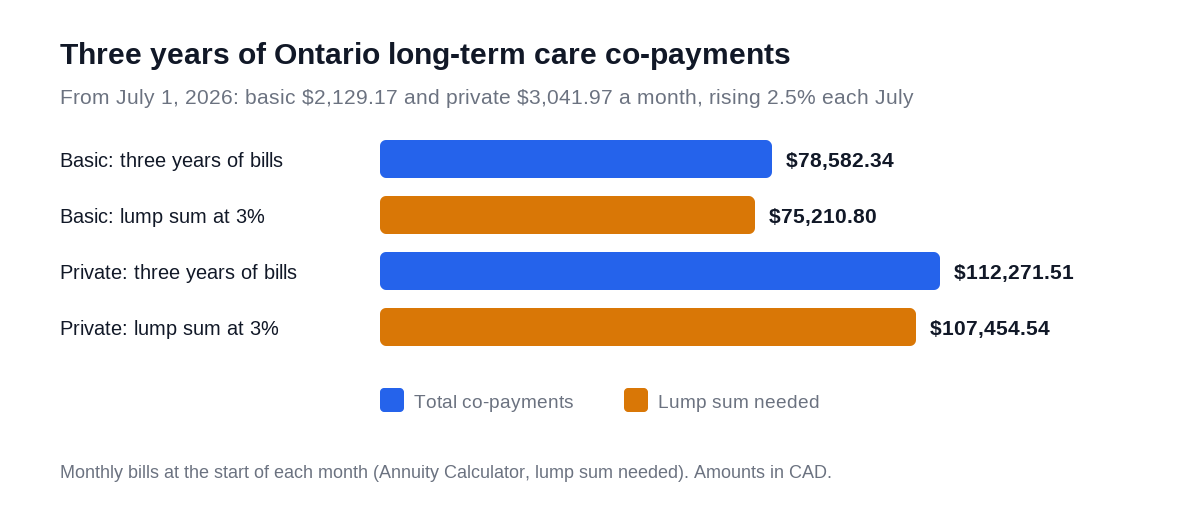
The gap between basic and private is about $33,700 over three years, before any rate reduction on the basic room.
Income comes first: Old Age Security, the Guaranteed Income Supplement, CPP and any workplace pension. For the part income does not cover, the Retirement Calculator shows whether savings stretch that far, and the Inflation Calculator projects today's rate to the year care might start.
Other provinces charge by income
Ontario's flat co-payment with an income-tested reduction is one model. British Columbia charges publicly subsidized long-term care at up to 80% of the resident's after-tax income: below $19,500 a year the monthly rate is after-tax income minus $3,900, divided by 12; at or above $19,500 it is 80% of after-tax income divided by 12, between a minimum and maximum monthly rate that are reset every year. Other provinces and territories set their own charges and rules on assets, so check your province's health ministry before comparing.
Tax credits: medical expenses or the disability amount
Two federal credits can apply. The figures below are for the 2026 tax year, when the fees in the example are charged, from CRA's indexation table; the 2026 editions of CRA's guides RC4065 and RC4064 were not yet published when this was written, so the rules are quoted from the 2025 editions.
Medical expense tax credit (line 33099, or 33199 for a dependant). Fees for full-time care in a nursing home count as medical expenses if Form T2201 is approved for the resident, or a medical practitioner certifies in writing that they depend on others for their personal needs and care because they lack normal mental capacity. You claim total eligible expenses minus the lesser of 3% of net income or $2,890 (2026; $2,834 for 2025), for any 12-month period ending in the tax year.
Disability tax credit (line 31600). The federal disability amount for 2026 is $10,341 ($10,138 for 2025) for an adult whose Form T2201 the CRA has approved: a severe and prolonged impairment, lasting or expected to last at least 12 months, with a marked restriction in an everyday activity. A supporting family member can transfer an unused amount.
You cannot claim both on the full fee. The CRA's rule is that you can claim the disability amount or the full-time nursing home fees, "but not both". The exception is the part of the fee the home identifies as salaries and wages for attendant care: with the disability amount, up to $10,000 of that can be claimed ($20,000 in the year of death). For Ontario residents the provincial limit was $17,627 for 2025; the 2026 figure was not yet in CRA's guide.
Worked on the basic room, with your father's net income at $30,000 (so the threshold is 3% of it, $900) and the 2026 federal credit rate of 14%, the lowest tax rate since Bill C-4 cut it from 15%:
| Choice | Credit calculation | Federal credit |
|---|---|---|
| Claim a year of basic fees, $25,550.04 | ($25,550.04 − $900) × 14% | $3,451.01 |
| Claim the disability amount plus $8,000 of attendant-care wages from the home's breakdown | $10,341 × 14% + ($8,000 − $900) × 14% | $2,441.74 |
Here the full fees win. The answer flips when the attendant-care share is large or the fees are low, so run both. These are non-refundable credits that only reduce tax owed, so if your father owes less than the credit, a family member who supports him may be able to claim his medical expenses on line 33199 instead. Provincial credits come on top; RC4065 gives Ontario's own limit for attendant-care wages.
This is general information. Provincial rules on admission, waitlists and rate reductions change, and the right tax claim depends on the whole family's returns, so check with the home's administrator and a tax professional before filing.
Tools for this job
- Annuity Calculator: the lump sum that three years of rising monthly co-payments need.
- Inflation Calculator: project today's co-payment to the year care might start.
- Savings Goal Calculator: the monthly saving that builds a care fund.
- Retirement Calculator: whether OAS, GIS, CPP and savings cover the bills.
- Caring for a Parent Checklist: the documents, benefits and care decisions when a parent needs help.
- Estate Planning Checklist: the will and powers of attorney to have in place before care is needed.
Saving for a goal when prices keep rising covers inflation, and how much to save for retirement sizes the whole pot.
Frequently asked questions
How much does long-term care cost per month in Ontario?
From July 1, 2026, the maximum co-payment is $2,129.17 a month ($70.00 a day) for a basic room, $2,567.17 for semi-private and $3,041.97 for private in a newer bed for residents admitted on or after July 1, 2015. Residents who cannot afford the basic co-payment can apply to the ministry for a rate reduction, renewed each July.
How often does the Ontario long-term care co-payment go up?
Every July 1. The basic rate rises by the inflation rate, capped at 2.5%: in 2026 the increase was 2.1%, from $68.56 to $70.00 a day. The newer-bed premiums rose from $14.10 to $14.40 a day (semi-private) and $29.39 to $30.01 (private). Residents receiving a rate reduction must reapply for each July-to-June cycle.
Can you claim long-term care home fees as a medical expense in Canada?
Yes, if the resident has an approved Form T2201 or a medical practitioner certifies their dependence because of a lack of normal mental capacity. The claim is fees minus the lesser of 3% of net income or $2,890 for 2026, and the federal credit is 14% of the result. Claiming the full fee rules out the disability amount for that person for the year.
Can you claim the disability tax credit and nursing home fees together?
Not for the full fee. The CRA lets you claim the disability amount or full-time nursing home fees, not both. You can combine the disability amount with the part of the fee that pays attendant-care wages, up to $10,000 ($20,000 in the year of death), if the home gives a breakdown. For 2026 the disability amount is $10,341, worth $1,447.74 at the 14% federal rate.
Sources and further reading
- Bulletin to residents of long-term care homes, spring 2026, Ontario Ministry of Long-Term Care (published by York Region). Co-payment rates from July 1, 2026, the rate formula and rate reduction renewal.
- Medical Expenses 2025 (RC4065), Canada Revenue Agency. The threshold, nursing home fees and the attendant-care limits.
- Disability-Related Information 2025 (RC4064), Canada Revenue Agency. The $10,138 disability amount, eligibility and transfers.
- Adjustment of personal income tax and benefit amounts, Canada Revenue Agency. The 2026 disability amount ($10,341) and medical expense threshold ($2,890).
- Report on the impact of reducing the lowest marginal personal income tax rate on non-refundable tax credits, Department of Finance Canada. The 14% rate for 2026 and the credits it applies to.
- Lines 33099 and 33199: eligible medical expenses, Canada Revenue Agency. Claiming for yourself or a dependant.
- Income Tax Folio S1-F1-C1, Medical Expense Tax Credit, Canada Revenue Agency. The statutory basis for the nursing home and disability credit rules.
- Long-term care services, Government of British Columbia. Income-based monthly rates for long-term care.