
Inflation and Savings in Canada: Goals in Future Dollars
How Statistics Canada measures inflation, how to set a down payment goal in future dollars, the bi-weekly saving it needs, and whether your HISA or TFSA keeps up.
By Redbison Dev · · 8 min read
Canada edition. Written for Canadian savers: Statistics Canada CPI figures in CA$, the Bank of Canada 2% target, a down payment goal saved every two weeks in a HISA, FHSA and TFSA limits, taxed interest, and CDIC coverage. US edition
Statistics Canada's CPI averaged 2.05% higher in 2025 than in 2024. A high-interest savings account paying 2.75% inside a TFSA beat that by about 0.69% in real terms. The same 2.75% outside a registered account, for someone with a 30% marginal tax rate, left 1.93% after tax and fell about 0.12% behind prices. Whether your savings keep up in Canada depends as much on the account they sit in as on the rate.
This edition covers how Canadian inflation is measured, how to state a goal such as a down payment in the dollars of the year you need it, and how to check your real return. The figures come from the Canada Inflation Calculator and the Canada Savings Goal Calculator, so you can reproduce each one. It is about the math, not which account or product to choose; a fee-only planner can help weigh an FHSA against the RRSP Home Buyers' Plan for your income.
How Statistics Canada measures inflation
The Consumer Price Index, all-items, is Canada's headline measure. Statistics Canada table 18-10-0005-01 gives its annual average back to 1914, on a 2002 = 100 base. To move an amount between years:
Value in year B = Amount × CPI(B) ÷ CPI(A)
The annual average was 44.0 in 1980 and 164.2 in 2025, so CA$100 of 1980 spending needs CA$373.18 in 2025, an average of 2.97% a year. A 1980 dollar buys about 27 cents of what it did then. From 2000 the answer is CA$172.12, or 2.20% a year.
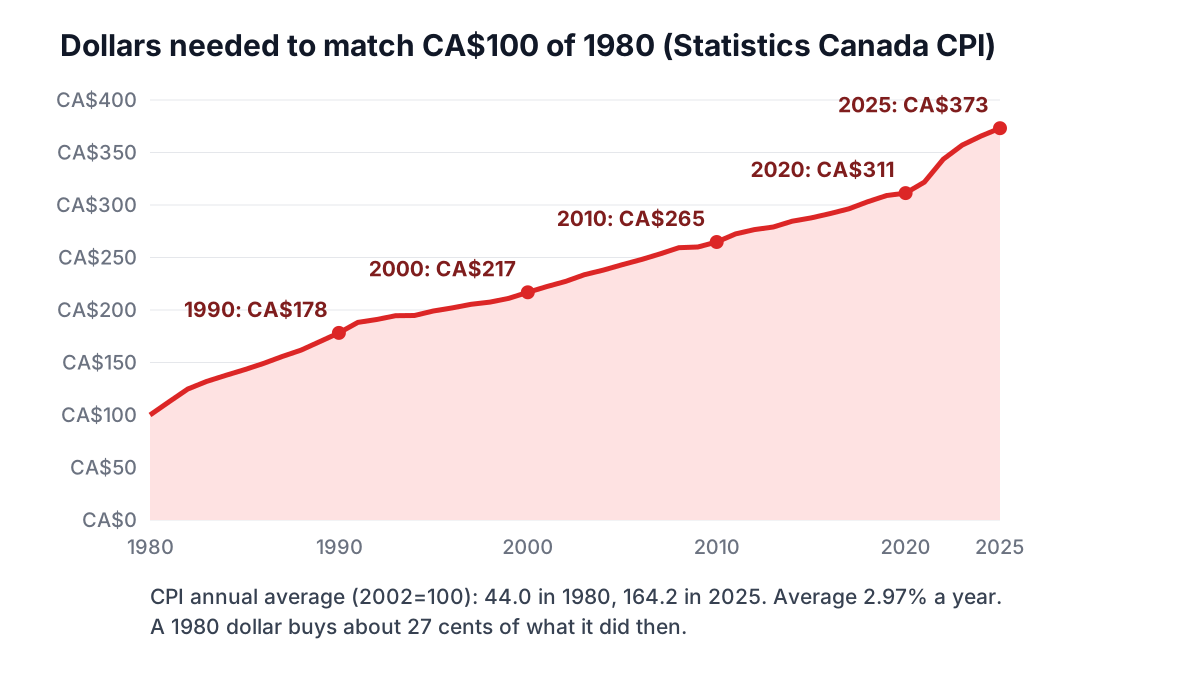
Recent years were rougher than the long average suggests: from 2020 to 2025 prices rose 19.85%, about 3.69% a year. Three cautions apply:
- Annual averages are not the monthly headline. The figure in the news is a 12-month change for one month, such as September against September. A whole-year comparison suits salaries and balances; it will not match one month's headline.
- Provinces differ. Statistics Canada publishes CPIs by province, and your own costs (rent in Toronto, fuel in rural Saskatchewan) may rise faster or slower than the national basket.
- Rules may name a different measure. Rent guidelines, contract escalators and tax indexing often use a specific month or index, so check the rule before quoting a calculator result.
The 2% target and projecting forward
The Bank of Canada aims to keep total CPI inflation at 2%, the midpoint of a 1% to 3% control range, under an agreement with the federal government that was renewed in 2026 for January 2027 to December 2031 (Bank of Canada inflation-control target). That makes 2% a natural central case and 3%, the top of the range, a cautious one.
Future cost = Today's cost × (1 + r)^years
At 2%, CA$100 of spending today costs CA$121.90 in ten years. Prices double in about 35 years at 2% and about 23 at 3%. CPP payments are raised each January in line with the CPI, and OAS is reviewed quarterly, so part of a retiree's income keeps up automatically; personal savings do not.
Worked example: a down payment in five years
A couple in Ottawa want a CA$40,000 down payment in present-day dollars, which under the FCAC down payment rules is the minimum on a CA$650,000 home (5% of the first CA$500,000 and 10% of the rest). They have CA$5,000 saved, will save from each bi-weekly pay cheque, and assume a HISA at 2.75% compounded monthly.
| Goal used in the plan | Goal in 5 years | Saving every two weeks |
|---|---|---|
| CA$40,000 (today's dollars, no inflation) | CA$40,000.00 | CA$246.01 |
| Inflated at 2% a year | CA$44,163.23 | CA$275.90 |
| Inflated at 3% a year | CA$46,370.96 | CA$291.76 |
The plan that ignores inflation reaches CA$40,000 on time and is about CA$4,200 short if home prices rise 2% a year, or CA$6,400 at 3%. House prices do not follow the CPI, so treat these rates as a floor for that goal rather than a forecast. The routine is:
- In the Canada Inflation Calculator, choose Assumed inflation rate and turn today's CA$40,000 into the figure for the purchase year.
- Enter that figure as the goal in the Canada Savings Goal Calculator, choose Every two weeks, and solve for the deposit.
Fitting it into an FHSA
The First Home Savings Account gives CA$8,000 of contribution room a year, with up to CA$8,000 of unused room carried forward and a CA$40,000 lifetime limit (CRA FHSA definitions). At 2% inflation the couple's deposits come to CA$7,173.40 a year (26 x CA$275.90) and CA$35,867.61 over five years, inside both limits for one holder. Contributions are deductible and a qualifying withdrawal is not taxed, so in an FHSA the 2.75% is not taxed either. Splitting the saving across two FHSAs, one each, doubles the room.
Real returns: is your account keeping up?
Real rate = (1 + rate after tax) ÷ (1 + inflation) − 1
Interest outside a TFSA, FHSA or RRSP is taxed every year at your marginal rate (CRA line 12100). The table uses a 30% marginal rate as an example; yours depends on your province and income.
| Inflation | HISA 2.75% in a TFSA | HISA 2.75% taxed at 30% (1.925%) |
|---|---|---|
| 2.05% (2025 average rise) | +0.69% | −0.12% |
| 2% (Bank of Canada target) | +0.74% | −0.07% |
| 3% (top of the control range) | −0.24% | −1.04% |
At these rates a taxed savings account roughly treads water at best, which is the main argument for using TFSA room (CA$7,000 for 2026, per the CRA limits page) for cash you are holding for a goal.
Money left for ten years
CA$7,000 left for ten years at 2.75% compounded monthly grows to CA$9,212.82, worth CA$7,557.72 in present-day dollars if inflation averages 2%. Put in CA$7,000 every January for ten years at the same rate and the TFSA holds CA$81,669.66, about CA$67,000 in present-day dollars at 2%. The balance tells you how many dollars you have; the inflation calculator tells you what they will buy.
Safety: CDIC coverage
The Canada Deposit Insurance Corporation covers eligible deposits, including GICs, up to CA$100,000 per category at each member institution, and a TFSA, an FHSA and an RRSP are each a separate category (CDIC coverage). A down payment held in an FHSA and a non-registered HISA at the same bank is covered as two categories.
A short checklist
- State the goal in the dollars of the year you need it, at 2% and 3%.
- Match the deposit to your pay: every two weeks gives 26 deposits a year.
- Compare the after-tax rate with inflation, and use TFSA or FHSA room for goal money where you can.
- Check your room in CRA My Account before large deposits; over-contributions are taxed.
- Rerun the plan each January, when new room opens and Statistics Canada has published the year's average, and raise the deposit rather than shrinking the goal.
Frequently asked questions
What is an old amount of money worth today in Canada?
On the Statistics Canada CPI annual averages, CA$100 of 1980 spending needs CA$373.18 in 2025, an average of 2.97% a year. A 1980 dollar buys about 27 cents of what it did then.
Does a high-interest savings account beat inflation in Canada?
In 2025, a 2.75% HISA held in a TFSA beat the 2.05% rise in the annual CPI by about 0.69%. Outside a registered account, taxed at a 30% marginal rate, it kept 1.925% and fell about 0.12% behind.
What inflation rate should I use for a Canadian savings goal?
The Bank of Canada's 2% target is a sensible central case and 3%, the top of its 1% to 3% control range, a cautious one. For a house, remember that prices do not follow the CPI, so treat the result as a minimum.
How do I add inflation to a down payment goal?
Multiply today's figure by (1 + inflation) raised to the number of years and save towards the result. CA$40,000 in five years at 2% becomes CA$44,163.23, which needs CA$275.90 every two weeks at 2.75% with CA$5,000 already saved, rather than CA$246.01.
Why does the calculator differ from the inflation rate in the news?
The monthly Statistics Canada release reports the change over 12 months to one month. The calculator compares annual averages, whole year against whole year, so the two differ when inflation is rising or falling.
Sources and further reading
- Consumer Price Index, annual average (table 18-10-0005-01), Statistics Canada. Annual CPI from 1914, 2002 = 100.
- Inflation-control target, Bank of Canada. The 2% target and its renewal to 2031.
- Definitions for FHSAs, Canada Revenue Agency. CA$8,000 yearly and CA$40,000 lifetime limits.
- MP, DB, RRSP, DPSP, ALDA, TFSA limits and the YMPE, Canada Revenue Agency. The CA$7,000 TFSA dollar limit for 2026.
- Line 12100: Interest and other investment income, Canada Revenue Agency. Interest is taxed yearly.
- Saving for a down payment, Financial Consumer Agency of Canada. Minimum down payment rules.
- What's covered, Canada Deposit Insurance Corporation. CA$100,000 per category.
Open the Savings Goal Calculator
More Calculators
Every tool in the Calculators section, free and in your browser.
- Investment Calculator
- Compound Interest Calculator
- Simple Interest Calculator
- Interest Calculator
- EMI Calculator
- Retirement Calculator
- Time-Weighted Return Calculator
- Savings Goal Calculator
- Inflation Calculator
- CAGR Calculator
- ROI Calculator
- Present and Future Value Calculator
- NPV and IRR Calculator
- 401(k) Calculator
- Roth IRA Calculator
- APY and CD Calculator
- SIP Calculator
- Annuity Calculator
- Bond Price and Yield Calculator
- Currency Converter
- Dividend Calculator
- Stock Average Calculator
- RMD Calculator