
Long-Term Care Costs in the US: What Pays and How to Plan
Medicare pays only short skilled nursing stays. Medicaid limits and the 60-month look-back, insurance and HSA tax rules, and what three years of care costs.
By Redbison Dev · · 11 min read
You are 60, a parent has just moved into a nursing home, and you want to know what the same care would cost you. In the US, Medicare pays only for short skilled nursing stays, Medicaid is the largest single payer once your assets are spent down, and the rest comes from savings or insurance. Indiana's official average private-pay nursing home rate is $8,027 a month for applications filed from July 1, 2026; at the 3.4% a year that figure has grown since 2002, it reaches $18,517 a month by age 85, and three years of care starting then needs a pot of about $650,334.
What Medicare pays, and where it stops
Medicare covers a skilled nursing facility (SNF) stay only after an inpatient hospital stay of at least three days in a row, generally with admission within 30 days of discharge; time under observation or in the emergency room does not count. Per benefit period:
| SNF days in a benefit period | You pay in 2026 | You pay in 2027 |
|---|---|---|
| Days 1 to 20 | $0 a day | $0 a day |
| Days 21 to 100 | $217 a day | $222 a day |
| Day 101 on | All costs | All costs |
A full 100-day stay in 2026 leaves you $17,360 of coinsurance (80 days at $217), which a Medigap policy may cover. After that, or as soon as you need only help with bathing, dressing and eating, Medicare's long-term care page is blunt: "Medicare doesn't pay for long-term care." The hospital stay that qualifies you carries the 2026 Part A deductible of $1,736.
How likely you are to need it, and for how long
The best federal estimate is the ASPE research brief Long-Term Services and Supports for Older Americans: Risks and Financing, 2022. Using microsimulation, it finds that 56% of Americans turning 65 will develop a disability serious enough to need long-term services and supports, and 22% will have one lasting more than five years. Women carry more of the risk: 64% against 49% for men, and 26% of women need five or more years.
That definition is strict: help with at least two activities of daily living for 90 days or more, or severe cognitive impairment, the same trigger a tax-qualified policy uses. LongTermCare.gov, run by the Administration for Community Living, gives a higher figure, "almost a 70% chance", but its 2020 page names no study or definition, and ASPE notes that broader definitions give higher estimates. This guide follows ASPE, whose method is published.
From the same brief, the average American turning 65 will incur $120,900 of future long-term care costs in 2020 dollars. Families pay 37% out of pocket, Medicaid pays 43%, and private insurance pays 5%. One in seven (14%) will spend at least $100,000 of their own money.
Medicaid: the main payer, and its limits
Medicaid pays for nursing home care and many home and community-based services once income and assets fall under state limits. States set the applicant's own asset limit; the SSI resource standard in the CMS chart is $2,000 for an individual in 2026. For married couples the federal spousal impoverishment rules protect the spouse at home. The 2026 figures from the CMS informational bulletin of April 27, 2026:
| 2026 standard | Amount |
|---|---|
| Community spouse resource standard | $32,532 minimum, $162,660 maximum |
| Maximum monthly maintenance needs allowance | $4,066.50 |
| Minimum monthly maintenance needs allowance (from July 1, 2026, all states except Alaska and Hawaii) | $2,705.00 |
| Home equity limit | $752,000 minimum, $1,130,000 maximum (state choice) |
The home equity limit does not apply while a spouse, a child under 21 or a blind or disabled child lives in the home. From January 1, 2028, Public Law 119-21 section 71108 exempts a home on a lot zoned for agricultural use and caps a state's higher option for other homes at $1,000,000.
The 60-month look-back. Assets given away or sold below value in the 60 months before applying trigger a penalty period (42 U.S.C. 1396p(c)). The months of ineligibility are the gift divided by the state's average monthly private-pay nursing home cost. In Indiana, a $50,000 gift to a grandchild made two years before applying means $50,000 / $8,027 = 6.23 months in which Medicaid will not pay for the nursing home, and the penalty starts only once the applicant is otherwise eligible.
Estate recovery. States must seek repayment of long-term care costs from the estates of enrollees who were 55 or older when they received care, deferred while a spouse, a child under 21 or a blind or disabled child survives (42 U.S.C. 1396p(b)).
What three years of care could cost you
Industry cost surveys are not public records, so this example starts from an official number: every state Medicaid agency sets an average monthly private-pay nursing home cost to compute look-back penalties, and Indiana's FSSA manual lists its figure for every year since 2002.
- Find the growth rate. In the CAGR Calculator, choose to find the rate, enter a beginning value of 3,598 (Indiana, applications from July 1, 2002), an ending value of 8,027 (from July 1, 2026) and 24 years. It gives 3.40% a year. The last 10 years alone (6,078 to 8,027) give 2.82%.
- Project the monthly cost. In the Inflation Calculator, choose an assumed inflation rate, future cost of today's amount, amount 8,027, rate 3.4% and 20 or 25 years.
- Size the pot. In the Annuity Calculator, choose lump sum needed, payment per month equal to the projected cost, 4% interest, 3 years, monthly, a 3.4% yearly increase and payments at the start of each period.
| Care starts at | Years from age 60 | Monthly cost at 3.4% | Monthly cost at 5% | Pot needed at 3.4%, 3 years of care |
|---|---|---|---|---|
| Today | 0 | $8,027 | $8,027 | |
| Age 80 | 20 | $15,666 | $21,298 | $550,205 |
| Age 85 | 25 | $18,517 | $27,182 | $650,334 |
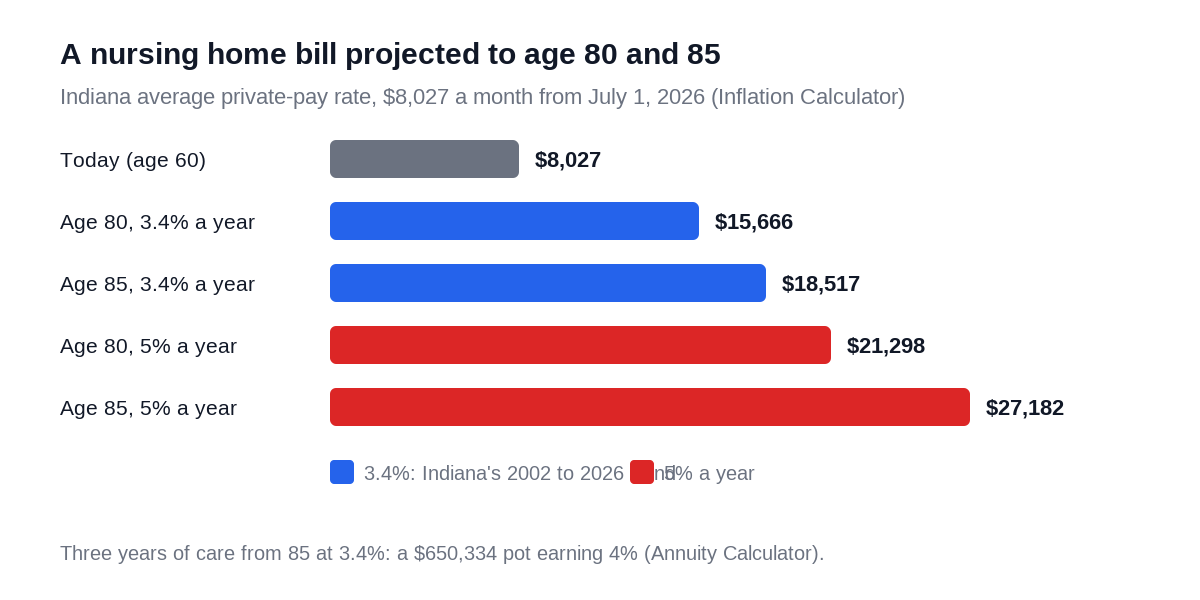
Pots use the rounded costs shown. The 36 monthly bills from age 85 add up to $689,534; the pot is smaller because the unspent part earns 4% meanwhile. To build $650,334 in 25 years, the Savings Goal Calculator (monthly deposits at the end of each month, monthly compounding) asks for $1,092.06 a month at 5%, or $1,264.92 at 4%.
Three years is a moderate case, not a worst one. ASPE puts 22% of people turning 65 at more than five years of need (26% of women), and those with any need average 5.4 years. Set the Annuity Calculator to 5 years and the pot at 85 becomes $1,076,900, or $1,808.37 a month saved over 25 years at 5%. Your state's rate may also be far from Indiana's. The Retirement Calculator carries a long-term care fund of $150,000 by default; replace it with the pot your own state's figure produces.
Insurance: traditional, hybrid and partnership policies
Traditional long-term care insurance pays a daily or monthly benefit after an elimination period. The NAIC's Shopper's Guide to Long-Term Care Insurance warns that the company cannot raise your premium because you claimed or your health changed, but it "can raise the premiums for an entire class of policies", and inflation protection and nonforfeiture benefits add substantially to the price.
Hybrid (combination) policies attach long-term care benefits to life insurance or an annuity, usually as a rider that accelerates the death benefit: unused, it goes to your heirs; each dollar paid for care reduces it. The NAIC notes that a life policy with a long-term care rider must follow the same laws as a standalone policy, and many such riders are tax-qualified. Benefits paid for a chronically ill insured are treated as death proceeds under 26 U.S.C. 101(g).
Partnership policies are tax-qualified policies approved under a state's partnership program. If you later apply for Medicaid, the state disregards assets equal to the benefits the policy paid, and does not recover them from your estate (42 U.S.C. 1396p(b)(1)(C)): a policy that paid $200,000 lets you keep $200,000 more than the normal limit. The statute requires compound inflation protection if you buy before 61 and some inflation protection from 61 to 75; from 76 it is optional. Not every state runs a program, so check with your state insurance department.
Tax rules: deductions, HSAs and 401(k) money
A tax-qualified policy's premiums count as medical expenses up to an age-based limit. For 2026, Rev. Proc. 2025-32 sets these limits per person:
| Age at the end of 2026 | Premium that counts as a medical expense |
|---|---|
| 40 or under | $500 |
| 41 to 50 | $930 |
| 51 to 60 | $1,860 |
| 61 to 70 | $4,960 |
| Over 70 | $6,200 |
Itemizers deduct only medical expenses above 7.5% of adjusted gross income, so many people get nothing from this. Benefits from a tax-qualified policy are generally tax-free. A policy that pays a fixed daily amount whatever the bills are can pay up to $430 a day tax-free in 2026, or your actual costs if higher (26 U.S.C. 7702B(d)).
HSAs. A health savings account can pay qualified long-term care premiums tax-free, up to the same age limits (IRS Publication 969); how an HSA works covers the account itself. The 2026 contribution limits are $4,400 for self-only and $8,750 for family coverage, plus $1,000 from age 55, and contributions stop once you enroll in Medicare. At 62 it can pay up to $4,960 of 2026 premiums tax-free. After 65, money drawn for anything else is taxed as income but carries no 20% penalty.
401(k) money. From December 30, 2025, SECURE 2.0 section 334 lets a defined contribution plan allow qualified long-term care distributions (IRC 401(a)(39)): the least of your premiums for certified long-term care coverage, 10% of your vested balance, or $2,600 for 2026 (IRS Notice 2026-33). The plan needs a long-term care premium statement from your insurer, which the insurer can file only after the IRS acknowledges its Issuer Disclosure for that product (Q&A A-1 to A-4). The 10% early-withdrawal tax does not apply (72(t)(2)(N)), except for spouse coverage on a married-filing-separately return, but the money is still taxable income, and plans do not have to offer it.
This is general information for US residents. Before gifts made with Medicaid in mind, or a large single-premium policy, pay for an hour with an elder law attorney or a fee-only adviser.
Tools for this job
- Inflation Calculator: project today's care cost to the age you expect to need it.
- CAGR Calculator: turn your state's published rate history into an annual growth rate.
- Annuity Calculator: the lump sum a run of rising monthly care bills needs.
- Savings Goal Calculator: the monthly saving that builds that lump sum.
- Retirement Calculator: fold the care fund into your whole retirement plan.
- Caring for a Parent Checklist: the documents, benefits and care decisions when a parent needs help.
- Estate Planning Checklist: the will, powers of attorney and health care directive to have before care is needed.
- US Retirement Records Checklist: the official sites, medicaid.gov included, as an editable list.
The 11 US retirement websites to bookmark covers medicaid.gov and the Eldercare Locator; the retirement savings guide sizes the whole pot, and saving for a goal when prices keep rising covers inflation.
Frequently asked questions
Does Medicare pay for a nursing home?
Only for a skilled nursing facility stay after at least three consecutive days as a hospital inpatient, and only for up to 100 days per benefit period. Days 1 to 20 cost nothing; days 21 to 100 cost $217 a day in 2026 and $222 in 2027. Medicare does not pay for custodial long-term care, such as help with bathing and dressing.
How much can you give away before applying for Medicaid?
Any gift or below-value sale in the 60 months before applying can delay coverage. The penalty in months equals the gift divided by your state's average monthly private-pay nursing home cost; in Indiana that figure is $8,027 for applications from July 1, 2026, so a $50,000 gift costs about 6.2 months. The IRS annual gift tax exclusion does not protect a gift from this rule.
Is long-term care insurance tax deductible?
Premiums for a tax-qualified policy count as medical expenses up to an age-based limit, which for 2026 ranges from $500 at 40 or under to $6,200 over 70. Itemizers deduct only medical expenses above 7.5% of adjusted gross income. An HSA can pay the same premiums tax-free up to those limits.
What is a long-term care partnership policy?
It is a tax-qualified policy sold under a state partnership program. If you later need Medicaid, the state lets you keep assets equal to what the policy paid out, on top of the normal asset limit. Buyers under 61 must get compound inflation protection. Not every state has a program; your state insurance department lists approved policies.
Sources and further reading
- Skilled nursing facility care, Centers for Medicare & Medicaid Services. The three-day rule, the Part A deductible and the 2026 and 2027 daily amounts.
- A Shopper's Guide to Long-Term Care Insurance, National Association of Insurance Commissioners. Class-wide premium increases, combination policies and partnership policies.
- Updated 2026 SSI and Spousal Impoverishment Standards, Centers for Medicare & Medicaid Services. Resource, income and home equity standards.
- 42 U.S.C. 1396p, Liens, adjustments and recoveries, and transfers of assets, Legal Information Institute. The look-back, penalty divisor, partnership disregard, estate recovery and home equity rules.
- Long-Term Services and Supports for Older Americans: Risks and Financing, 2022, HHS Office of the Assistant Secretary for Planning and Evaluation. The 56% risk estimate and lifetime costs by payer.
- Facility rate used to calculate penalty period, Indiana Family and Social Services Administration. The state's average private-pay rate for each year since 2002.
- Rev. Proc. 2025-32, Internal Revenue Service. The 2026 long-term care premium limits and the $430 per diem.
- Notice 2026-33, Guidance on Qualified Long-Term Care Distributions, Internal Revenue Service. The 401(k) distribution rule and its $2,600 limit for 2026.