
Paying for a Care Home in England: Means Test and Options
The care home means test in England: the £23,250 and £14,250 capital limits, when the house counts, deferred payments, NHS funding and Attendance Allowance.
By Redbison Dev · · 11 min read
United Kingdom edition. UK edition in pounds: the council means test in England for the 2026 to 2027 year, deferred payment agreements at the July to December 2026 rate, NHS funding, and how Scotland, Wales and Northern Ireland differ. US edition
Your mother, widowed, has moved permanently into a care home in England charging £1,300 a week. She owns a house worth £240,000 and has £60,000 in savings. The council will not help with the fees until her capital, house included, is at or below £23,250, unless someone protected by the rules still lives in the house. Her savings will cover the first 42 weeks or so; after that the house either gets sold or the council lends against it through a deferred payment agreement, which at 4.65% a year turns £132,600 of deferred fees into a debt of £142,128 after three years.
The £1,300 fee, her income and the house value are illustrations. Every council publishes its own charging policy; the national rules below are the floor they work from.
The means test in England
The Department of Health and Social Care's charging circular for 2026 to 2027 keeps the capital limits at their current level:
| Your capital | What you pay |
|---|---|
| Over £23,250 (upper capital limit) | The full cost of your care |
| £14,250 to £23,250 | Your assessed income plus "tariff income" of £1 a week for every £250 (or part of £250) above £14,250 |
| Under £14,250 (lower capital limit) | From your income only; the capital is ignored |
In a care home, nearly all your income goes towards the fee, but you keep a personal expenses allowance of at least £31.80 a week (up from £30.65). At home, the council must leave you at least the minimum income guarantee, £241.45 a week for a single person over Pension Credit age.
Tariff income in practice: with £20,000 left, £5,750 sits above the lower limit, which is 23 lots of £250, so the council assumes £23 a week of extra income on top of pensions and benefits.
There is no lifetime cap on care costs in England: the £86,000 cap planned for October 2023 was postponed, then cancelled after the Chancellor's announcement of 29 July 2024, so a long stay can use up everything above the lower limit. Councils have some room to charge less than the national rules allow, for example by disregarding more income or capping charges for care at home, so read your council's charging policy as well as the national figures.
When the house counts, and when it does not
Care at home, or a temporary stay in a care home, never brings the value of your main home into the test. A permanent move does, with exceptions set out in the Care and Support Statutory Guidance:
- 12-week disregard. The home is ignored for the first 12 weeks after you first become a permanent resident, or for 12 weeks after a protected relative living there dies or moves into care.
- Mandatory disregard. The home is ignored for as long as it is occupied, since before you went into care, by your partner or former partner (unless estranged), by a relative who is 60 or over or incapacitated, or by your child under 18.
- Discretion. The council may also choose to ignore it in other circumstances; ask what its policy covers.
Giving the house or savings away to get under the limits does not work: capital you have deprived yourself of to reduce the charge is counted as "notional capital" as if you still had it.
The worked example: savings first, then the house
Your mother's income is £300 a week from her State Pension and a small private pension, and she claims the higher rate of Attendance Allowance, £114.60 a week in 2026 to 2027. GOV.UK says you can keep claiming it if you pay all your care home costs yourself, but usually not once the council pays for the care, so tell the Department for Work and Pensions if that happens.
- Weekly shortfall. £1,300 minus £300 minus £114.60 is £885.40 a week from savings.
- Weeks 1 to 12, house ignored. Her £60,000 is still above £23,250, so she pays the full fee. Twelve weeks cost £10,624.80, leaving £49,375.20.
- From week 13, house counted. Her capital is now about £289,000 and she self-funds. A deferred payment agreement is open only to someone whose capital apart from the home is at or below £23,250, so she reaches that point after about 29.5 more weeks, around week 42.
- Then sell or defer. Selling pays the fees from the proceeds. Deferring means the council pays the home and adds the cost to a loan secured on the house, repaid when it is sold or from the estate.
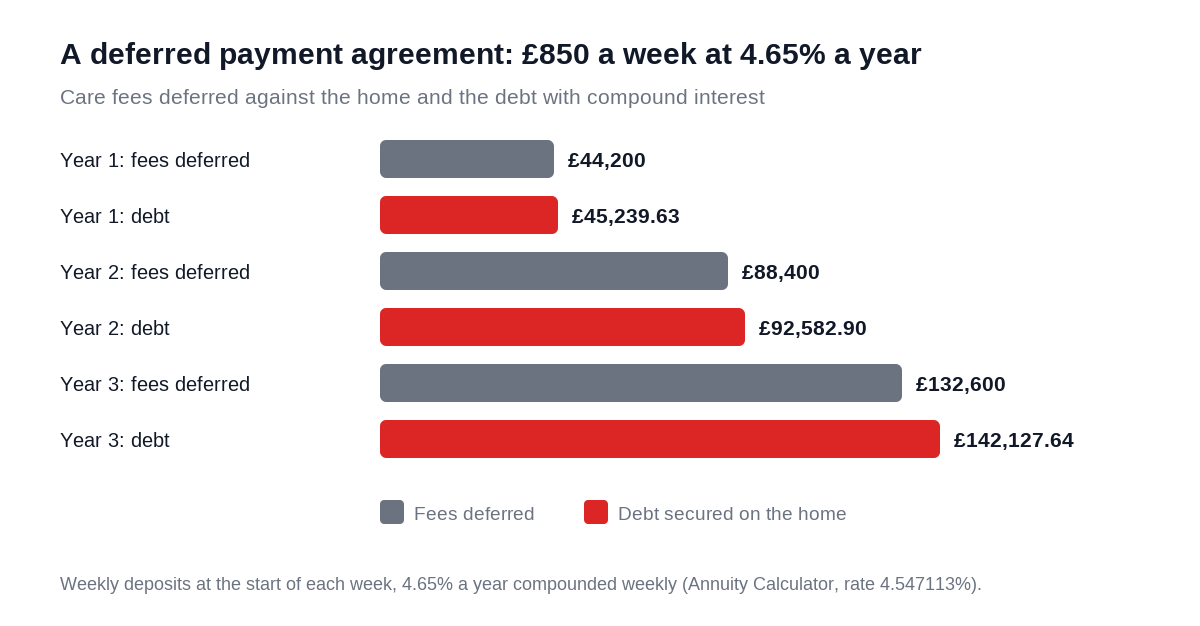
How fast the debt grows comes from the Annuity Calculator: growth of deposits, £850 deposited each week (52 a year) at the start of the week. The calculator divides its rate by 52, so enter 4.547113%: compounded weekly, that is exactly 4.65% a year, the rate as councils quote it.
| Deferring £850 a week | Fees deferred | Debt with interest at 4.65% |
|---|---|---|
| 1 year | £44,200 | £45,239.63 |
| 2 years | £88,400 | £92,582.90 |
| 3 years | £132,600 | £142,127.64 |
The £850 is the part of the fee her income does not cover; the council works out the real figure, and must let her keep a disposable income allowance of up to £144 a week if she wants it. The interest rate is capped nationally and changes on 1 January and 1 July, tracking the gilt rate in the Office for Budget Responsibility's latest forecast plus 0.15%. West Sussex, for example, charges 4.65% compound interest until 31 December 2026, plus a £721 set-up fee and £10.80 a week; other councils publish their own rate and fees. The loan stops growing at an equity limit tied to the house's value, so the agreement can end before the money runs out if the stay is long or the house falls in value.
To check whether savings would last instead, size the pot for three years of the £885.40 weekly shortfall in the same calculator (lump sum needed, 52 payments a year, a 4% yearly rise in fees, 3% interest): about £137,377.
NHS funding: continuing healthcare and nursing care
- NHS continuing healthcare. If her needs are mainly health needs, the NHS arranges and pays for all of her care, including the care home fee, and the means test does not apply. Eligibility depends on assessed needs, not on a diagnosis. It starts with a checklist, then a full assessment with the decision support tool. Ask for the checklist before a hospital discharge into a care home, and ask for written reasons if she is turned down.
- NHS-funded nursing care. Someone who does not qualify but lives in a nursing home with assessed nursing needs gets the NHS's contribution paid to the home: £267.68 a week from 1 April 2026, the same across England.
Scotland, Wales and Northern Ireland are different
| Nation (2026 to 2027) | Capital limits for a care home | Notable differences |
|---|---|---|
| England | £23,250 upper, £14,250 lower | Tariff income between the limits |
| Scotland | £36,750 upper, £22,750 lower (from 6 April 2026) | Free personal care of £260.30 a week and free nursing care of £117.10 a week, whatever your means; Pension Age Disability Payment replaces Attendance Allowance |
| Wales | One limit of £50,000 for residential care | Home care charges capped at £100 a week, with a £24,000 capital limit for care at home |
| Northern Ireland | £23,250 upper, £14,250 lower | The Health and Social Care Trust pays £100 a week towards nursing in a nursing home; the home counts 12 weeks after a permanent move |
Tools for this job
- Annuity Calculator: how fast a deferred payment debt grows, or the pot that three years of fees needs.
- Inflation Calculator: what today's weekly fee could become by the time care starts.
- Savings Goal Calculator: the monthly saving that builds a care fund.
- Retirement Calculator: fold a care fund into the whole retirement plan.
- Caring for a Parent Checklist: the assessments, benefits and paperwork when a parent needs care.
- Estate Planning Checklist: the will and Lasting Power of Attorney to have in place before care is needed.
Saving for a goal when prices keep rising covers the inflation side of a care fund.
This is general information for England, with notes on the other nations. Councils' policies differ in detail, so before selling a home or signing a deferred payment agreement, read your council's charging policy and take advice from a solicitor or a regulated adviser who specialises in care fees.
Frequently asked questions
Will I have to sell my house to pay for a care home in England?
Not while you receive care at home, nor for the first 12 weeks of a permanent care home stay, nor while a partner, your child under 18, or a relative who is 60 or over or incapacitated still lives there. Otherwise the home counts, but a deferred payment agreement lets the council recover the fees from the house later instead of forcing a sale.
What are the care home capital limits in England?
For the 2026 to 2027 year the upper capital limit is £23,250 and the lower limit £14,250. Above £23,250 you pay the full cost. Between the two, the council adds £1 a week of tariff income for every £250 above £14,250 to your assessed income. Below £14,250 your capital is ignored and you contribute from income only.
What interest does a deferred payment agreement charge?
Councils may charge up to a national maximum that changes on 1 January and 1 July: the gilt rate in the Office for Budget Responsibility's latest forecast plus 0.15%. West Sussex, for example, charges 4.65% compound interest until 31 December 2026. Councils can add set-up and running costs, which their charging policies list.
Who pays if someone qualifies for NHS continuing healthcare?
The NHS arranges and pays for all of the care, including care home fees, and there is no means test. Eligibility rests on assessed health needs rather than a diagnosis, starting with a checklist and then a full assessment. People who do not qualify but need nursing in a nursing home get £267.68 a week of NHS-funded nursing care.
Can you get Attendance Allowance in a care home?
Yes, if you pay all your care home costs yourself; it usually stops once the council pays for the care. It is £76.70 or £114.60 a week in 2026 to 2027, for people over State Pension age with a disability or health condition. In Scotland the equivalent is Pension Age Disability Payment.
Sources and further reading
- Social care charging for care and support: 2026 to 2027 local authority circular, Department of Health and Social Care. Capital limits, tariff income, the personal expenses allowance and minimum income guarantee.
- Care and support statutory guidance, Department of Health and Social Care. Property disregards, notional capital, deferred payment eligibility, interest and the disposable income allowance.
- Build Back Better: our plan for health and social care, Department of Health and Social Care. The £86,000 cap and the note that the reforms will not go ahead after 29 July 2024.
- Deferred payment scheme, West Sussex County Council. The 4.65% rate to 31 December 2026 and a council's fees.
- NHS continuing healthcare, NHS. Eligibility, the checklist and the decision support tool.
- Better community care thanks to nursing funding boost, Department of Health and Social Care, 9 March 2026. The £267.68 weekly NHS-funded nursing care rate.
- Attendance Allowance, GOV.UK. The 2026 to 2027 weekly rates, the care home rule and Pension Age Disability Payment in Scotland.
- Charging for Residential Accommodation Guidance, Circular CCD 1/2026, Scottish Government (copy published by Renfrewshire Council). Scotland's 2026 to 2027 capital limits and free personal and nursing care payments.
- Paying for care and support services: a guide for constituents, Senedd Research, July 2026. The £50,000 Welsh capital limit and £100 weekly cap.
- Paying your residential care or nursing home fees, nidirect. Northern Ireland's capital limits and nursing contribution.