
Pre-Tax vs After-Tax Retirement Accounts: 401(k), IRA, Roth
Which retirement money is taxed going in, while growing and coming out, what each 401(k) and IRA box is, and when a backdoor or mega backdoor Roth applies.
By Redbison Dev · · 9 min read
Your benefits portal offers three boxes for 401(k) money: pre-tax, Roth and after-tax. Pre-tax money (a traditional 401(k) or a deductible IRA) skips federal income tax now and is taxed in full when it comes out. Roth money (a Roth 401(k) or Roth IRA) is taxed now and comes out tax free once the withdrawal is qualified, normally after 59½ and five years. The third box, after-tax money that is not Roth, is taxed going in and again on its earnings coming out, unless it is converted to Roth: that conversion is what the backdoor and mega backdoor Roth are. In the US for 2026 the 401(k) deferral limit is $24,500 and the ceiling on everything added to a 401(k) account is $72,000; the gap between the two is what the mega backdoor uses.
This post is the map: what each account is, where the tax falls, and when the two backdoors apply. The limits in full, the employer match and the Roth-or-traditional inequality are in the guide to 401(k), Roth IRA and annuity maths. It explains federal rules, not your return; with a pension, self-employment income or a large rollover IRA, check a conversion with a tax professional first.
Three kinds of money, not two
Every dollar in a US retirement account has one of three tax statuses, and the account name does not always tell you which.
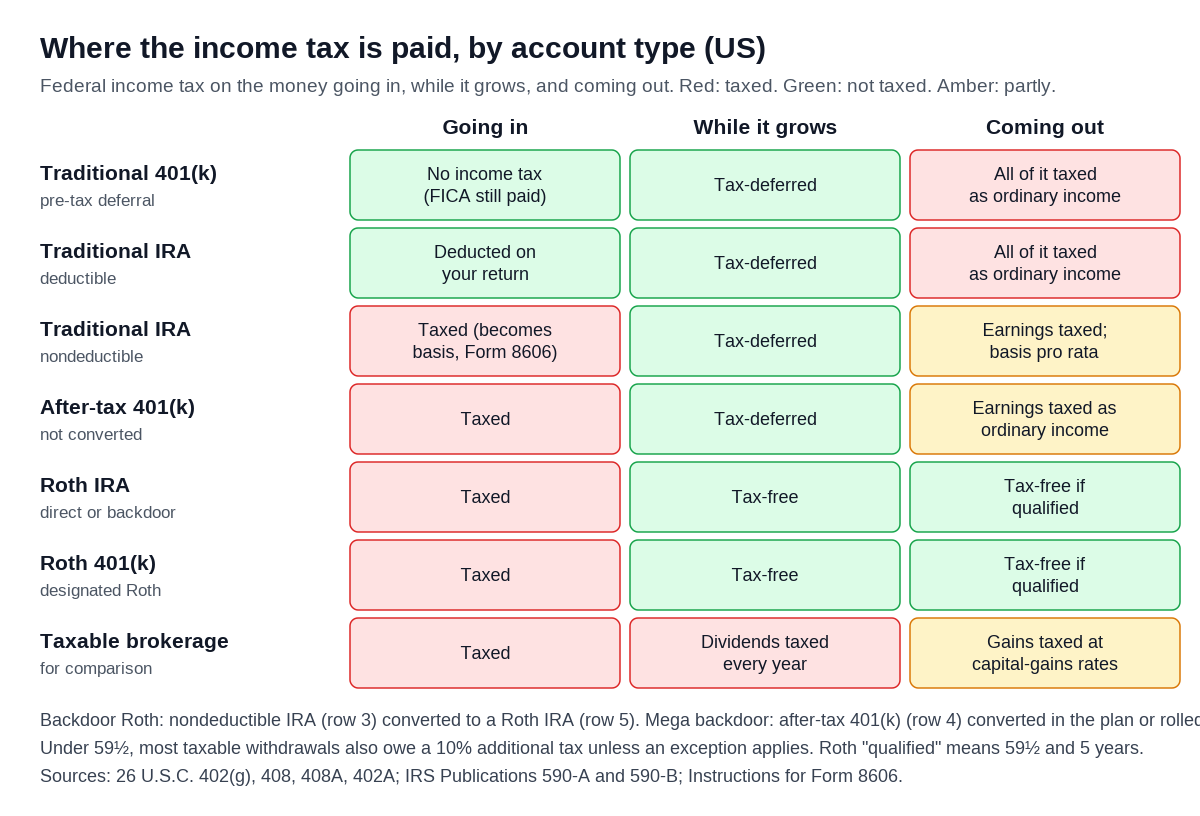
Three things the matrix shows that most comparisons skip:
- Pre-tax still pays FICA. A traditional 401(k) deferral escapes income tax, not Social Security and Medicare tax. The Paycheck Calculator shows the two lines move separately.
- Basis is money you already paid tax on. In a nondeductible IRA or an after-tax 401(k) subaccount, basis comes back tax free but its earnings are taxed as ordinary income, at the same rate as a paycheck. A brokerage account gets capital-gains rates on the same growth.
- Roth is the only box where earnings are never taxed, provided the withdrawal is qualified. Roth IRAs have no required minimum distributions while the owner is alive, and the IRS RMD FAQ says the same of Roth accounts in 401(k) and 403(b) plans. Traditional money must start coming out at 73 (75 if you were born in 1960 or later); see the RMD guide.
What each account is, and who can use it
| Account | What goes in | Income test | Coming out |
|---|---|---|---|
| Traditional 401(k) or 403(b) | Pre-tax payroll deferrals, plus employer money | None | Taxed as income; 10% extra before 59½ unless an exception applies |
| Roth 401(k) (designated Roth) | Taxed payroll deferrals, sharing the same deferral limit | None | Tax free once qualified |
| After-tax 401(k) | Taxed contributions above the deferral limit, if the plan allows them | None | Contributions tax free, earnings taxed |
| Traditional IRA, deductible | Your own contribution, deducted on your return | Deduction phases out if you or your spouse has a workplace plan | Taxed as income |
| Traditional IRA, nondeductible | The same contribution with no deduction, tracked on Form 8606 | None | Basis tax free, earnings taxed |
| Roth IRA | Taxed contributions | Phases out at higher incomes | Tax free once qualified |
The two IRA income tests are on modified AGI and move every year. For 2026, direct Roth IRA contributions start to phase out at $153,000 for a single filer and $242,000 for a joint return. If neither spouse has a workplace plan, the traditional IRA deduction is full at any income (IRS Publication 590-A); with one, it phases out at much lower incomes, and the contribution above that becomes nondeductible basis.
The Roth 401(k) has no income limit at all: the IRS FAQ on designated Roth accounts says income does not decide eligibility. One rule pushes money into Roth without a choice: from 2026, if your FICA wages from the employer were above $150,000 in 2025, your 401(k) catch-up contributions must be Roth.
Why after-tax money that is not Roth is the weakest box
Tax-deferred growth sounds like an advantage until the earnings come out taxed as income. One after-tax $7,500 contribution, held 25 years at 7%, with a 24% tax rate on withdrawal, and 15% on capital gains with a 2% dividend yield in a brokerage account, computed with the Roth IRA Calculator's function:
| Where the same after-tax $7,500 sits | After-tax value at year 25 |
|---|---|
| Roth IRA | $40,706 |
| Taxable brokerage account | $34,538 |
| Nondeductible IRA left unconverted | $32,736 |
Left alone, the nondeductible IRA loses to plain brokerage: $7,969 of its $33,206 of growth goes to tax at 24%. An after-tax 401(k) subaccount behaves the same way. That gap is the reason both backdoors exist: each one moves after-tax money that is not Roth into Roth, while its earnings are still small.
The backdoor Roth: what it is and when it applies
A backdoor Roth is a nondeductible traditional IRA contribution followed by a conversion to a Roth IRA. It applies when your income is above the Roth IRA range. It works because 26 U.S.C. 408A(c)(3) puts the income test on contributions only; conversions have none.
It is close to tax free only when you hold no other pre-tax money in traditional, SEP or SIMPLE IRAs at the end of the year: 26 U.S.C. 408(d)(2) treats all your IRAs as one, so with pre-tax IRA money most of the conversion becomes taxable.
The mega backdoor Roth: what it is and when it applies
Section 415(c) caps everything that goes into your 401(k) account in a year: your deferrals, the employer's money and any after-tax contributions. The cap is $72,000 for 2026 and $75,000 for 2027, and catch-up contributions sit outside it. The mega backdoor fills the unused part of that cap with after-tax contributions and then converts them to Roth.
How much room is there? Take a 39-year-old on $150,000 with a safe harbor match (100% of the first 3% of pay, 50% of the next 2%) who asks for 20%. The 401(k) Calculator's projection for 2026 caps the deferral at $24,500 and pays a $6,000 match:
415(c) room = 72,000 - 24,500 deferral - 6,000 match = 41,500
With the same pay and match, 2027 allows $75,000 - $25,500 - $6,000 = $43,500. To see the first-year row, enter salary 150000, contribution 20, match 100:3,50:2, current age 39 and retirement age 40.
It applies only if the plan document has both pieces:
- After-tax (non-Roth) employee contributions, separate from Roth deferrals.
- A route into Roth: an in-plan Roth conversion (the IRS FAQ lists after-tax contributions as eligible), or an in-service withdrawal rolled to a Roth IRA. On a withdrawal, IRS Notice 2014-54 lets the after-tax contributions go to a Roth IRA and their pre-tax earnings to a traditional IRA when both are paid out at the same time.
Converting quickly matters for the reason in the table above. Left 20 years at 7% in the after-tax subaccount, the same calculator function gives $41,500 growing to $160,592, of which $119,092 of earnings would be taxed at 24% on the way out: $28,582 that an early conversion avoids. After-tax contributions also count in the plan's 401(m) nondiscrimination test, so a plan can refund some of them to highly compensated employees after the year ends.
Clocks and order, in brief
Roth money has its own five-year clocks: one for the first Roth IRA contribution, which decides when earnings come out tax free; a separate one for each conversion, which matters only before 59½; and one per employer plan for a Roth 401(k) (IRS Publication 590-B and the designated Roth FAQ). Your own Roth IRA contributions always come out first and without tax, under 408A(d)(4). Which account to fund first is a judgment call. The usual sticking points are collecting the full employer match and the taxes now against later; the retirement accounts guide works the second through.
Tools for this job
- 401(k) Calculator: the deferral cap, the match and the employer dollars, which give your 415(c) room for a mega backdoor.
- Roth IRA Calculator: Roth against traditional against taxable for a given amount, years and tax rates now and later.
- Paycheck Calculator: what a pre-tax or Roth 401(k) percentage does to take-home pay and federal tax for tax year 2026.
- RMD Calculator: the withdrawals traditional money will force from 73 (75 if born in 1960 or later), which Roth money avoids.
- Retirement Calculator: whether the total across all three kinds of money covers your spending.
For the official records behind these accounts, see the US retirement websites to bookmark. To size the income these accounts have to produce, read the income replacement ratio guide. An HSA is the one account that can skip tax at every stage when spent on medical care; see how an HSA works.
Frequently asked questions
What is the difference between pre-tax and after-tax 401(k) contributions?
Pre-tax deferrals skip federal income tax now, still pay Social Security and Medicare tax, and are taxed in full on withdrawal. After-tax contributions are made from taxed pay and come back tax free, but their earnings are taxed as ordinary income unless converted to Roth. Roth 401(k) deferrals are also after-tax, but their earnings are tax free once the withdrawal is qualified.
What is the difference between Roth 401(k) and after-tax 401(k) contributions?
Both come from taxed pay. Roth deferrals share the $24,500 deferral limit for 2026 with pre-tax deferrals, and their earnings are tax free once qualified. After-tax contributions sit above that limit, inside the $72,000 total-additions cap for 2026, and their earnings are taxed unless converted to Roth, which is what the mega backdoor does.
Which retirement accounts are taxed when you withdraw?
Traditional 401(k), 403(b) and deductible IRA money is taxed in full as ordinary income. Nondeductible IRA money and after-tax 401(k) contributions come back tax free, but their earnings are taxed. Roth IRA and Roth 401(k) withdrawals are tax free once qualified, normally after 59½ and five years; before that, earnings can be taxed and, under 59½, charged a 10% additional tax unless an exception applies.
Who can use a mega backdoor Roth?
Anyone whose 401(k) plan allows after-tax contributions plus in-plan Roth conversions or in-service withdrawals, and who has room under the 415(c) cap after deferrals and employer money. On $150,000 with a $24,500 deferral and a $6,000 match, that room is $41,500 for 2026. Nondiscrimination testing can reduce it for high earners.
Sources and further reading
- Notice 2026-66: 2027 amounts relating to retirement plans and IRAs, Internal Revenue Service. The 2027 $25,500 deferral limit and $75,000 section 415(c) limit.
- 401(k) limit increases to $24,500 for 2026, IRA limit increases to $7,500 (IR-2025-111), Internal Revenue Service. 2026 limits.
- Retirement plan and IRA required minimum distributions FAQs, Internal Revenue Service. No lifetime RMDs from Roth IRAs or designated Roth accounts.
- Publication 590-B: Distributions from IRAs, Internal Revenue Service. Qualified distributions and the five-year periods.
- Rollovers of after-tax contributions in retirement plans, Internal Revenue Service. Notice 2014-54 split of after-tax and pre-tax amounts.
- Retirement plans FAQs on designated Roth accounts, Internal Revenue Service. No income limit, the per-plan five-year period, in-plan Roth rollovers.
- 26 U.S. Code 408A: Roth IRAs, Cornell Legal Information Institute. Contribution limits, qualified distributions and the ordering rules.