
Pension, ISA or Lifetime ISA: Where the Tax Falls
How UK pensions, ISAs and the Lifetime ISA are taxed going in, growing and coming out: relief at source, net pay, salary sacrifice, the 25% tax-free lump sum.
By Redbison Dev · · 9 min read
United Kingdom edition. UK edition in pounds for the 2026 to 2027 tax year: relief at source, net pay and salary sacrifice, SIPPs, ISAs, the Lifetime ISA, the lump sum allowance and the annual allowance taper. US edition
Your payslip shows a pension deduction, your bank keeps offering a stocks and shares ISA, and a friend swears by the Lifetime ISA. All three shelter investment growth from tax. What differs is when HMRC takes its share: a pension gives relief on the way in and taxes most of the money on the way out, an ISA does the reverse, and the Lifetime ISA adds a government bonus with a 25% penalty for leaving early. For a basic-rate taxpayer, £100 of take-home pay grown for 30 years at 5% ends up as £432 in an ISA, £459 in a relief-at-source pension and £510 through salary sacrifice, before any employer money.
Figures are for the 2026 to 2027 tax year (6 April 2026 to 5 April 2027) and the rates for England, Wales and Northern Ireland; Scotland has its own income tax bands. This explains the rules, not your position: if you have a defined benefit scheme, protected allowances from before 2024 or income near £100,000, get regulated advice or free Pension Wise guidance from 50.
Where the tax falls in each wrapper
| Wrapper | Going in | While invested | Coming out | Earliest access |
|---|---|---|---|---|
| Workplace pension, net pay | Taken from pay before income tax; National Insurance still due | No income or capital gains tax | 25% tax-free, rest taxed as income | Normal minimum pension age: 55, rising to 57 on 6 April 2028 |
| Workplace pension, salary sacrifice | Salary reduced, so no income tax and no NI on the sacrificed amount | As above | As above | As above |
| Personal pension or SIPP, relief at source | Paid from taxed pay; provider adds 20%; higher-rate relief claimed from HMRC | As above | As above | As above |
| Stocks and shares or cash ISA | Taxed pay, no relief | No income or capital gains tax | Tax-free at any age | Any time |
| Lifetime ISA | Taxed pay plus a 25% government bonus | No tax | Tax-free from 60 or for a first home; otherwise a 25% charge | 60, or a first home |
The UK Pension Calculator turns these pots into a retirement income target; this page is about which pot each pound should go into.
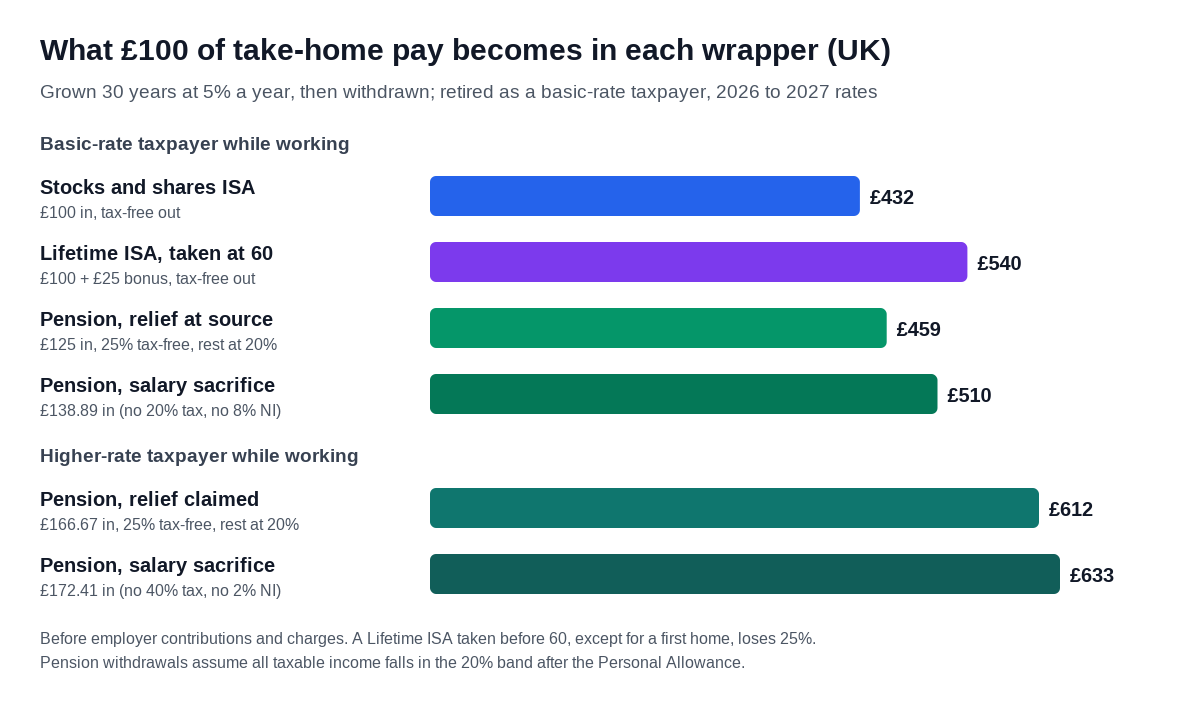
The chart uses one growth factor for every wrapper (5% a year for 30 years turns £1 into £4.32, from the compound interest calculator's function) so only the tax differs. Pension withdrawals are taken a quarter tax-free and three quarters taxed at 20%, an effective 15%, which is what a retiree whose State Pension and drawdown stay inside the basic-rate band pays. Three things fall out of it:
- The Lifetime ISA beats a relief-at-source pension for a basic-rate taxpayer. Both turn £100 into £125, but the Lifetime ISA pays out tax-free while 75% of a pension withdrawal is taxed. The pension wins back the lead once an employer contribution or salary sacrifice is added.
- Salary sacrifice adds the National Insurance you would have paid. At 8% NI and 20% tax, £100 of lost take-home pay buys £138.89 of pension.
- Higher-rate relief is the big lever. At 40% relief, £100 of take-home buys £166.67 of pension, and if that money comes out at 20% it is the best result on the chart.
Three ways the relief reaches you
HMRC's guidance on pension tax relief describes two mechanisms, and employers add a third:
- Relief at source. You pay from taxed pay and the provider claims 20% from the government and adds it to the pot. Personal pensions and SIPPs work this way, as do many workplace schemes. Higher and additional-rate taxpayers claim the rest through Self Assessment; the provider never adds more than 20%.
- Net pay. The employer takes the contribution before working out income tax, so you get relief at your top rate automatically. If you earn less than the £12,570 Personal Allowance, there is no tax to relieve; HMRC now pays a top-up for net pay savers in that position from the 2024 to 2025 tax year (pensions relief relating to net pay arrangements).
- Salary sacrifice. You give up salary and the employer pays the same amount into the pension. Because it is no longer your pay, neither income tax nor National Insurance is charged on it, and the employer saves its own 15% NI.
On 5% of salary, with Class 1 NI at 8% between £12,570 and £50,270 and 2% above for 2026 to 2027:
| £35,000 salary | £60,000 salary | |
|---|---|---|
| Contribution (gross) | £1,750 | £3,000 |
| Income tax saved | £350 (20%) | £1,200 (40%) |
| Cost to take-home pay: net pay | £1,400 | £1,800 |
| Cost to take-home pay: relief at source | £1,400 | £1,800 once the extra 20% is claimed, £2,400 if it is not |
| NI saved by salary sacrifice | £140 (8%) | £60 (2%) |
| Cost to take-home pay: salary sacrifice | £1,260 | £1,740 |
| Employer NI saved (15%) | £262.50 | £450 |
Some employers pass their NI saving into your pension; ask before choosing. A sacrifice also lowers the salary a mortgage lender or a pay-linked benefit sees.
From 6 April 2029 only the first £2,000 a year of salary-sacrificed pension contributions stays free of National Insurance; income tax relief is unchanged and employer contributions outside a sacrifice stay NI-free. The power is in the National Insurance Contributions (Employer Pensions Contributions) Act 2026, which requires the first regulations to set the limit at £2,000 a tax year from 2029 to 2030. At today's rates, the £60,000 earner's £3,000 sacrifice would lose NI relief on £1,000: £20 of employee NI and £150 of employer NI a year. The £35,000 earner's £1,750 is under the cap.
Limits on the way in
From HMRC's pension schemes rates for 2026 to 2027:
- Relief cap. Personal contributions get relief on up to 100% of your UK earnings, or £3,600 gross if that is higher. Someone with no earnings can pay £2,880 and the provider adds £720.
- Annual allowance. £60,000 of total pension saving across all schemes, your money and the employer's together. Unused allowance from the previous three tax years may be carried forward (annual allowance).
- Taper. If threshold income is over £200,000 and adjusted income (which adds back pension contributions) is over £260,000, the allowance falls by £1 for every £2 over, to a floor of £10,000 at £360,000 of adjusted income.
- Money purchase annual allowance. Once you flexibly access a defined contribution pot, for example by taking cash from flexi-access drawdown or an uncrystallised funds pension lump sum, future contributions to such pots are capped at £10,000 a year.
ISAs have no relief and one simple cap: £20,000 a year across all your ISAs for 2026 to 2027, of which up to £4,000 can go into a Lifetime ISA. A planned cut in the cash ISA limit to £12,000 for under-65s from 6 April 2027 will not go ahead: HMRC said on 19 November 2026 that the reducing legislation will be repealed and the cash limit stays at £20,000 (ISA changes to reporting).
The Lifetime ISA: a bonus with a lock
You must make your first payment before 40 and can pay in until 50. The government adds 25%, up to £1,000 a year. The money comes out tax-free from 60, for a first home costing £450,000 or less, or if you are terminally ill. Any other withdrawal pays a 25% charge, and because the charge is on the bonus-boosted amount, you get back less than you put in: GOV.UK's own example turns £800 of savings into £1,000 with the bonus and £750 after the charge, a 6.25% loss of your own money (withdrawing from a Lifetime ISA).
Against a pension, the Lifetime ISA comes out ahead for a basic-rate taxpayer whose employer adds nothing extra, because both get £25 per £100 in and only the Lifetime ISA is tax-free on the way out. It loses to a pension when an employer matches your contributions, when salary sacrifice adds NI relief, or when you pay higher-rate tax now. You also cannot reach it between 55 or 57 and 60, so it does not bridge an early retirement.
Coming out: the 25% and the lump sum allowance
You can usually take 25% of each pension tax-free, capped at the lump sum allowance of £268,275 across all your pensions (more with a protection from before April 2024). The rest is taxed as income in the year you take it, whether as drawdown, an annuity or a lump sum. That cap binds on pots above £1,073,100; below it, a quarter of everything comes out free.
The State Pension uses almost all of the £12,570 Personal Allowance: the full new State Pension is £241.30 a week, £12,547.60 a year, so nearly every taxable pound of pension sits in the 20% band or higher. That is why a pound in an ISA is worth more than a pound in a pension once you have retired, and why the relief on the way in has to do the work. Drawing large sums in one tax year can push taxable pension into the 40% band and turn the pension's advantage into a loss for a basic-rate saver.
Which pot first: a working order
- Take every pound of employer contribution the scheme offers. Nothing else on this page matches free money.
- Use salary sacrifice for further pension saving if the employer offers it, up to what you can lock away until 57.
- Claim higher-rate relief on any relief-at-source contributions through Self Assessment; the provider only ever adds 20%.
- Basic-rate and under 40, with no more employer money on offer: a Lifetime ISA up to £4,000 is worth comparing against the pension, especially if a first home is possible.
- Keep an ISA for anything you may need before 57 or 60, and for bridging the years between stopping work and your pension access age. The UK FIRE Planner splits pension and ISA money and tests that bridge.
Tools for this job
- UK Pension Calculator: the pot your spending and the State Pension call for, and whether your contributions reach it.
- Compound Interest Calculator: the growth factor behind the chart; change the rate and years to test your own horizon.
- UK FIRE Planner: retiring before State Pension age with a pension and an ISA bridge.
- Pension Review Checklist: fees, funds, beneficiaries and old pots to check once a year.
- Tax Year End Checklist: ISA and pension allowances, carry forward and relief claims before 5 April.
To size the income these wrappers have to produce, read what share of your salary you need in retirement; for the pot behind it, how much pension you need to retire in the UK.
Frequently asked questions
Is a pension better than an ISA?
For most employees, yes, up to the employer's maximum contribution, because the employer money and the relief on the way in outweigh tax on the way out. For a basic-rate taxpayer with no employer contribution and no salary sacrifice, £100 of take-home pay gives £459 from a pension against £432 from an ISA after 30 years at 5%, a narrow gap that disappears if the withdrawals fall into the 40% band.
What is the difference between relief at source and net pay?
Under net pay, the contribution comes out of your pay before income tax, so you get relief at your highest rate automatically. Under relief at source, you pay from taxed pay, the provider adds 20%, and higher-rate taxpayers claim the rest from HMRC. Neither saves National Insurance; only salary sacrifice does.
How much National Insurance does salary sacrifice save?
8% of the amount sacrificed if your pay sits between £12,570 and £50,270 in 2026 to 2027, and 2% on pay above £50,270. On a £1,750 contribution from a £35,000 salary that is £140 a year. From April 2029 the NI saving applies only to the first £2,000 a year sacrificed.
Is the Lifetime ISA better than a pension?
For a basic-rate taxpayer with no employer match, often yes: both add 25%, but the Lifetime ISA is tax-free at 60 while three quarters of a pension withdrawal is taxed. With an employer match, salary sacrifice or higher-rate relief, the pension usually wins. Taking Lifetime ISA money out early for anything but a first home costs 25%.
Can I still take 25% of my pension tax-free?
Usually, yes, up to the £268,275 lump sum allowance across all your pensions unless you hold a protection. You can take it in one go or a quarter of each withdrawal. The rest is taxed as income when you take it.
Sources and further reading
- Tax on your private pension contributions: tax relief, GOV.UK. Relief at source, contributions taken before tax, higher-rate claims, the 100% of earnings limit.
- Pension schemes rates and allowances, HM Revenue and Customs. 2026 to 2027 annual allowance, taper limits, money purchase annual allowance, lump sum allowances, £3,600 basic amount.
- Tax on your private pension: lump sum allowance, GOV.UK. 25% tax-free, the £268,275 and £1,073,100 allowances.
- Rates and thresholds for employers 2026 to 2027, GOV.UK. Primary threshold, upper earnings limit, 8%, 2% and 15% NI rates.
- Changes to salary sacrifice for pensions from April 2029, HM Revenue and Customs. The £2,000 NI cap.
- Lifetime ISA and withdrawing from a Lifetime ISA, GOV.UK. Age limits, the £4,000 limit and £1,000 bonus, the £450,000 first-home limit, the 25% charge.
- Relief relating to net pay arrangements, HM Revenue and Customs. The top-up for low earners in net pay schemes.
- Income Tax rates and Personal Allowances, GOV.UK. £12,570 Personal Allowance and the 2026 to 2027 bands.
- National Insurance Contributions (Employer Pensions Contributions) Act 2026, section 1, legislation.gov.uk. The £2,000 salary sacrifice limit from 2029 to 2030.
- Individual Savings Account: changes to reporting, HM Revenue and Customs. The cash ISA limit reduction will not be implemented.