
Rent or Buy in Canada? Run the Numbers by Net Worth
Rent or buy in Canada, compared by net worth: land transfer tax, CMHC premiums, condo fees, semi-annual mortgage rates, rent control and a TFSA for the renter.
By Redbison Dev · · 6 min read
Canada edition. Written for Canadian renters and buyers: CA$, Ontario and Toronto land transfer tax against Alberta's registration fees, CMHC, condo fees, Ontario rent control, the principal residence exemption and the FHSA. US edition
Buying a CA$850,000 condo in Toronto with 20% down costs CA$3,763.62 a month in mortgage payments at a 4.5% five-year fixed rate, plus CA$700 of condo fees and property tax. The same unit might rent for CA$2,800. On those numbers, a renter who invests the CA$199,450 the buyer spends up front is still about CA$26,800 ahead after 15 years, even with 3% price growth. Move the same comparison to a CA$600,000 house in Calgary, with no land transfer tax and a lower price-to-rent ratio, and buying pulls ahead in year 4.
The answer in Canada depends heavily on the province, the city and whether your current rent is controlled. This guide works through both cases with the Canadian Rent or Buy Calculator, and shows which inputs move the result most. It explains a method and is not financial advice; a fee-only planner can help if your case is complicated.
What is different about the Canadian calculation
Several defaults in US rent-versus-buy calculators are wrong for a Canadian home.
- No interest deduction. Interest on a mortgage for the home you live in is not deductible, so the tax rate in the comparison is 0.
- Semi-annual compounding. Fixed-rate mortgages state their rate compounded half-yearly, as the Interest Act requires, which makes the payment slightly lower than a US calculator shows. On a CA$680,000 loan at 4.5% over 25 years it is CA$3,763.62 instead of CA$3,779.66.
- Land transfer tax, by province and city. Ontario charges 0.5% up to CA$55,000, 1% to CA$250,000, 1.5% to CA$400,000, 2% to CA$2,000,000 and 2.5% above that for homes with one or two single-family residences; Toronto charges its municipal tax again on the same brackets, with higher luxury rates above CA$3,000,000. Alberta has no land transfer tax, only land titles fees.
- CMHC instead of PMI. Under 20% down, a one-time premium (3.10% of the loan at 90% loan-to-value) is added to the mortgage.
- No capital gains tax on your home. A property that was your principal residence for every year you owned it is generally sheltered by the principal residence exemption; you still report the sale on Schedule 3.
- Tax-free investing for the renter. A TFSA or FHSA lets the renter invest without tax on growth, which matches the calculator's untaxed return.
How the comparison works
Both households start with the same cash. The buyer spends it on the down payment and closing costs; the renter invests it. Each year the calculator totals housing costs on each side and invests the difference for whichever household spent less. At the end it compares the buyer's equity after selling costs, plus any investments, with the renter's portfolio. Rent and mortgage payments are never set against each other directly, because part of every mortgage payment returns as equity.
Worked example 1: a Toronto condo
Inputs for the Rent or Buy Calculator: CA$850,000 price, CA$170,000 down, 4.5% compounded semi-annually over 25 years, CA$29,450 of closing costs (CA$13,475 Ontario land transfer tax, CA$13,475 Toronto municipal land transfer tax and CA$2,500 legal), condo fees CA$8,400 a year, property tax CA$5,500, insurance CA$500, maintenance CA$2,000, selling costs 5%. Rent is CA$2,800 a month rising 3%, with CA$250 of tenant insurance. Prices grow 3% a year, the renter earns 5% and costs rise 2% a year.
| Year | Buy minus rent |
|---|---|
| 1 | −CA$70,950 |
| 3 | −CA$68,335 |
| 5 | −CA$64,783 |
| 10 | −CA$50,730 |
| 15 | −CA$26,763 |
The buyer spends CA$61,563 on housing in year one against CA$33,850 for the renter, and the land transfer taxes and 5% selling costs open a gap the buyer closes only slowly. At these assumptions buying overtakes renting in year 19.
First-time buyers narrow it. Ontario refunds up to CA$4,000 of provincial land transfer tax and Toronto up to CA$4,475 of the municipal tax. With CA$20,975 of closing costs instead of CA$29,450, the renter's lead after 15 years falls to CA$9,144.
Worked example 2: a Calgary house
Alberta charges a land titles fee instead of a land transfer tax: CA$50 plus CA$5 for every CA$5,000 of value, for both the transfer and the mortgage registration. On a CA$600,000 house with a CA$480,000 mortgage that is CA$650 plus CA$530, CA$1,180 in total.
Illustrative inputs (prices, rent and taxes here are assumptions for the example, not market data): CA$600,000 detached house, CA$120,000 down, 4.5% over 25 years, closing costs CA$3,180 (titles fees plus CA$2,000 legal), property tax CA$3,900, insurance CA$1,800, maintenance CA$6,000, no condo fees, rent CA$2,600 a month rising 3%, everything else as in Toronto.
| Year | Buy minus rent |
|---|---|
| 1 | −CA$23,976 |
| 3 | −CA$3,131 |
| 5 | +CA$21,319 |
| 10 | +CA$101,453 |
| 15 | +CA$216,235 |
The mortgage is CA$2,656.67 a month and buying moves ahead in year 4. The difference from Toronto is not the rate, which is the same, but two things: almost no transaction tax, and a price of about 19 years of rent rather than 25. With only 1% price growth, though, the Calgary renter is still ahead after 15 years by CA$10,054.
Rent control changes the renter's side
In Ontario, the rent increase guideline is 2.1% for 2026 and 1.9% for 2027, and a landlord can raise the rent only once every 12 months with 90 days' written notice. Units first occupied for residential purposes after November 15, 2018 are exempt from the guideline, so their rent can rise by any amount at the yearly increase.
That makes the rent increase input one of the most important in Ontario:
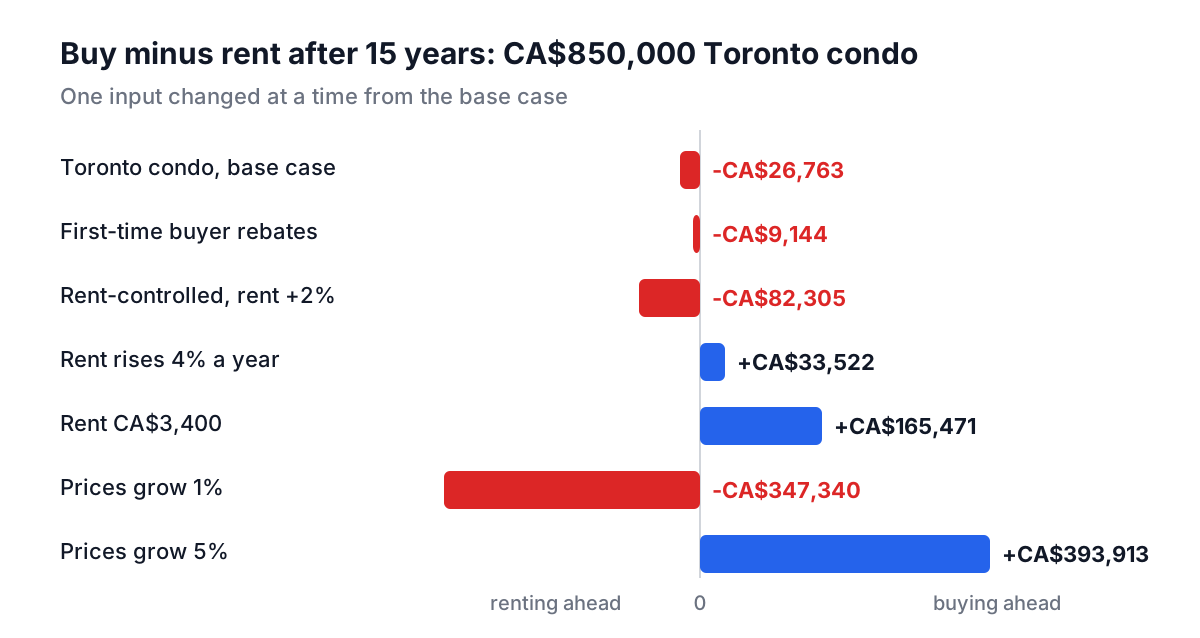
| Toronto condo, rent increase | Buy minus rent after 15 years |
|---|---|
| 2% (a rent-controlled unit near the guideline) | −CA$82,305 |
| 3% (base case) | −CA$26,763 |
| 4% (a newer, uncontrolled unit) | +CA$33,522 |
A tenant in a long-held, rent-controlled apartment has a strong financial case for staying; one in a post-2018 building faces the market every year, and buying looks better.
Which assumptions move the answer
| Change from the Toronto base case | Break-even year | Buy minus rent after 15 years |
|---|---|---|
| Base case | 19 | −CA$26,763 |
| Rent CA$3,400 instead of CA$2,800 | 7 | +CA$165,471 |
| Prices grow 5% a year | 4 | +CA$393,913 |
| Prices grow 1% a year | after 15 | −CA$347,340 |
| Renewal and rate at 5.5% throughout | after 15 | −CA$149,180 |
| Renter earns 7% | after 15 | −CA$258,939 |
Price growth swamps everything else, and nobody can forecast it. The rate matters more in Canada than the five-year term suggests, because you renew several times over the amortization; the calculator holds one rate for the whole period, so a 5.5% run is a reasonable stress case. And the price-to-rent ratio decides how much the buyer has to make up: at CA$3,400 a month, the same condo is a much better purchase.
Down payment under 20%
If you buy the Toronto condo with 10% down, the 3.10% CMHC premium (CA$23,715 on a CA$765,000 loan) is added to the mortgage, and in Ontario the 8% provincial sales tax on it, CA$1,897, is due in cash at closing. Enter the premium by lowering the down payment by that amount, and add the tax to closing costs. On those inputs the mortgage is CA$4,365.32 a month and the renter leads by CA$48,698 after 10 years. Less cash up front gives the renter less to invest, so the gap barely moves even though the payment rises.
Mistakes Canadians make with this comparison
- Comparing rent with the mortgage payment. In year one of the Toronto example, about CA$15,150 of the buyer's mortgage payments is principal that comes back as equity, while condo fees, property tax and the interest do not.
- Using monthly compounding. It overstates a fixed-rate payment, slightly.
- Forgetting the municipal land transfer tax in Toronto, which doubles the bill.
- Ignoring rent control on the renter's side, or assuming a new building's rent will follow the guideline.
- Assuming the renter invests. The comparison only holds if the CA$199,450 and any monthly savings really go into a TFSA, FHSA or similar account.
For the mortgage itself, the Canadian mortgage guide explains semi-annual compounding, CMHC premiums, the stress test and renewal, and the Mortgage Affordability Calculator shows the price your income supports at the qualifying rate.
Frequently asked questions
Is it better to rent or buy a condo in Toronto?
At a CA$850,000 price and CA$2,800 of rent, a renter who invests the down payment and land transfer taxes stays ahead for about 18 years at 3% price growth. Buying wins sooner if rent is higher relative to the price, if prices grow faster, or if your rent is not rent-controlled and rises quickly. Run your own unit and rent through the calculator.
Should I give up a rent-controlled apartment to buy?
Financially, often not. If your Ontario rent rises close to the guideline, 2.1% for 2026 and 1.9% for 2027, the Toronto example leaves the renter ahead by about CA$82,300 after 15 years. Units first occupied after November 15, 2018 are exempt from the guideline, which changes the result.
How much do land transfer taxes change the answer?
A lot over short stays. Toronto buyers pay the Ontario and municipal taxes, CA$26,950 on CA$850,000, while Alberta buyers pay only land titles fees, about CA$1,180 on a CA$600,000 house with a CA$480,000 mortgage. First-time buyer refunds of up to CA$4,000 (Ontario) and CA$4,475 (Toronto) cut the renter's 15-year lead from CA$26,763 to CA$9,144.
Do I pay tax on the gain when I sell my home in Canada?
Generally not, if it was your principal residence for every year you owned it. You still report the sale and designate the property on Schedule 3 of your return. The calculator does not tax the sale for that reason.
Where should the renter invest the money?
The comparison assumes untaxed growth, which a TFSA or FHSA provides. An FHSA takes up to CA$8,000 a year to a CA$40,000 lifetime limit and can later fund a first home, so a renter who might buy later keeps the option open.
Sources and further reading
- Interest Act, section 6, Justice Laws Website, Government of Canada. Mortgage rates stated yearly or half-yearly.
- Calculating land transfer tax, Government of Ontario. Provincial brackets.
- Municipal Land Transfer Tax rates and fees, City of Toronto.
- Municipal Land Transfer Tax rebate opportunities, City of Toronto. First-time purchaser rebate up to CA$4,475.
- Land titles and surveys common documents fee schedule, Government of Alberta. CA$50 plus CA$5 per CA$5,000 of value.
- Residential rent increases, Government of Ontario. Guidelines, the 12-month rule and the exemption for units first occupied after November 15, 2018.
- CMHC mortgage loan insurance cost, Canada Mortgage and Housing Corporation. Premiums and sales tax on premiums.
- Income tax information if you bought or sold a home, Canada Revenue Agency. Principal residence exemption.
- Make the most of your first home savings account, Canada Revenue Agency. FHSA limits.
Open the Rent vs Buy Calculator
More Analysis Tools
Every tool in the Analysis Tools section, free and in your browser.