
Rebar and Steel Weight per Metre: 10M, 15M, HSS (Canada)
Weight of Canadian 10M to 35M rebar, HSS Class C and Class H, metric W-shapes and plate in kg/m and lb/ft, with a worked order and the lift rules that need it.
By Redbison Dev · · 9 min read
Canada edition. Written for Canada: CSA G30.18 metric rebar masses (10M to 35M), HSS to CSA G40.21 Class C and Class H, metric W-shape names, kg and lb side by side, prices in CA$ and Ontario's rule that hoisting procedures state how steel weights are found. US edition
Canadian steel lives in two unit systems at once. Drawings and rebar designations are metric (10M, 15M, W310x39, HSS 152x152x6.4), but many quotes and US-made products still use pounds and feet. The weight in either unit comes from the same place: the bar's nominal area or the section's area, times 7,850 kg/m³. A 10M bar has a nominal area of 100 mm² and weighs 0.785 kg/m (0.527 lb/ft), so a bundle of a hundred 6 m bars is 471 kg. This edition covers how CSA bar sizes turn into mass, how HSS Class C and Class H differ, what the metric W-shape name tells you, and a worked order you can repeat in the Steel Weight Calculator (Canada).
Canadian rebar: the area sets the mass
CSA G30.18 bars are named 10M, 15M, 20M and so on. The number is the bar diameter rounded to the nearest 5 mm, as Wikipedia's rebar article describes it, but the figure that fixes the mass is the nominal area. Russel Metals' rebar table for CSA G30.18 Grade 400R or 400W lists the nominal areas and masses below; the last two columns are calculated:
| Bar | Nominal area | Mass | Equivalent round bar (calculated) | lb/ft (calculated from kg/m) |
|---|---|---|---|---|
| 10M | 100 mm² | 0.785 kg/m | 11.284 mm | 0.527 |
| 15M | 200 mm² | 1.570 kg/m | 15.958 mm | 1.055 |
| 20M | 300 mm² | 2.355 kg/m | 19.544 mm | 1.582 |
| 25M | 500 mm² | 3.925 kg/m | 25.231 mm | 2.637 |
| 30M | 700 mm² | 5.495 kg/m | ||
| 35M | 1,000 mm² | 7.850 kg/m |
Every mass in that table is the area times 0.00785 kg per mm² per metre (7,850 kg/m³). To make the calculator reproduce them, enter a round bar with the diameter that gives the nominal area, shown in the fourth column; the calculator then returns 0.785, 1.570, 2.355 and 3.925 kg/m exactly. Russel Metals prints its own lb/ft column as 0.528, 1.055, 1.583 and 2.638, which differs from the converted kg/m figures by at most 0.001 lb/ft.
The common shortcut of entering 15M as a 16 mm bar gives 1.578 kg/m instead of 1.570, half a percent heavy. On a 100-bar bundle of 6 m lengths that is 947 kg against 942 kg, small on one bundle but enough to make a takeoff disagree with the supplier's ticket.
If ASTM bars turn up on a job, note that they are a different series. The same Russel Metals page lists ASTM A615 #4 at 0.994 kg/m and #5 at 1.552 kg/m, so a #5 is about 1% lighter than a 15M even though both have a nominal area of 200 mm² on the table. Do not mix the two in one schedule.
HSS: Class C or Class H
Hollow structural sections in Canada are made to CSA G40.21 as Class C (cold-formed, not stress-relieved) or Class H (hot-formed, or cold-formed and stress-relieved). The Canadian Institute of Steel Construction explains that CSA S16 treats them differently in compression: its resistance tables use n = 1.34 for Class C and n = 2.24 for Class H.
The two classes also differ slightly in mass for the same nominal size, because their corners are formed differently. The calculator's corner options model a cold-formed tube with larger radii and a hot-finished tube with tighter ones:
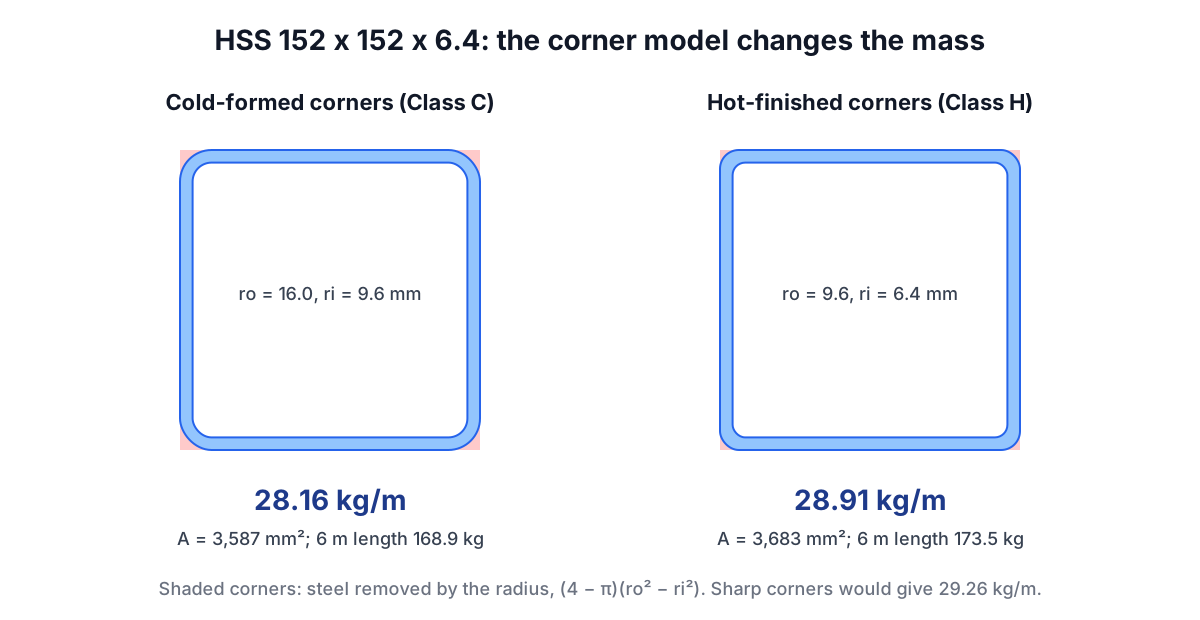
| HSS 152 x 152 x 6.4 | kg/m | lb/ft | 6 m length |
|---|---|---|---|
| Cold-formed corners (Class C) | 28.16 | 18.92 | 168.9 kg |
| Hot-finished corners (Class H) | 28.91 | 19.43 | 173.5 kg |
| Sharp corners (no radius) | 29.26 | 19.66 | 175.6 kg |
The calculator's radii follow the European product standards, so treat the result as a check and take the ordering weight from the mill's or supplier's table for the class on the drawing. If the drawing says Class H, a Class C tube is a design change, not a substitution, because of the different column curve.
W-shapes: the name carries the mass
Canadian practice names wide-flange shapes by nominal depth in millimetres and nominal mass in kilograms per metre. A W310x39 weighs about 39 kg per metre and a W200x27 about 27 kg/m, so a 9 m W310x39 is roughly 351 kg before connections. For these sections the name is the estimate and the handbook table is the exact figure.
If you enter a W-shape in the calculator from its plate dimensions, expect it to come in a little light. The calculator sums two flanges and a web; the rolled shape also has root fillets where they meet. That is fine for checking a fabricated plate girder (which has no fillets) and not fine for billing a rolled beam.
Worked example: a footing and wall order
A residential foundation calls for one hundred 10M bars and one hundred 15M bars at 6 m, plus forty 20M bars at 12 m for a grade beam. In the calculator, with the equivalent diameters from the table:
| Bars | Inputs | Result |
|---|---|---|
| 10M | round bar 11.284 mm, 6 m, qty 100 | 0.785 kg/m, 4.71 kg each, 471 kg |
| 15M | round bar 15.958 mm, 6 m, qty 100 | 1.570 kg/m, 9.42 kg each, 942 kg |
| 20M | round bar 19.544 mm, 12 m, qty 40 | 2.355 kg/m, 28.26 kg each, 1,130.4 kg |
The order is 2,543.4 kg, about 5,607 lb. A supplier pricing at CA$1.60 per kg (an example rate, not a market quote) puts the bar at about CA$4,069 before cutting, bending, delivery and GST or HST. If the quote is per pound, switch the calculator to imperial so the units match.
A single 12 m 20M bar weighs 28.26 kg; the 40-bar bundle is 1,130 kg and needs a crane or forklift.
Lifting: why the weight has to be written down
Ontario's construction projects regulation, O. Reg. 213/91, section 151, says no crane or similar hoisting device may be subjected to a load greater than its rated load-carrying capacity, and requires a load rating chart the operator can read at the controls. Where steel pieces are hoisted as a multi-tiered load, section 103.1 requires written procedures, prepared by an engineer, that identify the crane and its rated capacity and describe the method of determining the weight of the structural steel pieces. Other provinces have their own rules; the principle that the weight is known before the lift is the same.
For a lift plan use the mill or fabricator's weight, add connection plates, bolts and galvanizing, and read the chart at the actual radius.
Plate and flat bar
Plate has no fillets, so the calculation is exact for the nominal size: 7.85 kg/m² per millimetre of thickness. A 4 x 8 ft sheet of 1/4 in plate (1,219.2 x 2,438.4 x 6.35 mm) is 148.2 kg (326.7 lb). A metric 1,220 x 2,440 mm sheet of 10 mm plate is 233.7 kg. Flat bar is width times thickness times 0.00785 kg/m, so a 100 x 10 mm flat is 7.85 kg/m.
Tools for this job
- Steel Weight Calculator (Canada): rebar, HSS, W-shapes, flat bar and plate in kg and lb, with the cost in CA$.
- Rebar Calculator: bar count and spacing for a slab before converting to mass here.
- Section Properties Calculator: area and section modulus for built-up shapes.
- Beam Deflection Calculator (Canada): the self-weight in kg/m is one of its loads; see the Canadian beam deflection guide.
Weights here are nominal. A competent person should plan any lift using the certified weight.
Frequently asked questions
How many 15M bars are in a tonne?
At 1.570 kg/m, a 6 m 15M bar weighs 9.42 kg, so a tonne is about 106 bars of 6 m, or 53 bars of 12 m.
What is the weight of 10M rebar per foot?
About 0.53 lb/ft: Russel Metals lists 0.528, and converting the CSA mass gives 0.527. The CSA mass is 0.785 kg/m; multiply by 0.3048 m per foot and divide by 0.4536 kg per pound.
Is 15M rebar the same as #5?
They are close but not the same product. Both are listed with a nominal area of 200 mm², but the ASTM A615 #5 is listed at 1.552 kg/m against 1.570 kg/m for the CSA 15M, and the grades are specified differently. Use the bar the drawings call for.
Why does the HSS weight in my supplier's list differ from the calculator?
The corner radii. Class C and Class H tubes have different corner geometry, and the calculator's radii come from European product standards. Treat the calculator as a check and order from the supplier's table for the class on the drawing.
Sources and further reading
- Reinforcing bars (rebar), Russel Metals. CSA G30.18 Grade 400R/400W masses and nominal areas for 10M to 55M; ASTM A615 #3 to #18.
- Compressive resistance tables for compression members, Canadian Institute of Steel Construction. HSS Class C (cold-formed non-stress-relieved, n = 1.34) and Class H (n = 2.24) to CSA G40.21.
- O. Reg. 213/91: Construction projects, Government of Ontario. Section 151 rated load-carrying capacity and load rating charts; section 103.1 hoisting procedures that state how steel weights are determined.
- Rebar, Wikipedia. Canadian metric bar designations and their nominal diameters and areas.
- Eurocode 3: Design of steel structures, European Commission Joint Research Centre. The European steel design standards, for comparison with CSA S16.
Open the Steel Weight Calculator
More Civil & Structural
Every tool in the Civil & Structural section, free and in your browser.