
ACB per Share in Canada: Average Cost and Superficial Loss
How to work out the adjusted cost base of shares bought at different prices, with commissions, part sales, superficial losses, US-dollar trades and averaging down.
By Redbison Dev · · 9 min read
Canada edition. Written for Canadian investors: the CRA's average cost rule for identical properties and its own worked example, commissions in the ACB, the superficial loss rule, Canadian-dollar conversion of US trades and the 2025 inclusion rate, in CA$. US edition
In Canada the average cost of shares you bought more than once is not just a convenience: it is the adjusted cost base (ACB) the CRA expects you to use. Shares of the same class in the same company are identical properties, and each time you buy more you recalculate one average cost for all of them. Selling some does not change it. The ACB includes your buy commissions, a loss can be denied and moved into the ACB under the superficial loss rule, and trades in US dollars must be converted at the rate on each trade date. This edition works through each case in Canadian dollars with the Average Cost and ACB Calculator (Canada).
The CRA's identical property rule
The CRA's guide T4037, Capital Gains, says that for identical properties you have to calculate the average cost of each property in the group at the time of each purchase. Its Example 1 uses common shares of a company bought and sold over several years:
| Transaction | Cost | Shares | ACB per share |
|---|---|---|---|
| Buy 100 at $15 | $1,500 | 100 | $15.00 |
| Buy 150 at $20 | + $3,000 = $4,500 | 250 | $18.00 |
| Sell 200 at $18 | − $3,600 = $900 | 50 | $18.00 |
| Buy 350 at $21 | + $7,350 = $8,250 | 400 | $20.63 |
Enter those four trades (no commissions) and the calculator returns the same result: 400 shares, ACB $8,250, $20.625 a share. The sale in the third row takes shares out at the average, so the average is unchanged; that is the method the calculator's sell rows use.
Commissions go in, selling costs come off
T4037 defines the ACB as usually the cost of a property plus any expenses to acquire it, such as commissions and legal fees. On a sale, it lets you deduct outlays and expenses, including commissions and brokers' fees, from the proceeds.
A worked example with a $9.95 commission on every trade:
| # | Trade | Shares after | ACB after | ACB per share |
|---|---|---|---|---|
| 1 | Buy 200 at $48.30 + $9.95 | 200 | $9,669.95 | $48.35 |
| 2 | Buy 150 at $41.10 + $9.95 | 350 | $15,844.90 | $45.27 |
| 3 | Sell 120 at $52.75 − $9.95 | 230 | $10,412.36 | $45.27 |
The sale brings in 120 x $52.75 − $9.95 = $6,320.05 and removes 120 x $45.2711 = $5,432.54 of ACB, so the capital gain is $887.51. CRA's capital gains definitions say the inclusion rate for 2025 is generally 1/2, so at that rate $443.76 of the gain would be a taxable capital gain; check the rate for the year you sell. The 230 shares left keep the $45.27 ACB per share.
Break-even before the sale, covering the ACB and one more $9.95 commission, is ($15,844.90 + $9.95) / 350 = $45.30.
The superficial loss rule
Selling at a loss and buying straight back is where averaging and tax collide. T4037 says a superficial loss can occur when you dispose of capital property for a loss and both of these apply:
- you, or a person affiliated with you (such as your spouse or common-law partner, or a corporation either of you controls), buy the same or identical property during the period from 30 calendar days before the sale to 30 calendar days after it; and
- you or the affiliated person still own it 30 calendar days after the sale.
A superficial loss cannot be deducted, but if you are the person who acquired the substituted property you can usually add it to that property's ACB. Continuing from the two buys above, suppose the price falls and you sell 100 shares at $38 to realize a loss, then buy 100 back at $37 a week later and keep them:
- The sale removes 100 x $45.2711 = $4,527.11 of ACB for proceeds of $3,790.05: a loss of $737.06.
- After the buy-back you hold 350 shares with an ACB of $15,027.74 ($42.94 a share) before the rule.
- Because the loss is superficial, it is added back: ACB $15,764.80, or $45.04 a share.
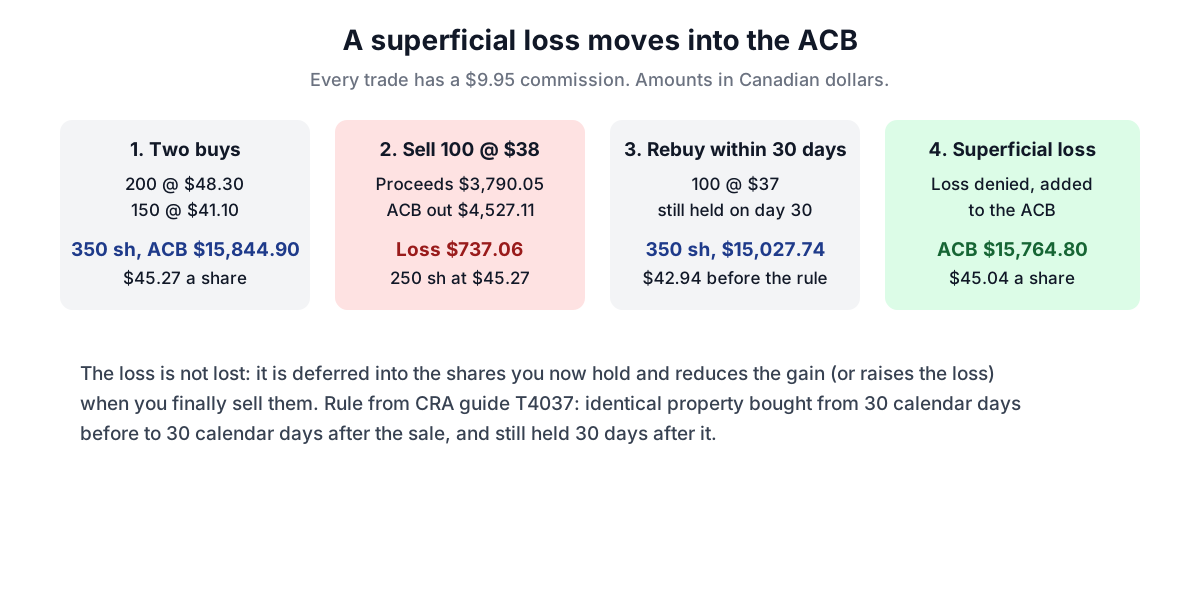
The calculator shows the realized loss and the ACB before the adjustment; add the denied loss to the ACB yourself. The loss is deferred, not destroyed: it reduces the gain, or increases the loss, when you finally sell the substituted shares.
US-listed shares: convert each trade
If you hold US-listed shares, note that T4037 says that when a sale is made in a foreign currency, you convert the proceeds at the exchange rate at the time of the sale, the ACB at the rate when the property was acquired, and outlays and expenses at the rate when they were incurred. It names the Bank of Canada rate on the day of the transaction as the general choice.
So the ACB of a US stock is not its US-dollar average times today's rate. With example rates (not actual Bank of Canada figures) of 1.36 on the first buy, 1.41 on the second and 1.38 on the sale, and a US$4.95 commission each time:
| Trade | In US$ | Rate | In C$ (calculator input) |
|---|---|---|---|
| Buy 50 | at US$180 + US$4.95 | 1.36 | at $244.80 + $6.73 |
| Buy 30 | at US$160 + US$4.95 | 1.41 | at $225.60 + $6.98 |
| Sell 40 | at US$200 − US$4.95 | 1.38 | at $276.00 − $6.83 |
Entered in Canadian dollars, the calculator gives an ACB of $237.77 a share and a capital gain of $1,522.32 on the 40 shares sold. Working in US dollars and converting the gain at the sale-date rate would give US$1,090.10 x 1.38 = $1,504.34, about $18 less, because the shares were bought when the dollar was at different levels. Report the Canadian-dollar figure.
Averaging down
The same holding of 350 shares at $45.27 (before any sale), with the stock now at $37: how many more shares bring the ACB per share to $42? For S shares at average A, price P and target T, n = S x (A − T) / (T − P). Including the $9.95 commission on the new buy, the calculator gives 230.97 shares, so 231 in practice, for about $8,556.95. That is more than half the original investment again to move the average by about $3.27.
Two points specific to Canada:
- An averaging-down purchase made within 30 days of a loss sale is exactly what creates a superficial loss.
- The affiliated-person test means a purchase by your spouse or common-law partner counts too, so coordinate before either of you rebuys.
Whether to add to a falling position is a judgment about the company's value, not about the average. If your situation involves several accounts, options or corporate actions, a tax professional can check the ACB before you file.
Stock splits
T4037 explains that a 2-for-1 split doubles the number of shares and halves the price, so the total ACB does not change and the ACB per share is recalculated, for example $1,000 over 200 shares instead of 100, or $5 a share. In the calculator, re-enter earlier buys with split-adjusted figures rather than adding a new buy.
Tools for this job
- Average Cost and ACB Calculator (Canada): ACB, break-even, partial sales and averaging down in CA$.
- Dividend Calculator: the income from the shares you hold.
- ROI Calculator: the return on everything you have put in.
Frequently asked questions
Does selling shares change my ACB per share?
No. Under the identical property rule, a sale removes shares at the current average, so the ACB per share of the shares you keep stays the same. Only purchases, and adjustments such as a denied superficial loss, change it.
Are brokerage commissions part of the ACB?
Commissions to buy are added to the ACB. Commissions to sell are outlays and expenses that reduce your proceeds.
What happens to a superficial loss?
You cannot deduct it, but if you acquired the substituted shares you can usually add the loss to their ACB. In the example, a $737.06 loss raises the ACB from $15,027.74 to $15,764.80.
How do I calculate ACB for US stocks?
Convert each purchase and its commission to Canadian dollars at the exchange rate on the purchase date, and the sale at the rate on the sale date, then average in Canadian dollars. The CRA generally expects the Bank of Canada rate for the day.
Sources and further reading
- Capital Gains, guide T4037, Canada Revenue Agency. Identical properties and Example 1, ACB and outlays and expenses, superficial loss, foreign-currency conversion, and stock splits.
- Definitions for capital gains, Canada Revenue Agency. The 1/2 inclusion rate for 2025.
- Definitions for capital gains, Canada Revenue Agency. Adjusted cost base and outlays and expenses.
- Daily exchange rates, Bank of Canada. Daily average rates for 24 currencies, including the US dollar, published each business day by 16:30 ET.
- Weighted arithmetic mean, Wikipedia. Why the average cost is weighted by the number of shares.
- Line 12700: Taxable capital gains, Canada Revenue Agency. Where the gain is reported, with links to Schedule 3.
Open the Stock Average Calculator
More Calculators
Every tool in the Calculators section, free and in your browser.
- Investment Calculator
- Compound Interest Calculator
- Simple Interest Calculator
- Interest Calculator
- EMI Calculator
- Retirement Calculator
- Time-Weighted Return Calculator
- Savings Goal Calculator
- Inflation Calculator
- CAGR Calculator
- ROI Calculator
- Present and Future Value Calculator
- NPV and IRR Calculator
- 401(k) Calculator
- Roth IRA Calculator
- APY and CD Calculator
- SIP Calculator
- Annuity Calculator
- Bond Price and Yield Calculator
- Currency Converter
- Dividend Calculator
- Stock Average Calculator
- RMD Calculator