
Average Share Price and the Section 104 Pool (UK)
Work out your average price per share in pounds with dealing costs and 0.5% stamp duty, how HMRC's Section 104 pool and 30-day rule use it, and averaging down.
By Redbison Dev · · 9 min read
United Kingdom edition. Written for UK investors: pounds and pence, 0.5% Stamp Duty Reserve Tax counted in the cost, HMRC's same-day, 30-day and Section 104 matching rules, and the 2026 to 2027 Capital Gains Tax rates and allowance. US edition
If you have bought the same UK share more than once, your average price per share is the total you paid, dealing charges and stamp duty included, divided by the shares you hold. In the UK that number is more than a convenience on a broker's screen: it is how HMRC values a Section 104 holding for Capital Gains Tax. Shares of the same class in the same company sit in one pool at an average cost, and a sale takes cost out of the pool in proportion. The exception is the 30-day rule, which can override the pool if you buy back soon after selling. This edition works through all of it in pounds with the Share Average Price Calculator (UK).
What goes into the cost of each purchase
Two costs sit on top of the share price on almost every UK purchase.
- Stamp Duty Reserve Tax. GOV.UK's tax when you buy shares page says you usually pay 0.5% when you buy shares, as SDRT on an electronic purchase or as stamp duty on a paper transfer over £1,000. A 1.5% rate applies when shares go into certain depositary receipt schemes or clearance services. There is no stamp duty on a new issue you subscribe to, on OEIC or unit trust units bought from the fund manager, or normally on foreign shares bought outside the UK.
- Dealing charge. Whatever your platform charges per trade.
Both belong in the cost. HMRC's Capital Gains Manual at CG15250 lists costs of transfer, including stamp duty, among the allowable incidental costs of acquisition, along with fees or commission paid for the professional services of an agent. In the calculator, put the SDRT and the dealing charge together in each buy's fee box.
Worked example: building the pool
You buy a UK-listed share twice through a platform charging £5.99 a trade:
| Buy | Shares x price | SDRT at 0.5% | Dealing | Fee box | Total cost |
|---|---|---|---|---|---|
| 1 | 1,000 x £2.40 = £2,400.00 | £12.00 | £5.99 | £17.99 | £2,417.99 |
| 2 | 800 x £1.95 = £1,560.00 | £7.80 | £5.99 | £13.79 | £1,573.79 |
Enter the two buys and the calculator returns 1,800 shares, total cost £3,991.78, average £2.2177. The plain average of the prices paid, weighted by shares, would be £2.20; costs add about 1.8p a share. If you sell everything with another £5.99 charge, break-even is (£3,991.78 + £5.99) / 1,800 = £2.2210.
Selling part of a Section 104 holding
HMRC's helpsheet HS284, Shares and Capital Gains Tax explains that all shares of the same class in the same company are held together in a Section 104 holding, a single pool of expenditure. If you dispose of only some of them, the allowable cost is the fraction of the pool equal to the shares sold divided by the shares held.
Sell 600 of the 1,800 shares at £2.60, with a £5.99 charge:
- Proceeds: 600 x £2.60 − £5.99 = £1,554.01.
- Allowable cost: 600 / 1,800 x £3,991.78 = £1,330.59.
- Gain: £223.42.
The calculator's sell row does exactly this: it removes shares at the pool average, so the 1,200 shares left keep the £2.2177 average and £2,661.19 of cost. That is why the average does not move when you sell.
The same-day and 30-day rules
The pool is not always the cost HMRC uses. HS284 sets the order in which a sale is matched with purchases:
- shares bought on the same day as the sale;
- shares bought in the 30 days after the sale (the "bed and breakfasting" rule), provided you were UK resident when you bought them;
- the Section 104 holding.
Suppose that after selling the 600 shares at £2.60 you buy 600 back at £2.50 a fortnight later. The sale is now matched with the new purchase, not the pool:
- Cost of the matched shares: 600 x £2.50 + £7.50 SDRT + £5.99 dealing = £1,513.49.
- Gain: £1,554.01 − £1,513.49 = £40.52.
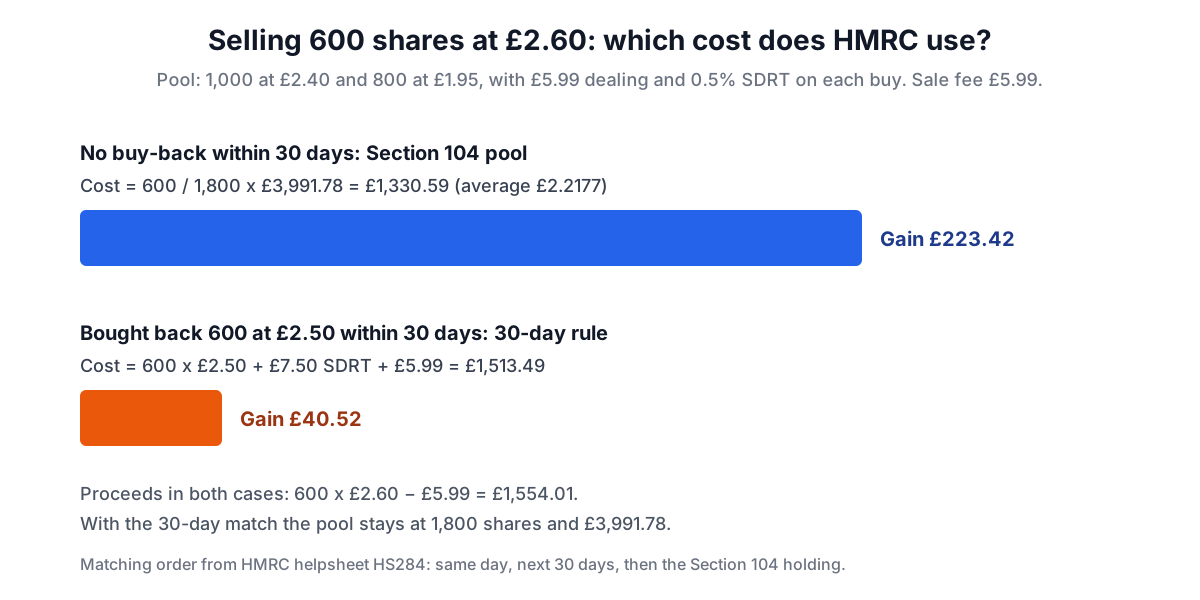
The pool stays at 1,800 shares and £3,991.78, because the shares bought back were used up in the match. To check this, start a new calculation with only the buy-back (600 at £2.50, fees £13.49) followed by the sale at £2.60 (fee £5.99); the realised figure, £40.52, is the 30-day gain. Adding the buy-back to the existing pool would average it in and give a different figure. The rule exists to stop selling and buying back to crystallise a gain or a loss without really changing your position, so it also catches people who sell at a loss in March and buy back in early April.
Averaging down, with stamp duty on the new buy
The shares have fallen to £1.80 and you want to bring the pool average down to £2.10. The number of shares to buy at price P to reach a target average T from S shares at average A is:
n = S x (A − T) / (T − P)
Stamp duty applies to the new purchase too, so the effective price is £1.80 x 1.005 = £1.809 a share, plus £5.99 dealing. With 1,800 shares at £2.2177, entering £1.809 as the price and £5.99 as the fee, the calculator gives 748.4 shares, so in practice 749 shares for about £1,360.93 including SDRT and dealing. That takes the average to £2.0999.
The table below shows how fast the cost grows as the target nears the market price, which is the main reason to be wary of averaging down: you are putting more money into the same company, and the last few pence of average cost the most.
| Target average | Shares to buy (rounded up) | Cost with SDRT and £5.99 |
|---|---|---|
| £2.15 | 375 | £684.37 |
| £2.10 | 749 | £1,360.93 |
| £2.00 | 2,083 | £3,774.14 |
| £1.90 | 6,350 | £11,493.14 |
| £1.85 | 16,288 | £29,470.98 |
Run other targets in the calculator's "Target average" box; it refuses a target outside the range between today's price and your current average, because no number of shares can reach it.
Capital Gains Tax on the result
For the 2026 to 2027 tax year, GOV.UK's Capital Gains Tax rates page gives 18% on gains that fall within the basic Income Tax band and 24% above it, and the allowances page gives a £3,000 tax-free allowance for individuals. The £223.42 gain in the example sits well inside the allowance.
Shares held in a Stocks and Shares ISA are outside this: GOV.UK's page on what you pay Capital Gains Tax on lists gains from ISAs or PEPs among those you do not pay it on, and the ISA page gives a £20,000 maximum you can save in ISAs in 2026 to 2027. The pooling arithmetic matters for shares in a general investment account.
This edition explains the arithmetic, not your tax position. If you have shares from employee schemes, rights issues, demergers or holdings from before April 2008, the rules in HS284 add steps; a tax adviser can help.
Tools for this job
- Share Average Price Calculator (UK): the pool average, break-even, part sales and averaging down in pounds.
- Dividend Calculator: income from the shares while you hold them.
- ROI Calculator: the return on the whole amount invested.
Frequently asked questions
Do I include stamp duty in the cost of my shares?
Yes. HMRC's Capital Gains Manual lists costs of transfer, including stamp duty, as allowable incidental costs of acquisition, so add the 0.5% SDRT and the dealing charge to each purchase.
Does selling some shares change my average price?
No. A part disposal takes a proportion of the pool's cost (shares sold divided by shares held), so the remaining shares keep the same average. The 30-day rule can change which cost is used for that sale, but it does not change the pool.
What happens if I sell and buy back the same shares within 30 days?
HMRC matches the sale with the shares you bought back, not with the pool. In the example, a sale at £2.60 matched with a buy-back at £2.50 gives a gain of £40.52 instead of £223.42.
How many shares do I need to buy to lower my average?
Shares held x (average − target) / (target − price). From 1,800 shares at £2.2177, reaching £2.10 at £1.80 a share, with 0.5% SDRT and £5.99 dealing on the new buy, takes 749 shares.
Sources and further reading
- Shares and Capital Gains Tax (HS284), HM Revenue and Customs. Section 104 holdings, part disposals and the same-day and 30-day matching rules.
- Tax when you buy shares, GOV.UK. 0.5% SDRT or stamp duty, the 1.5% rate and exemptions.
- Capital Gains Manual CG15250: incidental costs, HM Revenue and Customs. Stamp duty and agents' fees as allowable costs.
- Capital Gains Tax rates, GOV.UK. 18% and 24% from 6 April 2026.
- Capital Gains Tax allowances, GOV.UK. £3,000 for individuals.
- Individual Savings Accounts, GOV.UK. £20,000 ISA allowance for 2026 to 2027.
- Capital Gains Tax: what you pay it on, GOV.UK. No CGT on gains from ISAs or PEPs.
Open the Stock Average Calculator
More Calculators
Every tool in the Calculators section, free and in your browser.
- Investment Calculator
- Compound Interest Calculator
- Simple Interest Calculator
- Interest Calculator
- EMI Calculator
- Retirement Calculator
- Time-Weighted Return Calculator
- Savings Goal Calculator
- Inflation Calculator
- CAGR Calculator
- ROI Calculator
- Present and Future Value Calculator
- NPV and IRR Calculator
- 401(k) Calculator
- Roth IRA Calculator
- APY and CD Calculator
- SIP Calculator
- Annuity Calculator
- Bond Price and Yield Calculator
- Currency Converter
- Dividend Calculator
- Stock Average Calculator
- RMD Calculator