
Buy Now Pay Later UK: New FCA Rules, Section 75 and Costs
How Buy Now Pay Later works in the UK since FCA regulation began on 15 July 2026: affordability checks, Section 75, the Ombudsman, and what overlapping plans cost.
By Redbison Dev · · 10 min read
United Kingdom edition. Written for UK shoppers: FCA regulation of Deferred Payment Credit from 15 July 2026, Section 75 cover and its £100 to £30,000 band, the Financial Ombudsman Service, and examples in pounds. US edition
Buy Now Pay Later in the UK changed on 15 July 2026, when the Financial Conduct Authority started regulating the interest-free kind, which the law calls Deferred Payment Credit (DPC). For a plan taken out from that date with a separate lender, the lender must be authorised (or in the FCA's temporary permissions regime), must check you can afford the repayments, must tell you the late fee before you sign, and you can take a complaint to the Financial Ombudsman Service. You also get Section 75 protection on qualifying purchases, the same as with a credit card. Two gaps remain: plans offered directly by the shop itself, and any plan you took out before 15 July 2026. This edition covers what the new rules do and do not change, and works through the costs in pounds with the UK APR calculator.
Two kinds of BNPL, two sets of rules
The FCA's Buy Now Pay Later page for consumers separates two products that look the same at the checkout:
| Deferred Payment Credit (DPC) | Other BNPL credit | |
|---|---|---|
| Interest | None | Charged, or charged if you do not repay in time |
| Shape | 12 or fewer instalments, over 12 months or less | Can run longer than 12 months or have more instalments |
| Regulated? | From 15 July 2026, if the lender and the shop are different businesses | Already regulated consumer credit |
| Typical example | Pay in 3 monthly instalments | "Pay monthly" or "spread the cost" on furniture or electronics |
The FCA's policy statement PS26/1 explains that it uses "DPC" because that is the term in the legislation, and that the regime covers lenders that finance the purchase of goods or services from a merchant. Merchants that offer their own DPC directly, and the broking of DPC, are outside it.
What the regulation gives you
For a regulated DPC agreement, the FCA's consumer page lists:
- An affordability check before the agreement is made.
- Key information up front: the amount borrowed, when repayments are due, how much they are, the late fee, and your rights.
- Contact after a missed payment, explaining what it means, and support if you are struggling.
- A route to the Financial Ombudsman Service if the lender does not put a complaint right.
- Section 75 of the Consumer Credit Act, so that if something goes wrong with what you bought you may be able to claim from the lender.
Check the lender on the FCA Firm Checker before you agree. The FCA page says to look for "Authorised" and permission to "Lend you money on an unsecured basis", or for the lender's name in its temporary permissions list.
What it does not cover
- Plans from before 15 July 2026 stay unregulated, and the new protections do not apply to them.
- In-house plans, where the shop itself lends you the money, are not regulated as DPC.
- The amount you can owe across lenders. Each lender checks your affordability, but nothing in the rules adds up your plans for you.
Section 75: the £100 to £30,000 band
Section 75 of the Consumer Credit Act 1974 makes the lender jointly liable with the seller for a misrepresentation or breach of contract. Section 75(3) excludes any single item with a cash price of £100 or less, or more than £30,000. For small pay-in-3 purchases, that line matters:
| Purchase on regulated DPC | Cash price | Section 75 cover |
|---|---|---|
| Trainers in 3 x £30 | £90 | No (£100 or less) |
| Jacket in 3 x £40 | £120 | Yes |
| Sofa in 3 x £150 | £450 | Yes |
The test is the cash price of a single item, not the basket total or the instalment. Your rights against the shop under consumer law apply whatever the price.
The cost: 0% until something goes wrong
A regulated DPC plan is interest-free, so with no fees its APR is 0%. In the UK APR calculator, £450 over 3 months at 0% with no fees gives £150.00 a month and an APR of 0%. Late fees are not part of an APR (they are default charges), which is why the FCA now requires the lender to tell you the late fee before you sign.
Longer BNPL that charges interest is a different product, and the APR shows it. Take a £1,200 television on a 12-month plan at an interest rate of 29.9%. With the calculator set to the UK method (the annual effective rate under the FCA's Consumer Credit sourcebook):
| Plan | Monthly payment | Total interest | APR (UK method) |
|---|---|---|---|
| £1,200, 12 months, 0% | £100.00 | £0.00 | 0% |
| £1,200, 12 months, 19.9% interest | £111.10 | £133.25 | 21.8% |
| £1,200, 12 months, 29.9% interest | £116.93 | £203.11 | 34.4% |
The UK APR is higher than the interest rate because it counts monthly compounding over a year; a US-style calculator would show 29.9%. The FCA notes that some interest-bearing BNPL charges interest only if you do not repay within a set time, so read which rate applies once that period ends.
Worked example: three plans in one autumn
Each plan is small; the trouble starts when they overlap. Suppose that in September you buy the £120 jacket (3 x £40 from September), in October the £450 sofa (3 x £150 from October), and in November the £90 trainers (3 x £30 from November), all on monthly pay-in-3:
| Month | Jacket | Sofa | Trainers | Total due |
|---|---|---|---|---|
| September | £40 | £40 | ||
| October | £40 | £150 | £190 | |
| November | £40 | £150 | £30 | £220 |
| December | £150 | £30 | £180 | |
| January | £30 | £30 |
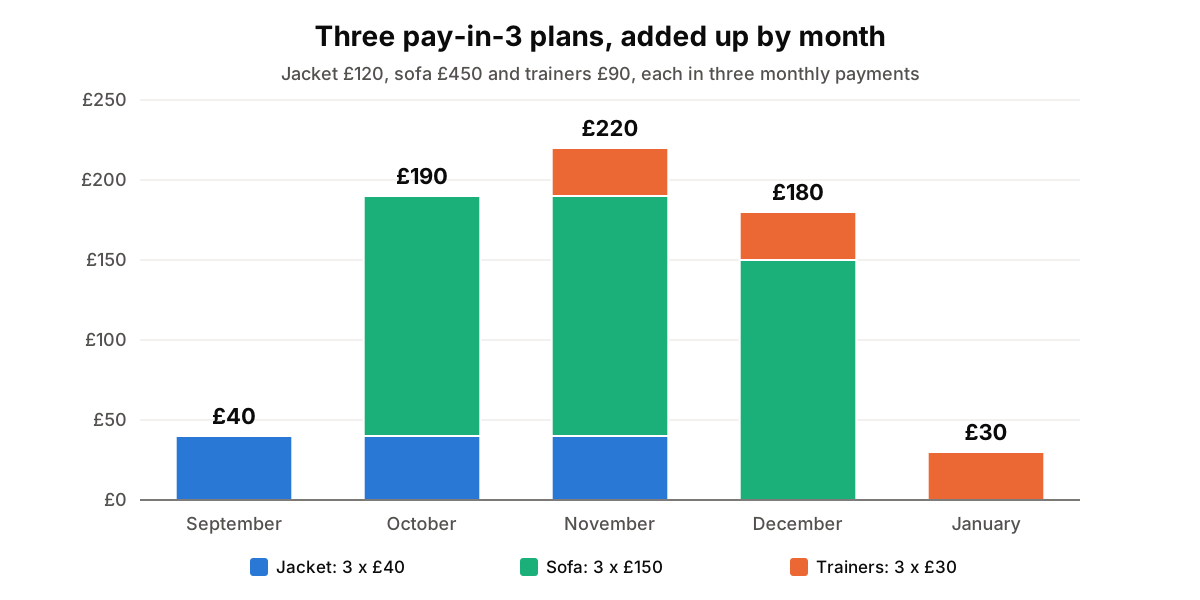
Each lender's affordability check looks at its own plan. The £220 in November is what lands on your bank account, in the same month as Christmas shopping. Add every instalment to your monthly budget, in the month it falls, before taking the next one.
A UK checklist before "pay in 3"
- Is the lender separate from the shop, and authorised? Then the July 2026 protections apply. Check the FCA Firm Checker.
- Is the cash price over £100? Then Section 75 can apply to a regulated plan.
- What is the late fee? It must be in the information you get before signing.
- Is it DPC or interest-bearing credit? Anything over 12 months, or charging interest, is the second kind; compare its APR with a credit card or a personal loan.
- What else is due that month? List all your plans together.
If you are struggling with repayments, contact the lender, which must provide support under the FCA's rules; the FCA also points to MoneyHelper's free debt guidance and its Debt Advice Locator. This page explains the rules; it is not personal financial advice.
Frequently asked questions
Is Buy Now Pay Later regulated in the UK?
Interest-free BNPL, called Deferred Payment Credit, has been regulated by the FCA since 15 July 2026 when the lender is a different business from the shop. Agreements made before that date, and plans offered by the shop itself, are not regulated.
Do I get Section 75 protection with Buy Now Pay Later?
On a regulated DPC agreement, the FCA says Section 75 is available. It covers single items with a cash price over £100 and up to £30,000.
Can I complain to the Financial Ombudsman about a BNPL lender?
Yes, for a regulated agreement. Complain to the lender first; if you are unhappy with the response, you can take it to the Financial Ombudsman Service.
Does a 0% plan have an APR?
A plan with no interest and no compulsory fees has an APR of 0%. Late fees are not included in an APR, so a missed payment can cost money even on a 0% plan.
Sources and further reading
- Buy Now Pay Later, Financial Conduct Authority. Regulation of DPC from 15 July 2026, what is and is not covered, affordability, information, complaints and Section 75.
- PS26/1: Regulation of Deferred Payment Credit, Financial Conduct Authority. The final rules, the DPC definition and the merchant and broking exclusions.
- Consumer Credit Act 1974, section 75, legislation.gov.uk. Joint liability and the £100 and £30,000 limits in subsection (3).
- Financial Ombudsman Service. Free complaints service for regulated financial products.
- Regulating Buy Now Pay Later, Financial Conduct Authority. When a DPC agreement is regulated, the exemptions, and the rule that agreements made before 15 July 2026 stay exempt.
- Buy now, pay later: pros, cons and hidden costs, RedBison. The US edition, with US credit reporting and late fee rules.