
Buy Now Pay Later in Ireland: Rules, Fees and Credit Checks
How Buy Now Pay Later works in Ireland: Central Bank authorisation, the 23% APR cap, late fees, the Central Credit Register's €500 line and stacked plans in euro.
By Redbison Dev · · 10 min read
Ireland edition. Written for Irish shoppers: Central Bank authorisation and the Consumer Protection Code, the 23% APR cap, the FSPO, Central Credit Register reporting from €500, and examples in euro. US edition
Buy Now Pay Later in Ireland is regulated credit. According to the Competition and Consumer Protection Commission (CCPC), BNPL providers have needed authorisation from the Central Bank of Ireland since 2022, are covered by the Consumer Protection Code, must check affordability and suitability, and are held to an interest rate cap of 23% APR (moneylenders excepted). Complaints the provider does not resolve can go to the Financial Services and Pensions Ombudsman. The weak spots are elsewhere: late fees, several small plans running at once, and the fact that plans under €500 may not appear on the Central Credit Register that other lenders check. This edition works through those in euro with the Irish APR calculator.
How BNPL is sold in Ireland
The CCPC's Buy Now Pay Later guide describes two broad shapes, split at €500:
| Purchase | Usual options | Credit check and interest |
|---|---|---|
| Under €500 | Interest-free instalments, fortnightly or monthly, over three to six months; or one interest-free payment within 14 or 30 days | No interest if paid on time |
| €500 or more | Payments spread over six to 36 months | A credit check, and interest may be charged |
The CCPC points out that some providers in the second group are regulated high-cost credit providers that charge more than banks or building societies, and that the shop and the BNPL provider are usually different companies, so you sign a separate credit agreement with the provider. BNPL can also appear as the default option at an online checkout; check the payment method before you pay.
The rules that protect you
From the CCPC guide:
- Authorisation. Since 2022, BNPL providers must be authorised by the Central Bank of Ireland and follow the Consumer Protection Code.
- Time to think. You should be given enough time during the purchase to consider whether the product is right for you.
- Affordability and suitability checks before you are given credit.
- A 23% APR cap on interest, except for moneylenders.
- Complaints go first to the provider, then to the Financial Services and Pensions Ombudsman.
What the rules do not do is stop you holding several plans with different providers, each of which looks affordable on its own.
Late fees: the real cost of 0%
An interest-free plan paid on time costs nothing extra. A missed instalment is where the money goes. The CCPC gives an illustration (it stresses that real fees vary by provider):
| Order value | Late fee in the CCPC illustration |
|---|---|
| €20 | €5 |
| €150 | €30, because the fee is capped at 20% of the order |
| €200 | €35, the cap in money |
On the €20 order, one late fee adds a quarter to the price. The CCPC also notes that some providers charge no interest even on late payments but block further purchases, and some let you "snooze" a payment for a fee. If a debt stays unpaid, it can be passed to a debt collection agency.
Converting a fee into an APR
A set-up or "snooze" fee on an interest-free plan is still a cost of credit, and the APR shows how big it is. Take a €900 purchase over 6 monthly payments of €150 at 0% interest, with a €25 fee. In the Irish APR calculator, enter 900, 0%, 6 months and a €25 fee deducted from the loan: you effectively borrow €875 and repay €900, and the APR is 10.18% as an annual effective rate. The fee is under 3% of the price, but you have the money for only a few months on average.
For a longer plan with interest, the calculator gives the repayment and the cost. A €1,500 sofa over 24 months at an interest rate of 18% costs €74.89 a month and €297.27 in interest, an APR of 19.56%.
What the 23% cap means for the interest rate
Because the APR is an annual effective rate, a rate quoted per year but charged monthly is lower than the APR it produces. Charged monthly with no fees, an annual interest rate of about 20.88% compounds to 23% APR. An offer of 21% a year charged monthly works out at 23.14%, over the cap. That is one reason to compare BNPL offers on APR, not on the headline rate.
Worked example: three small plans at once
Suppose you buy boots for €240 in October (3 x €80), a games console for €450 in November (6 x €75) and a €60 jacket in December (3 x €20), all on monthly BNPL plans:
| Month | Boots | Console | Jacket | Total due |
|---|---|---|---|---|
| October | €80 | €80 | ||
| November | €80 | €75 | €155 | |
| December | €80 | €75 | €20 | €175 |
| January | €75 | €20 | €95 | |
| February | €75 | €20 | €95 | |
| March | €75 | €75 | ||
| April | €75 | €75 |
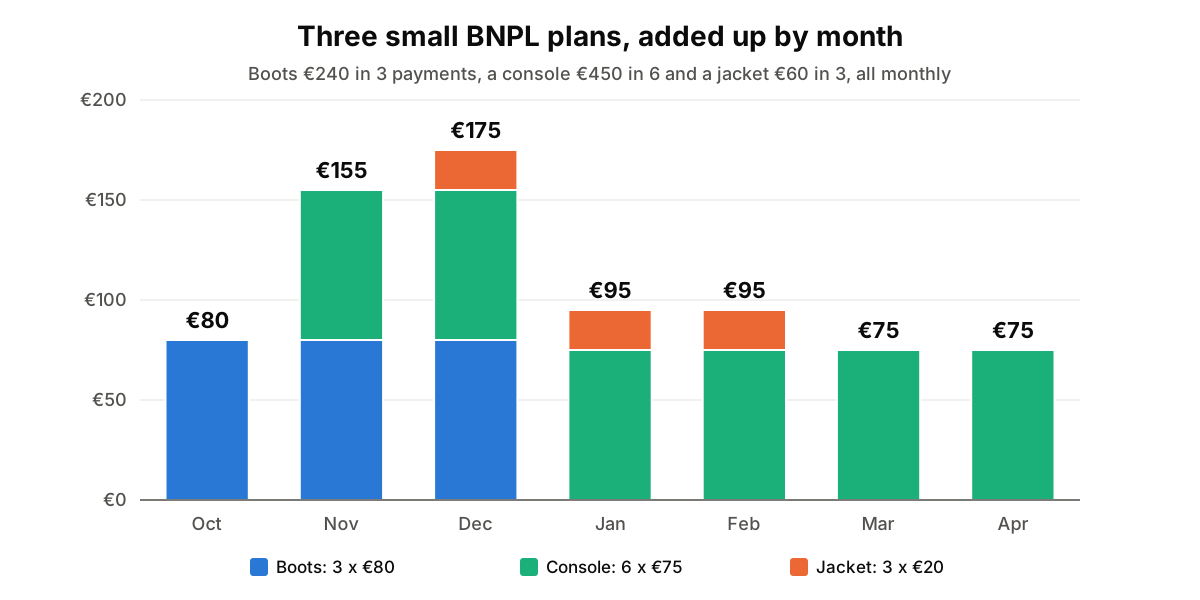
December carries €175 of instalments on top of Christmas. Each provider's check looked at its own plan.
The Central Credit Register and the €500 line
The Central Credit Register, set up by the Central Bank under the Credit Reporting Act 2013, holds credit and personal information on loans of €500 or more, and lenders must report loans at that level. The CCPC says BNPL agreements of €500 or more may be reported, and once they are, other lenders can see them.
That has two effects in the example above:
- The three plans total €750, but each is under €500, so none of them need appear on the register. The next lender's check may not see them at all.
- The €1,500 sofa plan is over the line, so missed payments on it can show on your credit report.
You can request your own Central Credit Register report free of charge, subject to fair use. Each time a lender looks at your report it leaves a footprint, which stays visible for five years after that lender's last access.
An Irish checklist
- Is the provider authorised by the Central Bank? It should be.
- Is this plan under or over €500? That decides whether interest and Central Credit Register reporting are likely.
- What is the late fee, and is there a cap? It should be in the agreement.
- What is the APR? Any fee or interest makes it more than 0%. The CCPC gives the 23% cap but excludes moneylenders, and notes that some BNPL providers are high-cost credit providers with higher rates, so check which kind you are dealing with.
- What else is due that month? Add up every plan.
If repayments are getting difficult, contact the provider early, before a late fee or a debt collector is involved. This page explains the rules; it is not personal financial advice.
Frequently asked questions
Is Buy Now Pay Later regulated in Ireland?
Yes. The CCPC says BNPL providers have needed Central Bank of Ireland authorisation since 2022 and are covered by the Consumer Protection Code, including affordability and suitability checks.
Does Buy Now Pay Later show on the Central Credit Register?
Agreements of €500 or more may be reported, according to the CCPC, and the register records loans of €500 or more. Smaller plans are below that line.
What is the maximum interest on BNPL in Ireland?
The CCPC says interest rates are capped at 23% APR, except for moneylenders. Charged monthly with no fees, that is an annual interest rate of about 20.88%.
Where can I complain about a BNPL provider?
Complain to the provider first. If you are not satisfied, you can take the complaint to the Financial Services and Pensions Ombudsman.
Sources and further reading
- Buy Now Pay Later, Competition and Consumer Protection Commission. Payment options, late fee illustration, Central Bank authorisation, the 23% APR cap, FSPO and Central Credit Register reporting.
- Central Credit Register, Central Bank of Ireland. Loans of €500 or more under the Credit Reporting Act 2013.
- Central Credit Register FAQ, Central Bank of Ireland. Reporting obligation, free credit reports and footprints.
- Consumer protection codes and regulations, Central Bank of Ireland.
- Financial Services and Pensions Ombudsman. Complaints about regulated financial service providers.
- Buy now, pay later: pros, cons and hidden costs, RedBison. The US edition.