
Buy Now Pay Later NZ: Your Rights, Fees and Hardship Help
How Buy Now Pay Later works in New Zealand under the CCCFA: credit checks, default fees, hardship applications, dispute schemes and fortnightly plans in NZ$.
By Redbison Dev · · 10 min read
New Zealand edition. Written for New Zealand shoppers: the CCCFA and the 2023 Buy Now, Pay Later regulations, hardship applications, the four financial dispute resolution schemes, and fortnightly plans in NZ dollars. US edition
In New Zealand, Buy Now Pay Later providers must follow the responsible lending principles of the Credit Contracts and Consumer Finance Act (CCCFA) and the Credit Contracts and Consumer Finance (Buy Now, Pay Later) Amendment Regulations 2023. In practice that means a credit check before you get an account or a higher limit, clear information on default fees, the right to ask for a hardship change, and a free dispute resolution scheme if you cannot sort out a complaint. What the rules do not stop is the usual BNPL problem: several fortnightly plans running at once, each affordable on its own. This edition sets out the NZ rules from Consumer Protection (MBIE) and adds up fortnightly plans in NZ dollars.
How BNPL works here
Consumer Protection's BNPL page describes the usual pattern. You open an account with a provider, buy goods, and receive them once the first payment is made. Payments are locked in, "usually weekly or fortnightly", and may come straight out of your bank account. If you miss one, default fees may be charged, and that "may also affect your credit rating".
Two points differ from other credit in New Zealand:
- No cooling-off period. The CCCFA normally gives five working days to cancel a credit contract (longer if the documents were emailed or posted), but the Consumer Protection CCCFA page says this does not apply to BNPL purchases. BNPL providers let you cancel at any time by repaying the debt.
- You may not be able to cancel the sale after the first payment. Returns follow the shop's own policy and the Consumer Guarantees Act; a refund goes back to your BNPL account, and you can ask for it to be paid to your bank account.
What providers must do
Under the CCCFA and the 2023 BNPL regulations, the Consumer Protection page says BNPL providers must:
| Duty | What it means for you |
|---|---|
| Give key information | Your contract terms, changes to them, and the timing and amount of default fees |
| Run credit checks | To make sure you can afford the credit without substantial hardship, including when you ask for a higher limit |
| Help you understand | What you are signing up to, before you sign |
| Treat you fairly | Including how they behave when you cannot pay |
| Tell you about dispute resolution | The scheme they belong to, for complaints and hardship applications |
| Point you to help | Information about financial mentoring if you miss payments |
If a provider breaks these rules, you can apply to have the contract changed or cancelled, and you may be able to get compensation and statutory damages.
If you cannot make the payments
Talk to the provider first. You have the right to ask for changes to a credit contract when unforeseen circumstances, such as illness, injury, losing your job or the end of a relationship, cause hardship. One rule worth knowing: you can make only one hardship application on the same grounds in any four-month period, unless the provider agrees to consider another. Put everything into the first one.
A free financial mentor can help you prepare the application or talk to the lender for you; Consumer Protection points to the MoneyTalks helpline.
If the provider goes out of business, you still owe the payments, and you keep the goods.
Complaints: four free schemes
Consumer Protection's guide to complaining about a financial service provider says every bank, lender and retail financial service provider must belong to a financial dispute resolution scheme. There are four: the Banking Ombudsman Scheme, the Insurance & Financial Services Ombudsman Scheme, Financial Services Complaints Limited and the Financial Dispute Resolution Service. They are free and an alternative to court, and you do not need a lawyer. Your provider must tell you which one it belongs to. Keep notes of dates and what was said.
Worked example: fortnightly plans by the month
Because NZ plans are usually fortnightly, a month can carry three payments from one plan. Suppose you set up three pay-in-four plans, each paid every 14 days:
| Plan | Price | Payment | Due dates |
|---|---|---|---|
| A | NZ$240 | NZ$60 | 2, 16 and 30 October, 13 November |
| B | NZ$360 | NZ$90 | 16 and 30 October, 13 and 27 November |
| C | NZ$120 | NZ$30 | 6 and 20 November, 4 and 18 December |
Added up by calendar month:
| Month | Plan A | Plan B | Plan C | Total |
|---|---|---|---|---|
| October | NZ$180 | NZ$180 | NZ$360 | |
| November | NZ$60 | NZ$180 | NZ$60 | NZ$300 |
| December | NZ$60 | NZ$60 |
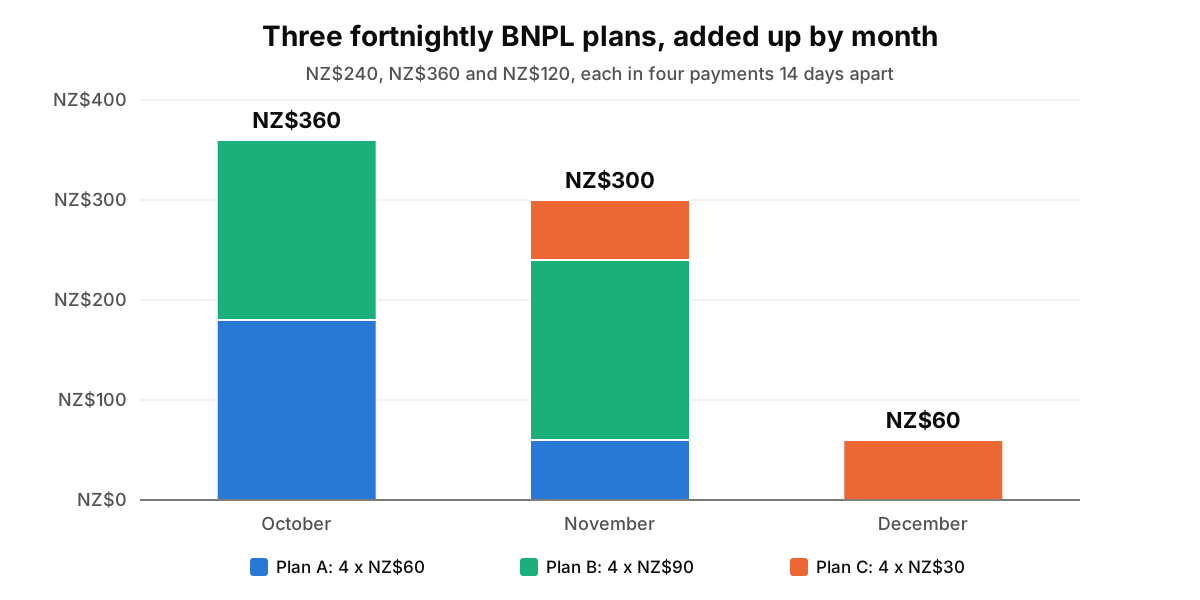
October carries NZ$360 even though no single plan costs more than NZ$90 a fortnight, because plan A's first three payments all fall in it. If you are paid monthly, line the due dates up against your pay day, not against a four-week month. Sorted's guide to starting a budget is a good place to list them.
When a fee turns 0% into a cost
BNPL is interest-free, but any account or service fee is still a cost of credit. To see its size, put it into the APR Calculator. For a NZ$1,000 purchase over 6 monthly payments with a NZ$30 fee paid up front, enter 1000, 0%, 6 months and a NZ$30 fee: you effectively borrow NZ$970 and repay NZ$1,000. With "APR stated as" left on Nominal (12 x the monthly rate), the calculator gives 10.53% a year; switched to Annual effective, it gives 11.05%. Compare that with what the same purchase would cost on a credit card you clear in full, or simply with waiting.
A New Zealand checklist
- Is this an everyday need? Consumer Protection suggests talking to a budgeting adviser if you are using BNPL for food and petrol.
- When exactly are the payments? Fortnightly plans do not line up with months.
- What is the default fee? It must be disclosed.
- Which dispute scheme is the provider in? It should tell you.
- Do you need a hardship change? Ask early and include everything, because of the four-month rule.
This page explains the rules; it is not personal financial advice.
Frequently asked questions
Is Buy Now Pay Later regulated in New Zealand?
Yes. BNPL providers must follow the CCCFA's responsible lending principles and the Credit Contracts and Consumer Finance (Buy Now, Pay Later) Amendment Regulations 2023, including credit checks and disclosure of default fees.
Is there a cooling-off period for BNPL in NZ?
No. The CCCFA's cooling-off period does not apply to BNPL purchases, but providers let you cancel the BNPL contract at any time by repaying what you owe.
What can I do if I cannot afford my BNPL payments?
Contact the provider and make a hardship application. You can make one application on the same grounds in any four-month period. A free financial mentor, for example through MoneyTalks, can help.
Who do I complain to about a BNPL provider?
Complain to the provider first, then to its financial dispute resolution scheme. All lenders must belong to one of the four free schemes.
Sources and further reading
- Buy Now Pay Later, Consumer Protection, Ministry of Business, Innovation and Employment. How BNPL works, provider duties under the 2023 regulations, hardship and refunds.
- Credit Contracts and Consumer Finance Act, Consumer Protection. Cooling-off periods and why they do not apply to BNPL.
- How to complain about your financial service provider, Consumer Protection. The four financial dispute resolution schemes.
- MoneyTalks. Free financial helpline and referrals to budgeting services.
- How to start a budget, Sorted.
- Buy now, pay later: pros, cons and hidden costs, RedBison. The US edition.