
Injector Sizing for a Remap: bhp, cc/min and Bar
Size injectors for a bhp target in cc/min at 3 bar: rolling-road figures to crank bhp, PS to bhp, BSFC, 80% duty, the square-root pressure rule and E5 or E10 petrol.
By Redbison Dev · · 10 min read
United Kingdom edition. UK edition in bhp, PS, cc/min and bar, starting from rolling-road figures, with E10 and E5 pump petrol and the MOT emissions check in mind. US edition
To size fuel injectors, multiply the engine's power at the flywheel by its brake specific fuel consumption (BSFC), then share that fuel between the injectors at no more than about 80% duty. A turbocharged four making 260 bhp at the wheels on a rolling road is about 306 bhp at the flywheel, burns about 183.5 lb of petrol an hour at full load, and needs roughly 600 cc/min per injector at 3 bar. A 650 cc injector covers it with headroom; raise the rail to 4 bar and a 550 cc injector does the same job.
This edition works in the units UK tuners use: bhp and PS, cc/min and bar. Every figure comes from the Fuel Injector Size Calculator (UK). The American version of this article, in lb/hr and psi, is here.
The formula
per-injector flow (lb/hr) = crank bhp × BSFC ÷ (injectors × max duty)
cc/min                    ≈ lb/hr × 453.6 ÷ 60 ÷ fuel density (g/cc)
BSFC is usually quoted in lb per hp per hour, which is why the middle of the sum is in lb/hr even in Britain. For petrol at a specific gravity of 0.72, lb/hr × 10.5 gives cc/min.
Step 1: get the power at the flywheel
BSFC is defined at the crank, so the power figure has to be too.
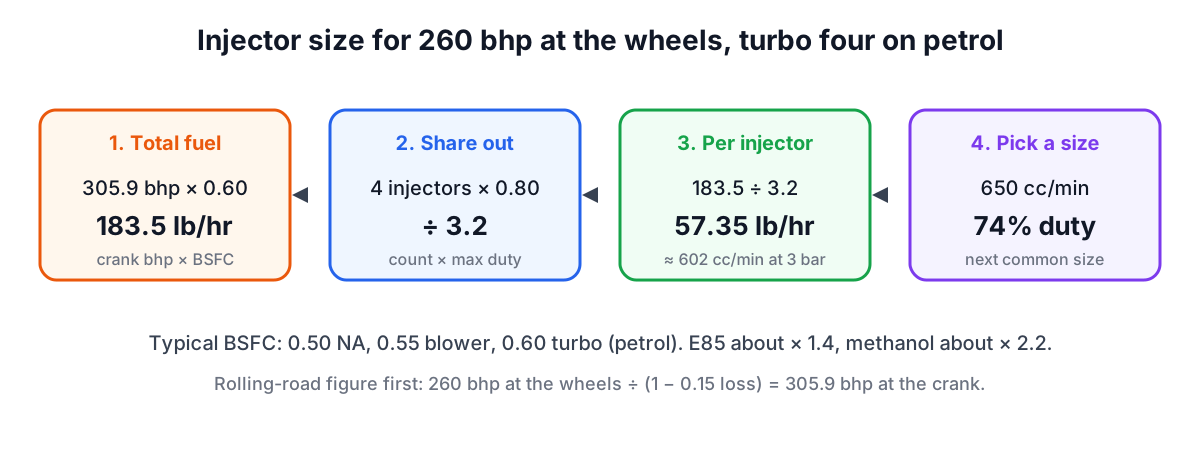
From a rolling road. Most UK rolling roads print wheel power and an estimated flywheel figure, and the flywheel number depends on the loss each operator assumes. If you only have wheel bhp, divide by (1 − loss). With 15% loss, 260 bhp at the wheels is 260 ÷ 0.85 = 305.9 bhp at the flywheel. Front-wheel-drive manuals lose least; automatics and four-wheel drive lose more. Whatever you choose, do not mix wheel and flywheel numbers.
From a manufacturer's figure in PS. European makers quote metric horsepower (PS), which is slightly smaller than the bhp in the formula: 1 PS = 735.5 W and 1 bhp = 745.7 W, so multiply PS by 0.9863. A remap target of 350 PS is 345.2 bhp. In kW, multiply by 1.341.
Step 2: choose BSFC
BSFC at full load depends mostly on induction and how rich the tune runs:
| Engine | Petrol BSFC (lb/hp·hr) |
|---|---|
| Naturally aspirated | 0.45 to 0.50 |
| Belt-driven blower | 0.55 to 0.60 |
| Turbocharged | 0.60 to 0.65 |
The calculator's presets are 0.50, 0.55 and 0.60. Turbo engines run richer at full boost to keep exhaust gas temperatures and knock in check, so they need more fuel per bhp. If your rolling road measured fuel flow, work out your own: BSFC = fuel flow (lb/hr) ÷ bhp. A 0.05 change in BSFC moves the answer by 8 to 10%.
Step 3: leave headroom with duty cycle
Duty cycle is the share of each engine cycle the injector is open. In a four-stroke, each cylinder fires once every two revolutions, so at 6,500 rpm one cycle lasts 60 ÷ 6,500 × 2 = 18.5 ms. At 80% duty the injector is open for 14.8 ms of it.
Size for about 80% at peak power. Above 85 to 90% the injector struggles to close and reopen cleanly, and there is nothing left for a hot day, a tired pump or a richer map.
Worked example 1: a stage 2 turbo four
Rolling-road result 260 bhp at the wheels, front-wheel drive, 15% loss, turbo BSFC 0.60, four injectors, 80% duty, injectors rated at 3 bar:
- Flywheel: 260 ÷ 0.85 = 305.9 bhp.
- Fuel at full load: 305.9 × 0.60 = 183.5 lb/hr.
- Per injector: 183.5 ÷ (4 × 0.80) = 57.35 lb/hr = 602.2 cc/min at 3 bar.
- Next common size: 650 cc/min, which runs at about 74% duty.
If the car's stock injectors are 440 cc, the reverse calculation shows their ceiling: 4 × 440 cc/min at 80% duty and BSFC 0.60 supports about 223.5 bhp at the flywheel, or 190 bhp at the wheels. Many "stage 2" maps on small turbo engines reach that ceiling before the turbo runs out, which is why bigger injectors often come with the second stage.
Worked example 2: a remap quoted in PS
A hot hatch remapped to 350 PS: 350 × 0.9863 = 345.2 bhp at the flywheel. With turbo BSFC 0.60, four injectors and 80% duty, each needs 64.73 lb/hr, or 679.6 cc/min at 3 bar. The next common size is 750 cc/min.
Many modern hot hatches use direct injection, where injectors run at a hundred bar or more and are sized by the engine maker with their own pumps. This calculator is for port injection, or for the port injectors on engines that have both.
Worked example 3: a naturally aspirated track car
A 2.0 litre four making 200 bhp at the flywheel, naturally aspirated, BSFC 0.50, four injectors at 80%: 200 × 0.50 ÷ 3.2 = 31.25 lb/hr = 328.1 cc/min. A 380 cc injector runs it at about 69% duty. Sizing an NA engine with a turbo BSFC would push you towards injectors 20% bigger than needed, and oversized injectors make idle and low-speed fuelling harder to tune.
Fuel pressure in bar: the square-root rule
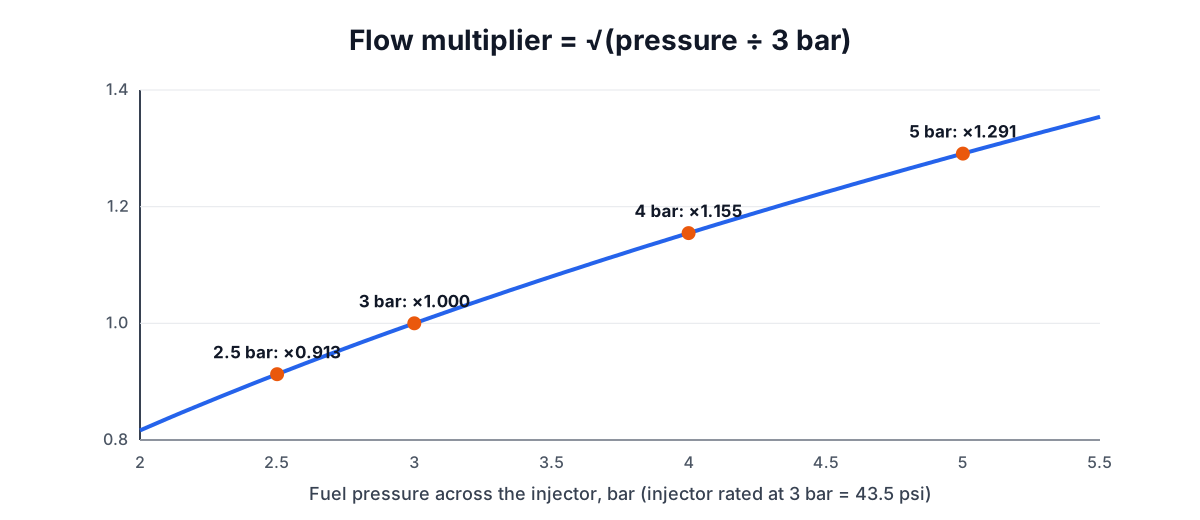
Injector flow rises with the square root of the pressure difference across it:
flow at new pressure = rated flow × √(new pressure ÷ rated pressure)
Most injector ratings in UK catalogues are at 3 bar (43.5 psi); check your data sheet, because some makers rate at 4 bar. Running the rail at 4 bar multiplies flow by √(4 ÷ 3) = 1.155. In worked example 1 that means a 521.5 cc/min injector (rated at 3 bar) would deliver the 602 cc/min needed, so a 550 cc injector at 4 bar does the work of a 650 at 3 bar, provided the pump keeps up at the higher pressure.
On a boosted engine the pressure that counts is rail pressure minus manifold pressure. A 1:1 rising-rate regulator keeps that difference constant under boost. A returnless system with a fixed rail pressure loses effective pressure as boost rises, so the ECU has to lengthen the pulse.
The same rule shows what higher pressure does to injectors you already have: 4 × 440 cc at 4 bar instead of 3 supports about 258 bhp at the flywheel instead of 223.5.
Petrol in the UK: E10, E5 and E85
Standard 95 octane petrol at UK forecourts has been E10, up to 10% ethanol, since September 2021 in Great Britain and November 2022 in Northern Ireland. Super grades of 97 octane and above remain E5. GOV.UK says E10 can reduce fuel economy by around 1%, which is far inside the margin of an 80% duty target, so it does not change injector size.
If a build is to run on E85, choose E85 in the calculator's fuel list: it scales BSFC by 1.4 and uses a density of 0.78. The turbo four in worked example 1 would need about 40% more fuel by mass on E85, roughly 30% more in cc/min, which usually means a size or two up and a bigger pump.
Beyond the injectors
- The pump. The pump must supply every injector at full duty, at the rail pressure plus boost on a rising-rate system. Pump curves are usually given in litres per hour against pressure, and fall steeply as pressure rises.
- The MOT. Bigger injectors with a poor map can fail the emissions test or trip an engine warning light. DVSA's inspection manual covers exhaust emissions in section 8.2.
- Insurance. Modifications that change engine performance usually need declaring to your insurer.
Tools for this job
- Fuel Injector Size Calculator (UK): injector size from a bhp, PS or kW target, or the power a set of injectors supports, in cc/min and bar.
- Horsepower Calculator: estimate power from other measurements.
- Compression Ratio Calculator: compression for a boosted build.
- The guide to torque, horsepower and rpm explains how a rolling-road torque curve becomes a power figure.
Frequently asked questions
What size injectors do I need for 300 bhp?
On a turbocharged four running petrol, at 80% duty and injectors rated at 3 bar, about 591 cc/min each (56.25 lb/hr), so a 650 cc injector leaves margin. A naturally aspirated 300 bhp engine needs less because its BSFC is lower.
How do I convert rolling-road wheel bhp to flywheel bhp?
Divide by (1 − drivetrain loss). With 15% loss, 260 bhp at the wheels is 305.9 bhp at the flywheel. Ask the operator what loss their flywheel estimate assumes, and use the same basis for every comparison.
Are bhp and PS the same?
No. 1 PS is 735.5 W and 1 bhp is 745.7 W, so 1 PS is 0.9863 bhp. A 350 PS figure is 345.2 bhp. The difference is small, but convert before sizing.
Will 440 cc injectors support a stage 2 map?
On a turbo four at BSFC 0.60 and 80% duty, four 440 cc injectors at 3 bar support about 223.5 bhp at the flywheel. Above that you need bigger injectors or higher fuel pressure, and a pump that keeps up.
Sources and further reading
- E10 petrol explained, Department for Transport. Standard 95 octane E10, super 97+ E5; about 1% lower fuel economy.
- MOT inspection manual: nuisance, including exhaust emissions, Driver and Vehicle Standards Agency. Section 8.2 emissions checks.
- Fuel Properties Comparison, US Department of Energy AFDC. Energy content of petrol, E85 and methanol.
- E85 (Flex Fuel), US Department of Energy AFDC. Ethanol blend properties.
- SI Brochure: The International System of Units, Bureau International des Poids et Mesures. The watt and pascal behind the PS, bhp and bar conversions.
Open the Fuel Injector Size Calculator
More Automotive
Every tool in the Automotive section, free and in your browser.