
Injector Sizing in kW: cc/min, Bar and Australian E85
Size injectors for a kW target in cc/min at 3 bar: rwkW to crank kW, BSFC, 80% duty, the square-root pressure rule, and why E85 here can be 70 to 85% ethanol.
By Redbison Dev · · 10 min read
Australia edition. Australian edition in kW, rwkW, cc/min and bar, with 91, 95 and 98 pump petrol, E85 that the national standard allows anywhere from 70 to 85% ethanol, and turbo six and V8 examples. US edition
To size fuel injectors, take the engine's power at the crank, multiply by its brake specific fuel consumption (BSFC), and share that fuel between the injectors at no more than about 80% duty. A turbocharged six making 300 kW at the crank on 98 needs about 528 cc/min per injector at 3 bar, so 550 cc injectors only just cover it. Switch the same engine to E85 and the requirement jumps to about 682 cc/min, which is why E85 conversions here so often go to 750 or 1000 cc injectors.
This edition works in kilowatts, because Australian dyno sheets and manufacturers quote kW, and in cc/min and bar. The numbers come from the Fuel Injector Size Calculator (kW). The American version of this article, in horsepower, lb/hr and psi, is here.
The formula, in kW
BSFC is almost always quoted in lb per horsepower per hour, so the calculator converts kW to hp first (× 1.341), then:
per-injector flow (lb/hr) = crank hp × BSFC ÷ (injectors × max duty)
cc/min                    ≈ lb/hr × 453.6 ÷ 60 ÷ fuel density (g/cc)
For petrol at a specific gravity of 0.72, lb/hr × 10.5 gives cc/min. E85 is denser, at about 0.78.
Step 1: from rwkW to crank kW
A chassis dyno measures at the wheels, and most Australian sheets print rwkW. BSFC is defined at the crank, so divide by (1 − drivetrain loss). With 15% loss, 250 rwkW is 250 ÷ 0.85 = 294.1 kW at the crank, or 394.4 hp. Automatics and all-wheel drive usually lose more than a manual rear-driver. The exact loss is a guess, so stay consistent rather than mixing wheel and crank figures.
Step 2: BSFC for the build
| Engine | BSFC on petrol (lb/hp·hr) | On E85 (× 1.4) |
|---|---|---|
| Naturally aspirated | 0.50 | 0.70 |
| Belt-driven blower | 0.55 | 0.77 |
| Turbocharged | 0.60 | 0.84 |
These are the calculator's presets, and they sit in the middle of the ranges tuners use (0.45 to 0.50 NA, 0.55 to 0.60 blown, 0.60 to 0.65 turbo). If your dyno logs fuel flow, calculate your own BSFC as fuel flow ÷ power.
Step 3: duty cycle
At 7,000 rpm one four-stroke cycle takes 60 ÷ 7,000 × 2 = 17.1 ms, so an injector at 80% duty is open for 13.7 ms. Size for 80% to 85% at peak power. That leaves room for a hot day in January, a tired pump or a richer map.
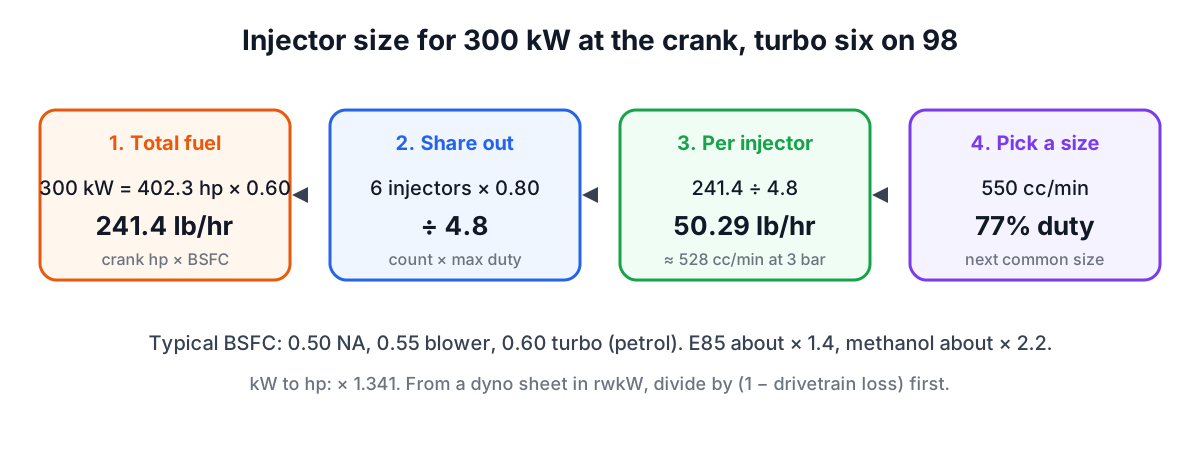
Worked example 1: 300 kW turbo six on 98
300 kW at the crank, turbo BSFC 0.60, six injectors, 80% duty, rated and run at 3 bar:
- 300 kW × 1.341 = 402.3 hp.
- Fuel: 402.3 × 0.60 = 241.4 lb/hr.
- Per injector: 241.4 ÷ (6 × 0.80) = 50.29 lb/hr = 528.0 cc/min.
- A 550 cc injector runs at about 77% duty; a 650 cc gives more room for the next step.
Reverse it to check what injectors already on the car support. Six 550 cc injectors at 3 bar and 80% duty support about 312.5 kW at the crank on petrol, or about 265.6 rwkW at 15% loss.
Worked example 2: the same engine on E85
Australian E85 is not fixed at 85% ethanol. The Fuel Quality Standards (Ethanol E85) Determination 2024 requires E85 to contain 70 to 85% ethanol by volume. More ethanol means more fuel for the same power, so size for the richest blend and let a flex-fuel sensor and the ECU trim for whatever is in the tank.
With the E85 preset (BSFC 0.84, density 0.78):
- Per injector: 70.40 lb/hr = 682.4 cc/min at 3 bar. A 750 cc injector covers it.
- Run the rail at 4 bar and the rating you need at 3 bar falls to 590.9 cc/min, so a 650 cc injector does it.
That is about 29% more flow in cc/min than on 98, and about 40% more fuel by mass. The pump has to deliver that extra volume too, and every part of the fuel system must be ethanol compatible.
Worked example 3: from the dyno sheet
A turbo six makes 250 rwkW on 98 and the owner wants to know what injectors an E85 tune will need for the same power:
| On 98 (BSFC 0.60) | On E85 (BSFC 0.84) | |
|---|---|---|
| Crank power | 294.1 kW (394.4 hp) | 294.1 kW |
| Fuel | 236.7 lb/hr | 331.3 lb/hr |
| Per injector at 3 bar | 517.7 cc/min | 669.0 cc/min |
| Next common size | 550 cc | 750 cc |
Worked example 4: a blown V8
A V8 with a belt-driven blower making 400 rwkW, 15% loss, eight injectors:
- On 98 (BSFC 0.55): 631.1 hp at the crank, 569.4 cc/min per injector. A 650 cc injector suits.
- On E85 (BSFC 0.77): 735.9 cc/min. A 750 cc injector would sit right at the 80% target with almost no margin, so most builders would go to 850 or 1000 cc.
Eight 1000 cc injectors on E85 at the same BSFC support about 639.5 kW at the crank, and six 1000 cc on E85 at turbo BSFC about 439.6 kW. On petrol, six 1000s support about 568.2 kW.
Fuel pressure: the square-root rule
Injector flow is proportional to the square root of the pressure difference across it:
flow at new pressure = rated flow × √(new pressure ÷ rated pressure)
Many injector ratings are quoted at 3 bar (43.5 psi); check the data sheet. At 4 bar flow is × 1.155, at 5 bar × 1.291 and at 2.5 bar × 0.913.
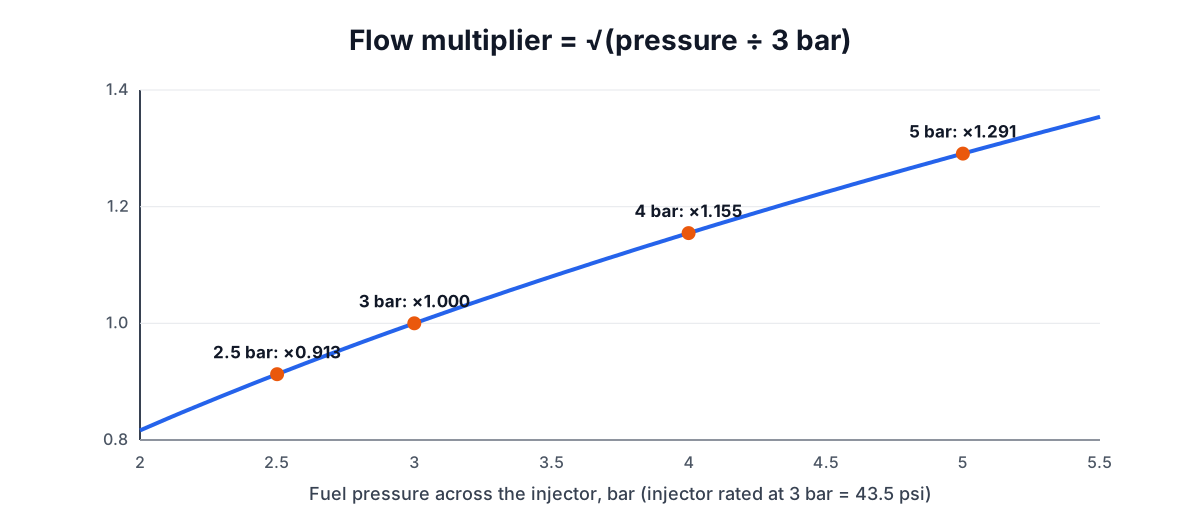
On a boosted engine, the pressure that counts is the difference between the rail and the manifold. A 1:1 rising-rate regulator holds that difference constant; a returnless system with a fixed rail loses effective pressure under boost, and the ECU must make up for it with longer pulses.
Pump fuel and paperwork
- Petrol. The Fuel Quality Standards (Petrol) Determination 2024 sets the minimum octane for regular unleaded at 91 RON and premium at 95 RON, with up to 10% ethanol allowed. E10 slightly raises fuel use for the same power, which an 80% duty target covers.
- Engineering. Bigger injectors are part of a tune, but the power increase they support may be a modification that needs certifying under your state's rules, which follow the National Code of Practice for Light Vehicle Construction and Modification (VSB 14). Ask a licensed vehicle certifier or your registration authority before a large power increase.
Tools for this job
- Fuel Injector Size Calculator (kW): injector size from a kW, rwkW or hp target, or the power a set of injectors supports, in cc/min and bar.
- Horsepower Calculator: estimate power from other measurements.
- Compression Ratio Calculator: compression for boosted and E85 builds.
- The guide to torque, horsepower and rpm explains how torque and rpm on a dyno sheet become kW.
Frequently asked questions
What size injectors do I need for 300 kW?
For a turbo six on petrol at 80% duty and 3 bar, about 528 cc/min each, so 550 cc with little margin or 650 cc with more. On E85 it is about 682 cc/min, so 750 cc.
How much ethanol is in Australian E85?
Between 70 and 85% by volume, under the Fuel Quality Standards (Ethanol E85) Determination 2024. Tuners size for the richest blend and use a flex-fuel sensor so the ECU adjusts for the actual content.
How do I convert rwkW to crank kW?
Divide by (1 − drivetrain loss). At 15% loss, 250 rwkW is 294.1 kW at the crank. The loss is an estimate, so use the same basis for every comparison.
How much power will six 1000 cc injectors support?
At 3 bar and 80% duty, about 568 kW at the crank on petrol with turbo BSFC 0.60, or about 440 kW on E85 with BSFC 0.84.
Sources and further reading
- Fuel Quality Standards (Ethanol E85) Determination 2024, Federal Register of Legislation. E85 must contain 70 to 85% ethanol by volume.
- Fuel Quality Standards (Petrol) Determination 2024, Federal Register of Legislation. 91 and 95 RON minimums; up to 10% ethanol.
- Fuel Properties Comparison, US Department of Energy AFDC. Energy content of petrol, E85 and methanol.
- E85 (Flex Fuel), US Department of Energy AFDC. Ethanol blend properties.
- SI Brochure: The International System of Units, Bureau International des Poids et Mesures. The watt and pascal behind kW, hp and bar.
Open the Fuel Injector Size Calculator
More Automotive
Every tool in the Automotive section, free and in your browser.