
Inflation and Savings in the UK: Goals in Today's Pounds
How UK inflation is measured (CPIH, CPI, RPI), how to set a savings goal in future pounds, and whether a cash ISA or savings account beats inflation after tax.
By Redbison Dev · · 8 min read
United Kingdom edition. Written for UK savers: ONS CPIH and CPI figures in pounds, the Bank of England 2% target, savings goals worked with an AER, the Lifetime ISA cap, the Personal Savings Allowance and FSCS protection. US edition
In 2025 the ONS CPIH index averaged 3.84% above 2024. A cash ISA paying 4% AER over that year kept its saver about 0.15% ahead in real terms. The same 4% in an ordinary account, taxed at 20% because the Personal Savings Allowance was already used, left the saver about 0.6% behind. That is the whole problem in one comparison: a savings plan in the UK has to beat a moving target, and it has to do it after tax.
This edition explains how UK inflation is measured, how to state a savings goal in the pounds of the year you need it, and how to tell whether your account is keeping up. The numbers come from the UK Inflation Calculator, which uses ONS CPIH and CPI, and the UK Savings Goal Calculator, so you can repeat each one. It covers the arithmetic, not which account to open; MoneyHelper's free guidance or a regulated adviser can help with that.
Three UK price indices, and which one to use
The Office for National Statistics publishes three measures that people quote, and they answer slightly different questions (ONS consumer price inflation bulletin).
| Index | What it covers | Use it for |
|---|---|---|
| CPIH | CPI plus owner occupiers' housing costs and council tax; the ONS lead measure | The broadest picture of household costs |
| CPI | The basket the Government sets the Bank of England's 2% target on | Comparing with the target; many benefits are uprated by it |
| RPI | An older index that does not meet the standard for accredited official statistics | Only where a contract or product names it |
To restate money from one year in another year's pounds, divide the two annual index values:
Value in year B = Amount × index(B) ÷ index(A)
On CPIH (2015 = 100) the annual index was 48.2 in 1988 and 138.0 in 2025, so £100 of 1988 spending needs £286.31 in 2025. On CPI it is £279.03. The average yearly rate over those 37 years is 2.88% on CPIH, which means a pound from 1988 buys about 35p of what it did then.
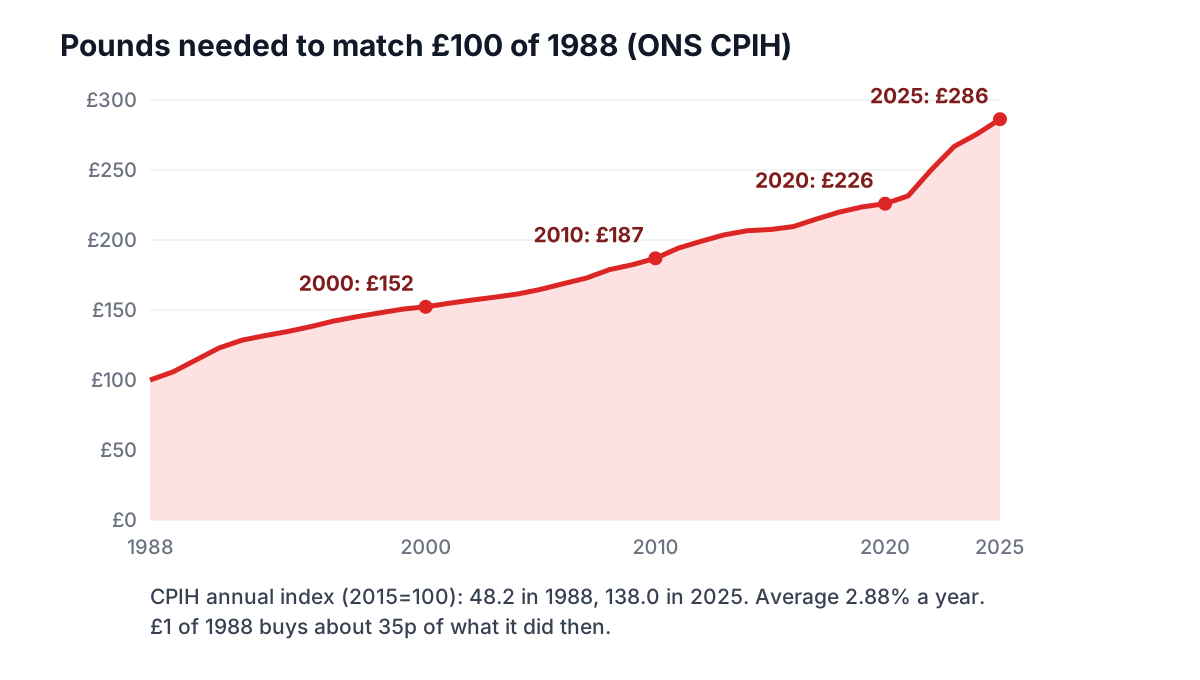
The averages hide the recent jump. From 2020 to 2025 CPIH rose 26.72%, an average of 4.85% a year, more than twice the target. Savings that sat in a 0.5% easy-access account through 2021 and 2022 lost a large slice of their value even though the balance never fell.
Annual averages against the monthly headline
The figure on the news is a 12-month rate for one month, such as September against the previous September. The calculator compares calendar-year averages, so its answer for "2024 to 2025" (3.84% on CPIH, 3.36% on CPI) will not match any single month's headline. For a salary or a savings balance over whole years, the annual average is the fairer comparison.
Projecting forward at the 2% target
The future has no index, so a plan uses an assumed rate:
Future cost = Today's cost × (1 + r)^years
The Bank of England's target is 2% on CPI, which makes it a sensible central case: £100 of shopping today costs £121.90 in ten years. At 2% prices double in 35 years, which the rule of 72 (72 ÷ 2 = 36) gets close to. Because inflation ran well above 2% for several recent years, run a cautious case too. This edition uses 3.5%.
Setting a savings goal in future pounds
Here is the mistake most plans make. Say you want a £30,000 house deposit in five years, you have £5,000 saved, and you can get 4% AER. The savings goal calculator gives the monthly amount:
| Goal used in the plan | Goal in 5 years | Monthly saving |
|---|---|---|
| £30,000 (today's prices, no inflation) | £30,000.00 | £361.39 |
| £30,000 inflated at 2% a year | £33,122.42 | £408.58 |
| £30,000 inflated at 3.5% a year | £35,630.59 | £446.48 |
All three use the AER with compounding set to annually, which is how UK banks quote savings rates; the UK compound interest guide explains why entering an AER as a monthly-compounded rate overstates the result.
The plan that ignores inflation reaches £30,000 on time and is still about £3,100 short of a deposit that has risen at 2%, or £5,600 short at 3.5%. Two steps fix it:
- In the UK Inflation Calculator, use the assumed rate mode to turn today's figure into the figure in your target year.
- Enter that future figure as the goal in the savings goal calculator and solve for the monthly amount.
Where the Lifetime ISA limit bites
If this is a first home costing £450,000 or less, a Lifetime ISA adds a 25% government bonus on up to £4,000 a year of your own money, so your share of each payment is the total divided by 1.25. At 2% inflation that is £408.58 ÷ 1.25 = £326.86 a month, £3,922 a year, inside the £4,000 cap. At 3.5% it is £357.18 a month, £4,286 a year, which goes over the cap: the extra would have to go into a cash ISA without the bonus, or the purchase date would move. The account must be open for 12 months before a penalty-free withdrawal for a first home, and you must open it before you turn 40. This treats the bonus as arriving with each payment, which simplifies when it is actually paid.
Real returns: is your account keeping up?
The gap between your interest rate and inflation is your real return, and the exact formula is:
Real rate = (1 + interest rate) ÷ (1 + inflation) − 1
Using the 2025 CPIH rise of 3.84% and an account paying 4% AER:
| Where the money is | Rate after tax | Real return |
|---|---|---|
| Cash ISA | 4.00% | +0.15% |
| Savings account, basic-rate taxpayer above the allowance (20%) | 3.20% | −0.62% |
| Savings account, higher-rate taxpayer above the allowance (40%) | 2.40% | −1.39% |
Against the 2% target instead, the cash ISA earns a real 1.96% and the basic-rate account 1.18%. So whether your savings beat inflation depends as much on tax as on the rate.
The tax side: ISAs and the Personal Savings Allowance
Interest in a cash ISA is tax-free, within the £20,000 overall ISA allowance for the 2026 to 2027 tax year. Outside an ISA, the Personal Savings Allowance covers £1,000 of interest a year for basic-rate taxpayers and £500 for higher-rate taxpayers; additional-rate taxpayers get none. At 4%, a basic-rate taxpayer uses the whole allowance with about £25,000 saved, so larger emergency funds and deposits start paying tax. From April 2027 two announced changes make the ISA gap wider: the cash ISA limit for savers under 65 falls to £12,000, and income tax rates on savings income rise by 2 percentage points.
Money left alone for ten years
£20,000 left for ten years at 4% AER grows to £29,604.89. In present-day money that is £24,286.32 if inflation averages 2%, and £22,028.82 at 3%. The balance rises by almost half; its buying power rises by a fifth at best.
Safety: the FSCS limit
Deposits with a UK-authorised bank, building society or credit union are protected up to £120,000 per person per authorised firm, a limit that applies to firms failing from 1 December 2025 (Bank of England FSCS explainer). Some banking brands share one licence, so check before spreading a large house deposit across names that are really one firm.
A short UK checklist
- State the goal in the pounds of the year you need it, using 2% and a cautious rate such as 3.5%.
- Enter the AER with annual compounding.
- Use the after-tax rate for money outside an ISA once your interest passes the Personal Savings Allowance.
- For a first home, check whether the Lifetime ISA's £4,000 cap covers your monthly amount.
- Rerun the plan each April, when allowances reset and the ONS has published the previous year's index, and change the monthly amount rather than the goal.
Frequently asked questions
What is an old amount of money worth today in the UK?
On the ONS CPIH annual index, £100 of 1988 spending needs £286.31 in 2025 money, an average of 2.88% a year. On CPI the answer is £279.03. The two differ because CPIH includes owner occupiers' housing costs and council tax.
Should I use CPIH, CPI or RPI to check my savings?
Use CPIH for the broadest measure of household costs or CPI to compare with the Bank of England's 2% target. RPI does not meet the standard for accredited official statistics and is only worth using where a product or contract is linked to it.
Does a cash ISA beat inflation?
It depends on the year. In 2025 CPIH rose 3.84%, so a 4% AER cash ISA earned a real return of about 0.15%. The same 4% outside an ISA, taxed at 20%, fell about 0.62% behind. At the 2% target the ISA would be about 1.96% ahead.
How do I include inflation in a house deposit savings plan?
Inflate today's deposit to the year you plan to buy, then save towards that figure. A £30,000 deposit in five years at 2% inflation becomes £33,122.42, which needs £408.58 a month at 4% AER with £5,000 already saved, instead of £361.39.
What inflation rate should I assume for UK savings goals?
The Bank of England's 2% CPI target is a reasonable central case. Because CPIH averaged 4.85% a year from 2020 to 2025, also test a cautious rate such as 3.5% and plan to the higher monthly amount if you can.
Sources and further reading
- Consumer price inflation, UK: latest release, Office for National Statistics. CPIH as the lead measure, CPI and RPI.
- CPIH index, all items, 2015=100 (L522), Office for National Statistics. Annual index values used here.
- CPI index, all items, 2015=100 (D7BT), Office for National Statistics. The index behind the 2% target.
- Inflation and the 2% target, Bank of England. The target and how it is set.
- Individual Savings Accounts, GOV.UK. The £20,000 allowance for 2026 to 2027.
- Lifetime ISA, GOV.UK. The £4,000 limit, 25% bonus and first-home rules.
- Tax on savings interest: how much is tax free, GOV.UK. The Personal Savings Allowance.
- What is the Financial Services Compensation Scheme?, Bank of England. The £120,000 deposit limit.
Open the Savings Goal Calculator
More Calculators
Every tool in the Calculators section, free and in your browser.
- Investment Calculator
- Compound Interest Calculator
- Simple Interest Calculator
- Interest Calculator
- EMI Calculator
- Retirement Calculator
- Time-Weighted Return Calculator
- Savings Goal Calculator
- Inflation Calculator
- CAGR Calculator
- ROI Calculator
- Present and Future Value Calculator
- NPV and IRR Calculator
- 401(k) Calculator
- Roth IRA Calculator
- APY and CD Calculator
- SIP Calculator
- Annuity Calculator
- Bond Price and Yield Calculator
- Currency Converter
- Dividend Calculator
- Stock Average Calculator
- RMD Calculator