
Simultaneous Equations by Elimination: GCSE to Further Maths
Solve simultaneous equations by elimination the GCSE way: scaling both equations, linear and quadratic pairs on Higher tier, and 3 by 3 systems in Further Maths.
By Redbison Dev · · 10 min read
United Kingdom edition. UK edition for GCSE and A level, following the DfE GCSE mathematics subject content (A19 and A21), AQA's 8300 specification tiers and the DfE A level Further Mathematics content on three simultaneous equations. US edition
To solve simultaneous equations by elimination, make the coefficient of one letter the same in both equations, add or subtract the equations so that letter disappears, solve for the other letter, then substitute back and check in both originals. For 3x + 2y = 4 and 4x + 5y = 17, multiplying the first by 5 and the second by 2 gives 10y in both, and subtracting leaves 7x = −14, so x = −2 and y = 5.
That is the skill named in the Department for Education's GCSE mathematics subject content as "solve two simultaneous equations in two variables (linear/linear or linear/quadratic) algebraically; find approximate solutions using a graph". The System of Equations Solver checks any linear pair or triple with exact fractions and shows its working; for the quadratic step there is the Quadratic Equation Solver. The US version of this article, built around matrices and rank, is here.
Where it sits in GCSE and A level
- GCSE (all boards). The DfE subject content lists simultaneous equations at A19, and A21 adds forming them from a situation: "derive an equation (or two simultaneous equations), solve the equation(s) and interpret the solution."
- Foundation and Higher. AQA's 8300 specification sets out A19 with linear/linear pairs and graphical solutions in the foundation columns, and "including linear/quadratic" as higher content only.
- A level Further Mathematics. The DfE content asks students to solve three linear simultaneous equations in three variables using the inverse matrix (C7) and to interpret geometrically when a solution exists and when it fails (C8).
Elimination with scaling: the standard GCSE method
Sometimes only one equation needs multiplying. Often both do.
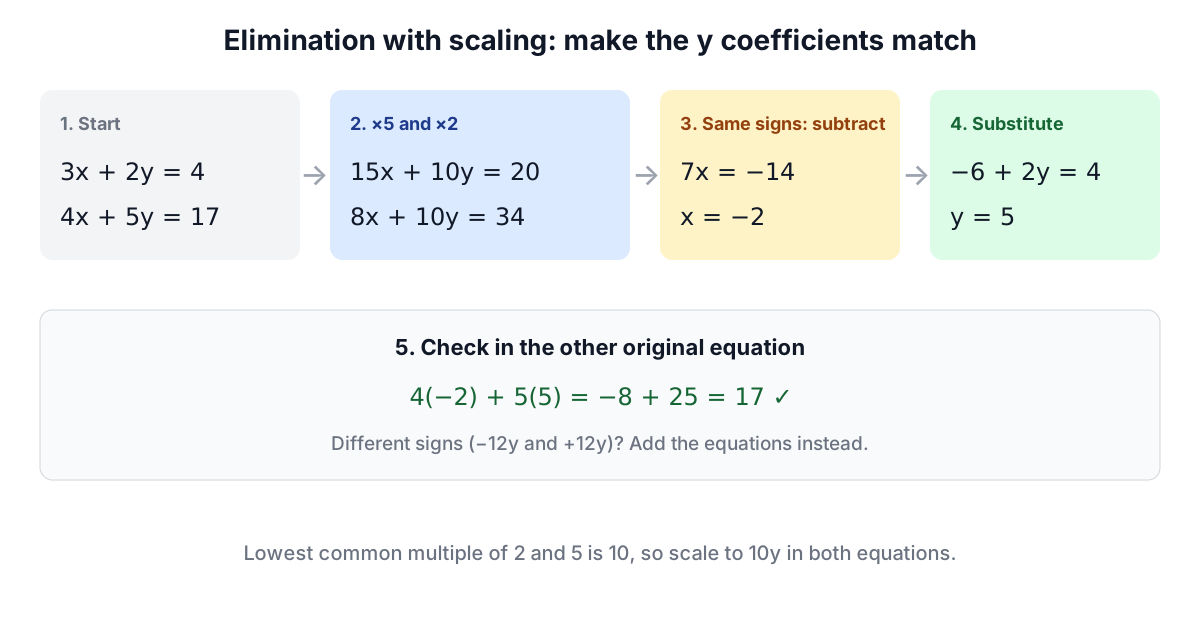
3x + 2y = 4     (1)
4x + 5y = 17    (2)
Choose which letter to eliminate. The y coefficients are 2 and 5, whose lowest common multiple is 10, so multiply (1) by 5 and (2) by 2:
15x + 10y = 20   (3)
 8x + 10y = 34   (4)
Same signs, so subtract: (3) − (4) gives 7x = −14, x = −2. Substitute into (1): 3(−2) + 2y = 4, so 2y = 10 and y = 5. Check in (2): 4(−2) + 5(5) = −8 + 25 = 17.
A sign rule worth memorising is "same signs subtract, different signs add":
5x − 3y = 19    (1)
2x + 4y = −8    (2)
Multiply (1) by 4 and (2) by 3 to get −12y and +12y. The signs differ, so add: 20x + 6x = 76 − 24, so 26x = 52 and x = 2. Then 2(2) + 4y = −8 gives y = −3.
The solver gets the same answers by a different route: it divides the first row by its leading coefficient and works with fractions (for the first pair, its steps begin R1 ← R1 ÷ 3). Any correct sequence of operations reaches the same solution, so use the solver to check your answer, not to copy its steps into an exam script.
Forming the equations: a GCSE-style problem
A21 questions give the situation in words. For example: a cinema sells 4 adult and 3 child tickets for £49, and 2 adult and 5 child tickets for £42. Find the price of each.
Let a be the adult price and c the child price in pounds:
4a + 3c = 49
2a + 5c = 42
Double the second equation: 4a + 10c = 84. Subtract the first: 7c = 35, so c = £5. Then 2a + 25 = 42, a = £8.50. The solver shows a = 17/2, which is the same thing; write money answers in pounds and pence.
Most of the work is in the setting up: say what each letter stands for, keep the units consistent (all pounds or all pence), and finish with a sentence that answers the question.
Higher tier: one linear, one quadratic
When one equation is a circle or a curve, elimination by adding equations no longer works neatly; substitution does. Take
y = x + 1
x² + y² = 25
Substitute the linear equation into the quadratic: x² + (x + 1)² = 25, which expands to 2x² + 2x + 1 = 25, so 2x² + 2x − 24 = 0, or x² + x − 12 = 0. The Quadratic Equation Solver gives x = 3 or x = −4 (it factorises to (x − 3)(x + 4)). Put each back into the linear equation: (3, 4) and (−4, −3).
Two points, because the line cuts the circle twice. If the quadratic had a negative discriminant the line would miss the circle, and if the discriminant were zero it would be a tangent with one point. The System of Equations Solver accepts only linear equations, so it rejects x² and you need the quadratic step instead.
Common slips: forgetting to pair each x with its own y, substituting into the quadratic and creating false extra answers, and dropping the minus when squaring (x + 1)².
When there is no answer, or infinitely many
At GCSE these appear as graphs: two parallel lines never meet, and two equations for the same line meet everywhere. Algebraically, elimination removes both letters at once:
- If it leaves something false, such as 0 = 2, the equations are inconsistent and have no solution (parallel lines).
- If it leaves 0 = 0, they are the same line and every point on it works.
The solver says which case you have and, for the second, gives the answer in terms of a parameter t.
Further Maths: three equations, three unknowns
The same elimination extends to three letters: use two pairs of equations to remove the same letter, leaving two equations in two letters. For
 x +  y + z = 10
2x −  y + z = 6
 x + 2y − z = 3
adding the first and third removes z: 2x + 3y = 13. Adding the second and third also removes z: 3x + y = 9. Solving that pair gives x = 2, y = 3, and then z = 5. The solver reports the same answer with a determinant of 7.
Specification point C7 asks you to do this with the inverse matrix: write the system as Ax = b, where A is the 3 by 3 coefficient matrix, and x = A⁻¹b. The inverse exists only when det A ≠ 0, which is the matrix version of "the planes meet at a single point". The Matrix Calculator finds A⁻¹ so you can check your by-hand inverse. C8's geometric interpretation covers the cases where det A = 0: three planes forming a sheaf through a common line (infinitely many solutions) or a prism or parallel planes (no solution).
Frequently asked questions
How do you solve simultaneous equations by elimination?
Multiply one or both equations so a letter has the same coefficient, subtract if the signs are the same or add if they differ, solve the equation that is left, then substitute into an original equation and check in the other. For 3x + 2y = 4 and 4x + 5y = 17 the answer is x = −2, y = 5.
Are linear and quadratic simultaneous equations on Foundation?
No. AQA's specification lists linear/linear pairs as foundation content and adds linear/quadratic pairs as higher content only, in line with the DfE subject content point A19.
Should I use elimination or substitution?
Elimination is usually quicker for two linear equations with no letter on its own. Substitution is quicker when one equation already gives y = or x =, and it is the method for a linear and a quadratic pair.
Can I check my answer with a calculator?
Yes, substitute your values into both original equations. The System of Equations Solver also solves linear pairs and triples exactly and shows the steps.
How are three simultaneous equations solved in Further Maths?
By the inverse matrix, x = A⁻¹b, when the determinant of the coefficient matrix is non-zero. When it is zero, the A level content asks you to interpret the arrangement of the three planes: a shared line gives infinitely many solutions, otherwise there are none.
Sources and further reading
- GCSE mathematics: subject content and assessment objectives, Department for Education. Algebra points A19 and A21.
- GCSE mathematics subject content (PDF, DFE-00233-2013), Department for Education.
- GCSE Mathematics (8300) specification, AQA. A19 by tier.
- GCE AS and A level subject content for further mathematics, Department for Education. Points C6 to C8 on matrices and three simultaneous equations.
- Solving Systems with Gaussian Elimination, OpenStax College Algebra 2e.
- Systems of equations, Khan Academy. Practice on elimination and substitution.
Open the System of Equations Solver
More Math Calculators
Every tool in the Math Calculators section, free and in your browser.
- Percentage Calculator
- Fraction Calculator
- Ratio Calculator
- GCF and LCM Calculator
- Prime Factorization Calculator
- Quadratic Equation Solver
- Long Division Calculator
- Scientific Notation Calculator
- Number to Words Converter
- Roman Numeral Converter
- Percent Error Calculator
- Root Calculator
- Exponent Calculator
- Logarithm Calculator
- Rounding Calculator
- Weighted Average Calculator
- System of Equations Solver