
Elimination Method for a Pair of Linear Equations, Class 10
Solve a pair of linear equations by elimination the NCERT Class 10 way: the four steps, the a1/a2, b1/b2, c1/c2 test, and board-style word problems checked.
By Redbison Dev · · 10 min read
India edition. Indian edition for CBSE Class 10, following the NCERT chapter "Pair of Linear Equations in Two Variables" (Reprint 2026-27) and the CBSE 2026-27 Class X curriculum, with its ratio test, ₹ word problems and boat-and-stream questions. US edition
To solve a pair of linear equations by elimination, multiply one or both equations so that one variable has the same coefficient in both, add or subtract to remove that variable, solve the single equation that is left, and substitute back. That is the four-step method in Chapter 3 of the NCERT Class 10 textbook, Pair of Linear Equations in Two Variables, and it is one of the two algebraic methods the CBSE 2026-27 Class X curriculum lists, alongside substitution.
Every example below can be checked in the System of Equations Solver: type each equation on its own line, such as 9x - 4y = 2000, and it shows the solution as exact fractions, whether the pair is consistent, and the row operations it used. The US version of this article, which goes on to three-variable systems and matrices, is here.
What the syllabus covers now
The CBSE Secondary Curriculum for Class X (2026-27) puts this chapter in Unit II, Algebra, which carries 20 marks. Its content list is short:
- A pair of linear equations in two variables and the graphical method, with consistency and inconsistency.
- Algebraic conditions for the number of solutions.
- Solution by substitution and by elimination, with simple situational problems.
The current NCERT chapter (marked Reprint 2026-27) matches it: a graphical method, then 3.3.1 Substitution and 3.3.2 Elimination, and a summary that lists only those methods. Cross-multiplication is not in the current chapter. Many older guides and question banks still use it. It is a legitimate shortcut, but the syllabus names only substitution and elimination, so practise those.
The four steps, on NCERT's own example
Example 8 in the chapter: the incomes of two people are in the ratio 9 : 7, their expenditures in the ratio 4 : 3, and each saves ₹2,000 a month. Let the incomes be ₹9x and ₹7x and the expenditures ₹4y and ₹3y:
9x − 4y = 2000   (1)
7x − 3y = 2000   (2)
Step 1: make one coefficient equal. Multiply (1) by 3 and (2) by 4, so both y-terms become 12y:
27x − 12y = 6000   (3)
28x − 12y = 8000   (4)
Step 2: subtract to eliminate. (4) − (3) gives x = 2000.
Step 3: solve. Here Step 2 already gave x directly.
Step 4: substitute. In (1), 9(2000) − 4y = 2000, so 4y = 16000 and y = 4000.
The incomes are 9 × 2000 = ₹18,000 and 7 × 2000 = ₹14,000. Check: expenditures are ₹16,000 and ₹12,000, which are in the ratio 4 : 3. The solver gives x = 2000, y = 4000; its row operations divide by 9 first rather than multiplying to 12y, but the answer is the same, because any sequence of valid steps lands on the same solution.
When Step 2 leaves no variable
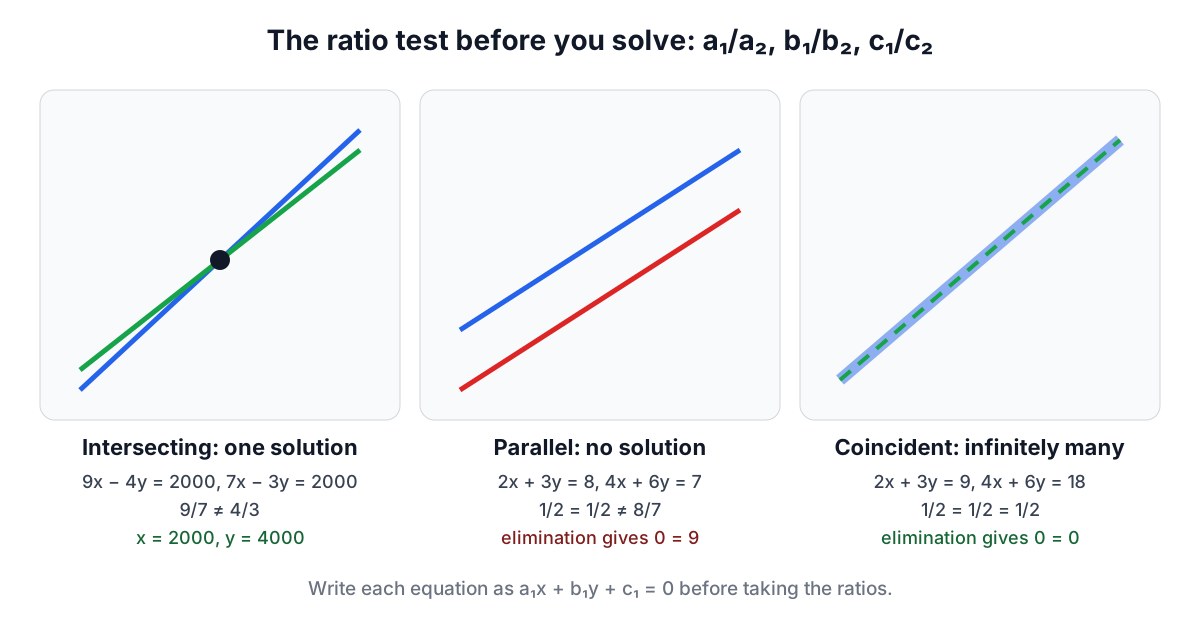
NCERT's rule is exact: if eliminating one variable also removes the other and leaves a true statement such as 0 = 0, the pair has infinitely many solutions; if it leaves a false one such as 0 = 9, there is no solution. Example 9 in the chapter, 2x + 3y = 8 and 4x + 6y = 7, gives 0 = 9 after doubling the first equation and subtracting, so it is inconsistent. The solver reports "no solution" for the same pair.
The a1/a2, b1/b2, c1/c2 test
Write each equation as a₁x + b₁y + c₁ = 0 and a₂x + b₂y + c₂ = 0. Before solving anything you can say how many solutions there are:
| Condition | Lines | Pair is | Solutions |
|---|---|---|---|
| a₁/a₂ ≠ b₁/b₂ | intersecting | consistent | exactly one |
| a₁/a₂ = b₁/b₂ ≠ c₁/c₂ | parallel | inconsistent | none |
| a₁/a₂ = b₁/b₂ = c₁/c₂ | coincident | dependent (consistent) | infinitely many |
Applied to the three pairs above:
| Pair | a₁/a₂ | b₁/b₂ | c₁/c₂ | Verdict |
|---|---|---|---|---|
| 9x − 4y − 2000 = 0, 7x − 3y − 2000 = 0 | 9/7 | 4/3 | 1 | unique solution |
| 2x + 3y − 8 = 0, 4x + 6y − 7 = 0 | 1/2 | 1/2 | 8/7 | no solution |
| 2x + 3y − 9 = 0, 4x + 6y − 18 = 0 | 1/2 | 1/2 | 1/2 | infinitely many |
In the solver, the same verdicts show up as the determinant and the rank: a non-zero determinant (1 for the first pair) means a unique solution; a determinant of 0 means the ratios a₁/a₂ and b₁/b₂ are equal, and the rank then separates "none" from "infinitely many". For the dependent pair it prints the family x = 9/2 − (3/2)t, y = t, which is the solver's way of saying every point on the line works.
A common type of question asks for the value of k that makes a pair inconsistent or dependent. Set a₁/a₂ = b₁/b₂, solve for k, then check c₁/c₂ to decide which case you have.
Board-style word problems
Most of the work in these questions is forming the equations correctly. Define the variables in words, write two equations, then solve.
Library charges. A library charges a fixed amount for the first three days and a further amount per extra day. One reader pays ₹27 for seven days, another ₹21 for five days. With fixed charge x and daily charge y: x + 4y = 27 and x + 2y = 21. Subtracting gives 2y = 6, so y = ₹3 and x = ₹15.
Ages. Five years ago, A was three times as old as B; ten years from now, A will be twice as old as B. Then x − 5 = 3(y − 5) and x + 10 = 2(y + 10), which simplify to x − 3y = −10 and x − 2y = 10. Subtracting gives y = 20, and x = 50.
Boat and stream. A boat goes 30 km upstream and 44 km downstream in 10 hours, and 40 km upstream and 55 km downstream in 13 hours. Find the speed of the boat in still water and of the stream. With boat speed x and stream speed y (km/h), the times are 30/(x − y) + 44/(x + y) = 10 and 40/(x − y) + 55/(x + y) = 13. These are not linear, but NCERT's summary notes that such equations can be reduced to a linear pair. Put u = 1/(x − y) and v = 1/(x + y):
30u + 44v = 10
40u + 55v = 13
The solver gives u = 1/5 and v = 1/11, so x − y = 5 and x + y = 11. Adding these gives 2x = 16: the boat moves at 8 km/h in still water and the stream at 3 km/h. Check: 30/5 + 44/11 = 6 + 4 = 10 hours.
Elimination or substitution?
Substitution is quicker when one equation already has a variable with coefficient 1, such as x + 4y = 27. Elimination is quicker when the coefficients are larger, as in 9x − 4y = 2000, because it avoids fractions until the end. When a question names the method, as in "solve by elimination", use that method and show its steps.
Three habits help:
- Number the equations, and say which you multiplied by what.
- Substitute your answer back into both original equations, not the scaled ones.
- In word problems, finish with a sentence that answers the question in its units (₹, years, km/h).
The same elimination idea works for three equations in three unknowns and is the basis of the matrix methods taught later; the US version of this article covers that ground. For fractions in the answers, the Fraction Calculator is handy for checking arithmetic.
Frequently asked questions
What are the steps of the elimination method?
Multiply the equations by suitable non-zero numbers so that one variable has numerically equal coefficients; add or subtract to eliminate it; solve the resulting one-variable equation; substitute the value into either original equation to find the other variable. If the subtraction leaves 0 = 0 there are infinitely many solutions, and if it leaves a false statement such as 0 = 9 there is none.
Is cross-multiplication method in the Class 10 syllabus?
Not in the current NCERT chapter or the CBSE 2026-27 Class X curriculum, which list the graphical, substitution and elimination methods. Older books still include it.
How do I know if a pair of linear equations is consistent?
Compare the ratios of the coefficients. If a₁/a₂ ≠ b₁/b₂ the pair has a unique solution and is consistent. If all three ratios are equal it is dependent and still consistent. If a₁/a₂ = b₁/b₂ but c₁/c₂ is different, the lines are parallel and the pair is inconsistent.
How do I solve boat and stream problems with linear equations?
Write each journey's time as distance ÷ speed, using (x − y) upstream and (x + y) downstream. Substitute u = 1/(x − y) and v = 1/(x + y) to get a linear pair, solve it by elimination, then solve x − y = 1/u and x + y = 1/v.
Can the solver check an equation like 2/x + 3/y = 13?
Not directly, because it only accepts linear equations. Substitute u = 1/x and v = 1/y first, solve the linear pair in u and v, then take reciprocals.
Sources and further reading
- Pair of Linear Equations in Two Variables (Class 10 Mathematics, Chapter 3), NCERT. Reprint 2026-27: sections 3.2 to 3.4, Examples 8 to 10 and the summary of conditions.
- NCERT textbooks online, National Council of Educational Research and Training.
- Secondary Curriculum Part 1: Mathematics, Class X (2026-27), Central Board of Secondary Education. Unit II Algebra (20 marks) and the content for pairs of linear equations.
- CBSE curriculum 2026-27, Central Board of Secondary Education.
- Solving Systems with Gaussian Elimination, OpenStax College Algebra 2e. The same method in matrix form.
- Systems of equations, Khan Academy. Practice on elimination and substitution.
Open the System of Equations Solver
More Math Calculators
Every tool in the Math Calculators section, free and in your browser.
- Percentage Calculator
- Fraction Calculator
- Ratio Calculator
- GCF and LCM Calculator
- Prime Factorization Calculator
- Quadratic Equation Solver
- Long Division Calculator
- Scientific Notation Calculator
- Number to Words Converter
- Roman Numeral Converter
- Percent Error Calculator
- Root Calculator
- Exponent Calculator
- Logarithm Calculator
- Rounding Calculator
- Weighted Average Calculator
- System of Equations Solver