
Static and Dynamic Compression Ratio in mm and cc
Work out static and dynamic compression in millimetres and cc, see what a head skim, a thicker gasket or a cam change does, and read UK pump fuel in RON.
By Redbison Dev · · 11 min read

United Kingdom edition. Written for UK engine builders: metric measurements, head skims and gaskets in mm, and UK pump fuel quoted in RON (95 octane E10 standard, 97+ E5 super) rather than the US pump average. US edition
Static compression ratio is the cylinder volume with the piston at bottom dead centre divided by the volume left at top dead centre. Dynamic compression ratio does the same sum from the moment the intake valve actually closes, so it is always lower and is closer to what the mixture feels. A two-litre four with an 86 mm bore and stroke, a 45 cc chamber and a 0.7 mm gasket comes out at 10.03:1 static and 9.05:1 dynamic with the intake closing 45° after bottom dead centre. For a UK build the numbers that move most are the ones a British workshop deals with every week: a head skimmed after a gasket failure, the thickness of the replacement gasket, and a cam change. All the figures below come from the UK compression ratio calculator, which works in millimetres and cc.
The static ratio in metric
CR = (V_swept + V_clearance) / V_clearance
V_swept     = π/4 x bore² x stroke
V_clearance = chamber + gasket + deck + piston
With dimensions in millimetres, π/4 x d² x h gives cubic millimetres; divide by 1,000 for cc. For the 86 x 86 mm four:
V_swept   = π/4 x 86² x 86 / 1000        = 499.56 cc
gasket    = π/4 x 87² x 0.7 / 1000       =   4.16 cc
deck      = π/4 x 86² x 0.2 / 1000       =   1.16 cc
dish      = 5 cc (positive: it adds volume)
chamber   = 45 cc
V_clearance                              =  55.32 cc
CR = (499.56 + 55.32) / 55.32            =  10.03:1
The gasket bore (87 mm) is used for the gasket volume, not the cylinder bore. The deck figure is positive when the piston crown sits below the block face at top dead centre, and negative if it stands proud. A piston dish or valve cut-outs add volume; a dome takes it away. Getting one of these signs wrong is the commonest way to be a point out.
Head skims and gaskets: the UK workshop case
A head that has been skimmed after overheating has a smaller chamber. On this engine, a 3 cc loss from the chamber is enough to add half a point:
| Build | Clearance | Static | Dynamic (IVC 45°) |
|---|---|---|---|
| As built, 45 cc, 0.7 mm gasket | 55.32 cc | 10.03:1 | 9.05:1 |
| Head skimmed, 42 cc | 52.32 cc | 10.55:1 | 9.51:1 |
| Skimmed head with a 1.0 mm gasket | 54.11 cc | 10.23:1 | 9.23:1 |
| Original head with a 1.0 mm gasket | 57.11 cc | 9.75:1 | 8.80:1 |
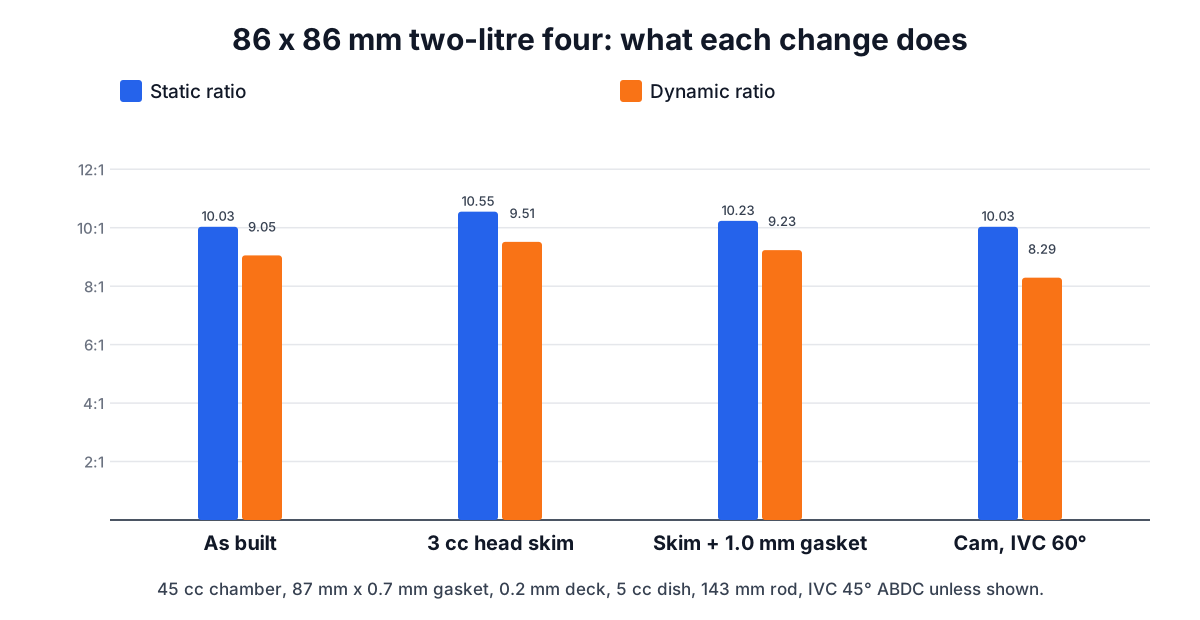
Each extra 0.3 mm of gasket on an 87 mm gasket bore adds 1.78 cc, which here is worth about three tenths of a point, so a thicker gasket can claw back part of what a skim took. Two cautions:
- Measure, do not estimate. Work out the chamber volume after machining with a burette and a clear plate. The depth cut does not convert reliably into cc because chamber shapes differ.
- Squish changes too. A thicker gasket raises the gap between the piston and the flat part of the head, which can make an engine more prone to knock even as the ratio falls.
The calculator also works backwards. For 10.5:1 on this bottom end, the chamber would need to be 42.26 cc; for 11:1, 39.63 cc.
Dynamic compression: where the cam comes in
The intake valve closes after bottom dead centre, and until it shuts the rising piston pushes some charge back into the port. Real compression starts at intake valve closing (IVC). The calculator finds the piston's distance from top dead centre at that crank angle with slider-crank geometry and uses it in place of the full stroke:
x(θ) = r + l − ( r cos θ + √( l² − r² sin² θ ) )
with r half the stroke, l the rod length (143 mm here) and θ = 180° + IVC. At IVC 45° the piston is 76.68 mm below top dead centre, so the effective swept volume is smaller and the ratio drops to 9.05:1.
Change only the cam and the static figure stays at 10.03:1 while the dynamic one moves:
| Intake closes (ABDC) | Effective stroke | Dynamic ratio |
|---|---|---|
| 35° | 80.37 mm | 9.44:1 |
| 45° | 76.68 mm | 9.05:1 |
| 60° | 69.43 mm | 8.29:1 |
A longer-duration cam closes the intake later, which bleeds off low-speed compression; that is why a bigger cam usually goes with more static compression, and why a head skim and a cam change are best planned together. The skimmed 42 cc head with the 60° cam gives 10.55:1 static but only 8.71:1 dynamic.
Use the cam's intake closing at or near the seat (seat timing or advertised duration), not the 0.050 in lift figure, which closes earlier and overstates the dynamic ratio.
UK pump fuel: RON, not the American number
UK pumps label petrol by research octane number (RON). GOV.UK's E10 guidance says standard grade (95 octane) petrol became E10 in Great Britain in September 2021, Northern Ireland followed in November 2022, and E5 remains available as the "super" grade (97+ octane) at most filling stations.
American guides and forums quote pump octane as the anti-knock index, the average of RON and MON, which the octane rating reference puts at 4 to 6 numbers lower than the RON quoted elsewhere for the same fuel. A US build "on 91 octane" therefore means roughly 95 to 97 RON, between UK standard and super, not 91 RON.
What that means for a build:
- A standard engine on 95 RON needs nothing special. E10 is sold at the same 95 octane as the E5 it replaced.
- More compression usually means planning for super. If a skim or new pistons raise the ratio above standard, the 97+ grade gives more knock margin, but how much ratio an engine tolerates depends on the chamber, ignition timing and the map, not on the ratio alone.
- Older vehicles. GOV.UK says all cars built since 2011 can use E10, but some classic, cherished and older vehicles, and some mopeds of 50 cc or less, may not be compatible. Its vehicle checker tells you which to use.
There is no single safe ratio for 95 or 97 RON. Treat the calculator's figures as a way to compare options before you buy parts, then set the final ignition timing with knock monitoring on a rolling road.
Mistakes in metric builds
- Using the gasket's free thickness. Use the compressed thickness the maker quotes; on this engine every 0.1 mm is about 0.6 cc.
- Using the cylinder bore for the gasket volume. The gasket bore is usually larger; 87 mm against 86 mm here adds 0.10 cc at 0.7 mm.
- Forgetting the deck figure after a block skim. Machining the block deck reduces deck clearance just as a head skim reduces the chamber.
- Trusting the handbook chamber volume on a used head. Valve seat work and previous skims change it. Measure.
- Treating the dynamic ratio as cylinder pressure. It is a geometric index. A compression test with a gauge gives a real-world check.
For displacement from bore and stroke, see the engine displacement guide. The US edition of this guide works the same method in inches on a small block V8.
Frequently asked questions
How much does skimming a cylinder head raise compression?
It depends on the cc removed from the chamber, not the depth cut. On an 86 x 86 mm four with a 45 cc chamber, losing 3 cc takes static compression from 10.03:1 to 10.55:1. Measure the chamber with a burette after machining.
Does a thicker head gasket lower compression?
Yes. On the same engine, going from a 0.7 mm to a 1.0 mm gasket adds 1.78 cc and lowers the ratio from 10.03:1 to 9.75:1. After a 3 cc skim, a 1.0 mm gasket brings it back from 10.55:1 to 10.23:1.
Is UK 95 octane the same as US 95?
No. UK pumps show RON; US pumps show the average of RON and MON, which is 4 to 6 numbers lower for the same fuel. UK standard unleaded at 95 RON works out at roughly 89 to 91 on a US pump, between US mid-grade and entry-level premium.
What compression ratio is safe on super unleaded?
There is no single figure. Super (97+ RON) gives more knock margin than 95, but the limit depends on chamber design, ignition timing, cam timing and the engine map. Use the calculator to compare builds and set the timing with knock monitoring.
Why is dynamic compression lower than static?
Because compression only starts when the intake valve closes, after bottom dead centre. On the two-litre example the piston has already risen to 76.68 mm from the top by then with the intake closing at 45°, so the effective swept volume is smaller: 9.05:1 instead of 10.03:1.
Sources and further reading
- E10 petrol explained, Department for Transport, GOV.UK. 95 octane E10 standard grade and 97+ octane E5 super.
- Check if your vehicle can use E10 petrol, GOV.UK.
- Octane rating, Wikipedia. RON, MON and the anti-knock index.
- Compression ratio, Wikipedia. Static and dynamic compression ratio.
- Internal Combustion Engines (course 2.61), MIT OpenCourseWare. Compression ratio and knock.
Open the Compression Ratio Calculator
More Automotive
Every tool in the Automotive section, free and in your browser.