
Engine Size in cc: Bore, Stroke and the UK cc Limits
Work out engine size in cc from bore and stroke in millimetres, then check a rebore against the 125 cc A1 limit, motorcycle tax bands and the 1,549 cc line.
By Redbison Dev · · 9 min read
United Kingdom edition. UK edition in millimetres and cc, built around the cc lines British owners meet: the 125 cc A1 licence, motorcycle vehicle tax bands, the 1,549 cc split for pre-2001 cars and the V5C rules on capacity changes. US edition
In the UK an engine's size is its cylinder capacity in cc, and you can work it out exactly from three measurements: bore (cylinder diameter), stroke (piston travel) and the number of cylinders. Capacity = π ÷ 4 × bore² × stroke × cylinders. With bore and stroke in millimetres, divide the answer by 1,000 to get cc. That figure is printed on the V5C logbook, and for learner riders, motorcycle tax and older cars it decides which side of a legal line the vehicle sits on.
This edition works in millimetres and cc throughout, uses engine sizes British owners meet on learner bikes, motorcycles and older cars, and checks each one against the UK limits with the UK Engine Size Calculator. The American version of this article, built around small-block V8s in cubic inches, is here.
The formula in millimetres
As the piston moves from top dead centre (TDC) to bottom dead centre (BDC), it sweeps out a cylinder of air. Its diameter is the bore and its height is the stroke. The volume left above the piston at TDC (combustion chamber, head gasket) is not counted, which is why engine size and compression ratio are separate calculations.
Working in millimetres keeps it simple:
cc per cylinder = 0.7854 × bore(mm)² × stroke(mm) ÷ 1,000
engine size     = cc per cylinder × cylinders
0.7854 is π ÷ 4. If you prefer centimetres, use bore and stroke in cm and skip the ÷ 1,000, because one cubic centimetre is one cc.
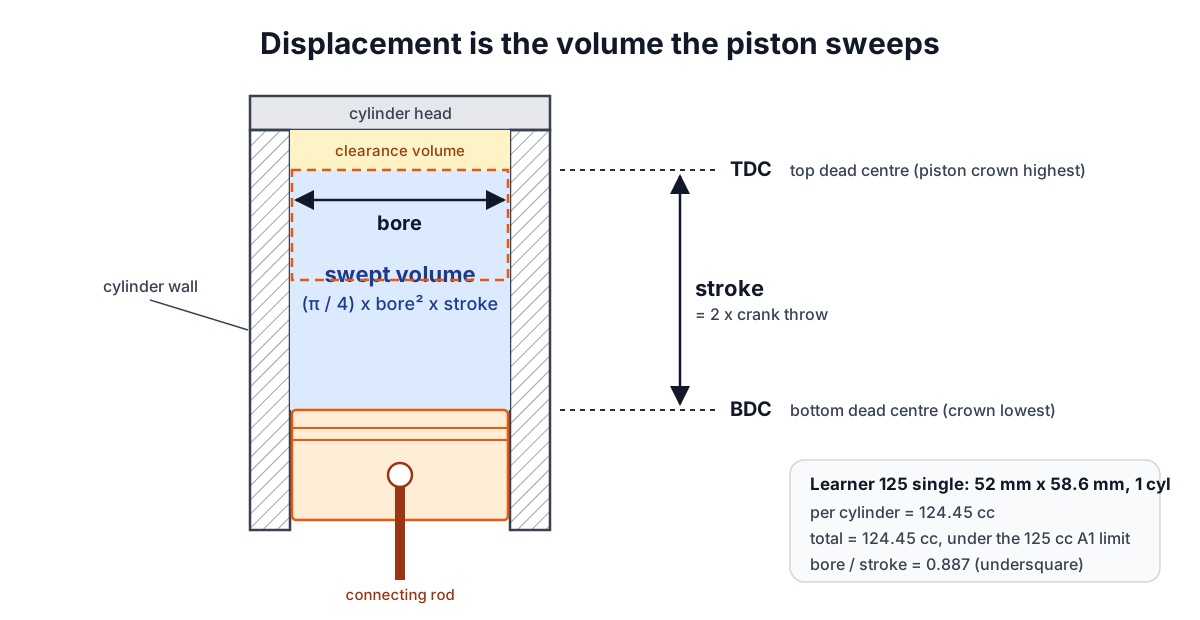
Stroke comes from the crankshaft: it is twice the crank throw. Connecting rod length changes how the piston moves through the stroke, not how far it goes, so a long-rod conversion leaves the capacity unchanged.
Why a few cc matter in the UK
Most car buyers never think about the exact cc, because cars first registered on or after 1 March 2001 are taxed on CO2 emissions, not engine size. Three groups of owners do need the exact figure.
| Who | Where the line is | What it decides |
|---|---|---|
| Learner and A1 riders | 125 cc, and also 11 kW and 0.1 kW per kg | Which bike you may ride from 17 on an A1 licence or a CBT |
| Motorcycle owners | Not over 150 cc, 151 to 400, 401 to 600, over 600 | The vehicle tax band |
| Owners of cars registered before 1 March 2001 | 1,549 cc | £230 or £375 a year in vehicle tax |
The tax rates in that table are the ones GOV.UK showed in November 2026: £27, £59, £90 and £125 a year for the four motorcycle bands, and £230 or £375 for the older cars. They usually change each April, so check the current tables before you rely on them. The cc boundaries themselves have been stable for years.
There is a fourth reason the number matters: GOV.UK lists "cylinder capacity (cc)" among the changes you must record on your V5C. If a rebore or an engine swap changes the capacity, the logbook has to be updated, and your insurer will want to know too.
Worked example 1: a 125 on the learner limit
Take a single-cylinder learner bike with a 52 mm bore and a 58.6 mm stroke, an illustrative engine sized close to the A1 line. Put those into the calculator with one cylinder:
- Per cylinder: 0.7854 × 52² × 58.6 ÷ 1,000 = 124.45 cc.
- Bore/stroke ratio: 52 ÷ 58.6 = 0.887, so the engine is undersquare (long stroke).
- Solve for bore at 125 cc with the same stroke: 52.11 mm.
That is 0.11 mm of headroom. A worn bore taken out to a +0.5 mm oversize gives 52.5 mm and 126.85 cc, which is over 125 cc. When an engine sits this close to the limit, the only rebuild that keeps the bike within A1 is one at the original bore, such as a new standard-size liner or barrel, or a replating. Check your own engine's bore and stroke in the workshop manual and run the same test. Big-bore kits sold as "150 cc" or "180 cc" upgrades take the bike out of A1 entirely, whatever the power.
The A1 category also has a power cap of 11 kW and a power-to-weight cap of 0.1 kW per kg. A bike can break those without changing its cc, for example with a remap, so the cc check is necessary but not sufficient.
Worked example 2: a classic car either side of 1,549 cc
Cars registered before 1 March 2001 pay one of two rates: not over 1,549 cc, or over 1,549 cc. Many "1.6" engines from that era were sized to sit below it. Take a four-cylinder with an 80 mm bore and 77 mm stroke:
- Per cylinder: 0.7854 × 80² × 77 ÷ 1,000 = 387.04 cc.
- Total: 387.04 × 4 = 1,548.18 cc, under the line by 0.82 cc.
- Bore for exactly 1,549 cc at a 77 mm stroke: 80.021 mm.
After a +0.5 mm rebore the bore is 80.5 mm and the engine becomes 1,567.59 cc. That puts the car on the higher rate, and because the cylinder capacity changed, the V5C needs updating. On a car taxed at £230 instead of £375, a routine rebuild can therefore cost £145 a year in tax on top of the machining.
The calculator's overbore field gives the new figure directly, so you can test +0.25, +0.5 and +1.0 mm before you choose pistons.
Worked example 3: rebuilding a classic "1275" four
Take a classic long-stroke four badged 1275, with a 70.6 mm bore and an 81.3 mm stroke over four cylinders (an illustrative engine; use the figures from your own workshop manual):
| Bore | Capacity | Bore/stroke |
|---|---|---|
| 70.6 mm (standard) | 1,273.06 cc | 0.868 |
| 71.1 mm (+0.5 mm, about +0.020 in) | 1,291.16 cc | 0.875 |
| 71.6 mm (+1.0 mm, about +0.040 in) | 1,309.38 cc | 0.881 |
The badge says 1275, the arithmetic says 1,273 cc, and a 1 mm overbore adds 36.3 cc, almost 3%. All three figures sit well under 1,549 cc, so the tax rate does not change, but the new capacity still belongs on the V5C. Pistons for older British engines are often listed in inch oversizes such as +0.020 or +0.040 in; switch the calculator to inches or convert at exactly 25.4 mm per inch.
Notice that the capacity rises with the square of the bore. Going from 70.6 to 71.6 mm is a 1.4% increase in bore but a 2.9% increase in capacity.
Worked example 4: is a "400" really in the 151 to 400 cc tax band?
Motorcycle vehicle tax jumps from £59 to £90 at 400 cc. An illustrative 400-class twin shows why the exact figure matters more than the name:
- Standard: 70 mm × 51.8 mm × 2 = 398.70 cc. It is in the 151 to 400 band.
- The same engine with a +0.5 mm overbore: 70.5 mm gives 404.42 cc, which is in the 401 to 600 band.
The largest bore that keeps that stroke at 400 cc is 70.11 mm. The bike's band is set by the cylinder capacity on its V5C, so if a rebuild raises it and you update the logbook as you must, the tax band follows.
Bore/stroke ratio and piston speed
The bore/stroke ratio tells you the shape of the engine:
- Above 1, oversquare: the 70 × 51.8 mm twin is 1.351. Short stroke, room for big valves, and an engine that likes revs.
- About 1, square.
- Below 1, undersquare: the 125 single (0.887), the 1275 four (0.868) and a 1.0 litre triple of 71.9 × 82 mm (0.877, 998.81 cc). Long-stroke engines tend to give better low-speed torque and a compact combustion chamber.
Mean piston speed in metres per second is 2 × stroke (m) × rpm ÷ 60. The 125 single at 10,000 rpm averages 19.53 m/s. The 1275 four at 6,000 rpm averages 16.26 m/s, and the 400 twin at 12,000 rpm averages 20.72 m/s. Road engines mostly stay below about 20 m/s at their limit. A 58.6 mm stroke is short in absolute terms even though the engine is undersquare, which is how a small single can rev past 10,000 rpm without exceeding that.
Mistakes that change the answer
- Mixing millimetres and inches. A British parts list may give pistons in inch oversizes and the workshop manual in millimetres. Convert one before you multiply.
- Using the badge. A "1.6" may be 1,548 cc or 1,598 cc, and only one of those is under the 1,549 cc line.
- Adding the chamber or gasket volume. That belongs to the compression ratio.
- Forgetting that the tax and licence rules follow the recorded capacity. A rebore you do not report leaves the V5C wrong, which can matter to your insurer after a claim.
Tools for this job
- UK Engine Size Calculator: capacity from bore and stroke, overbore, and solving for the bore or stroke that hits a cc target.
- Compression Ratio Calculator: what a rebore, thinner gasket or skimmed head does to compression. The companion post on static and dynamic compression ratio explains the trade-offs.
- Unit Converter: inch oversizes to millimetres and cc to cubic inches.
- Horsepower Calculator: capacity says nothing directly about power, which is what the A1 and A2 kW limits are about.
Frequently asked questions
Can I rebore a 125 cc bike and still ride it on an A1 licence?
Not with an oversize piston if the engine is close to the limit. The 52 × 58.6 mm example is 124.45 cc, and a +0.5 mm rebore takes it to 126.85 cc, over the 125 cc A1 limit. Rebuild at the original bore with a new liner, barrel or replating instead.
Do I have to tell DVLA if I change the engine size?
Yes. GOV.UK lists engine and cylinder capacity among the details you must update on the V5C. A rebore that changes the capacity and an engine swap both count. Tell your insurer as well.
My car was registered in 1999 and has a 1.6 engine. Which tax rate applies?
The one for the exact cylinder capacity on the V5C, not the badge. Engines not over 1,549 cc pay the lower rate for cars registered before 1 March 2001. An 80 × 77 mm four is 1,548.18 cc, under the line; a 1,598 cc engine is over it.
Why is my bike tax higher than my friend's 400?
Check both V5Cs. The band changes at 400 cc, so a 398.70 cc twin pays the 151 to 400 cc rate and a 404 cc one pays the 401 to 600 cc rate, even though both are sold as 400s.
Sources and further reading
- Motorcycle and moped licence categories, ages and requirements, GOV.UK. A1: up to 125 cc, 11 kW and 0.1 kW per kg from 17; A2: up to 35 kW.
- Other vehicle tax rates, GOV.UK. Motorcycle bands: not over 150 cc, 151 to 400, 401 to 600, over 600.
- Rates for cars and light goods vehicles registered before 1 March 2001, GOV.UK. Not over 1,549 cc and over 1,549 cc.
- Change vehicle details on a V5C registration certificate, DVLA. Engine and cylinder capacity changes must be recorded.
- SI Units: Length, National Institute of Standards and Technology. The inch has been exactly 25.4 mm since 1959.
- Internal Combustion Engines (course 2.61), MIT OpenCourseWare. Engine geometry and piston speed.
Open the Engine Displacement Calculator
More Automotive
Every tool in the Automotive section, free and in your browser.