
Compression Ratio of Car and Bike Engines in mm and cc
Work out static and dynamic compression for a car or bike engine in mm and cc, see what head facing, gaskets and cams change, and what 95 RON E20 petrol means.
By Redbison Dev · · 11 min read
India edition. Written for Indian car and motorcycle engines: metric inputs, a 1.2 litre four and a 350 cc single as worked examples, and India's move to E20 petrol with a 95 RON minimum from 1 April 2026. US edition
The compression ratio of an engine is the cylinder volume with the piston at the bottom of its stroke divided by the small volume left above it at the top. A 1.2 litre four with a 73 mm bore, 71.5 mm stroke and a 26 cc chamber comes out at 10.98:1. That is the static ratio. The dynamic ratio starts counting only when the intake valve closes, after bottom dead centre, and for the same engine with the intake closing at 50° it is 9.64:1. Both matter more in India since petrol changed: from 1 April 2026 oil companies sell petrol up to E20 with a minimum research octane number (RON) of 95, according to the Ministry of Petroleum and Natural Gas. This edition works both ratios for a small car engine and a 350 cc motorcycle single with the compression ratio calculator, in millimetres and cc.
The formula, per cylinder
CR = (V_swept + V_clearance) / V_clearance
V_swept     = π/4 x bore² x stroke         (mm³ ÷ 1000 = cc)
V_clearance = chamber + gasket + deck + piston dish (or − dome)
Everything is per cylinder. For a four-cylinder engine, use one cylinder's swept volume; for a single, the cylinder is the whole engine.
For the 1.2 litre four (73 x 71.5 mm, 26 cc chamber, 74 mm gasket bore at 0.6 mm compressed, piston 0.1 mm below the deck, 1 cc dish):
V_swept    = π/4 x 73² x 71.5 / 1000      = 299.26 cc
gasket     = π/4 x 74² x 0.6 / 1000       =   2.58 cc
deck       = π/4 x 73² x 0.1 / 1000       =   0.42 cc
dish                                      =   1.00 cc
chamber                                   =  26.00 cc
V_clearance                               =  30.00 cc
CR = (299.26 + 30.00) / 30.00             =  10.98:1
A small engine has a small clearance volume, so every cc matters more than on a big engine. Here 1 cc is a thirtieth of the clearance.
Head facing and gaskets on a small engine
When a head is faced (skimmed) after overheating or a blown gasket, the chamber gets smaller and compression rises. On the 1.2 litre four:
| Build | Clearance | Static | Dynamic (IVC 50°) |
|---|---|---|---|
| As built, 26 cc chamber, 0.6 mm gasket | 30.00 cc | 10.98:1 | 9.64:1 |
| Head faced by 2 cc, 24 cc chamber | 28.00 cc | 11.69:1 | 10.25:1 |
| Faced head with a 0.9 mm gasket | 29.29 cc | 11.22:1 | 9.84:1 |
| Cam closing the intake at 60° | 30.00 cc | 10.98:1 | 9.05:1 |
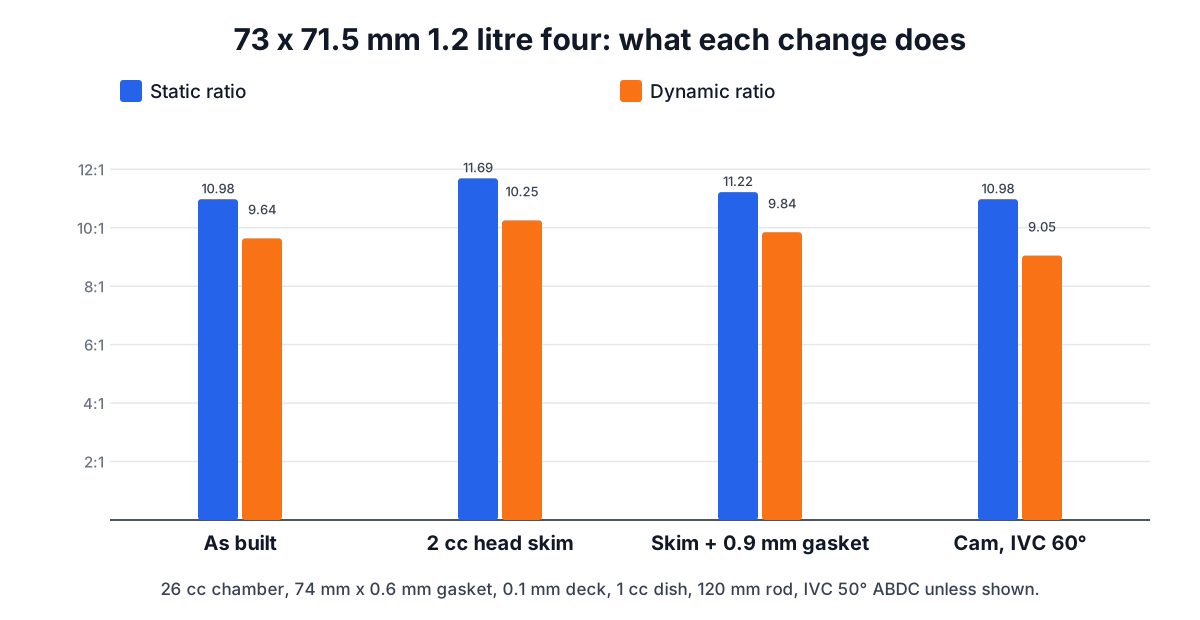
Taking just 2 cc out of the chamber adds 0.71 of a point, far more than the same 2 cc would on a large engine. A 0.3 mm thicker gasket gives back 1.29 cc. The calculator's target field runs the sum backwards: this bottom end would need a 24.50 cc chamber for 11.5:1 and a 27.50 cc chamber for 10.5:1.
Before relying on the numbers, measure the chamber with a burette and a clear plate after any machining; a cut depth does not translate cleanly into cc.
A 350 cc single
Motorcycle engines work the same way. Take a single with a 72 mm bore, 85.8 mm stroke, a 30 cc chamber, a 73 mm gasket bore at 0.8 mm, the piston 0.2 mm below the deck, a flat-top piston, a 140 mm rod and the intake closing at 55°:
| Build | Clearance | Static | Dynamic |
|---|---|---|---|
| As built, 0.8 mm gasket | 34.16 cc | 11.23:1 | 9.58:1 |
| 1.3 mm gasket | 36.26 cc | 10.64:1 | 9.08:1 |
| Head faced by 2 cc, 0.8 mm gasket | 32.16 cc | 11.86:1 | 10.11:1 |
A 0.5 mm thicker gasket adds 2.09 cc and drops compression by 0.59 of a point, which is one way builders bring compression down. Facing the head by 2 cc pushes it up by 0.64.
Dynamic compression and the camshaft
Compression only begins when the intake valve shuts. The calculator finds how far the piston has already travelled from top dead centre at that moment, using the rod length:
x(θ) = r + l − ( r cos θ + √( l² − r² sin² θ ) ), θ = 180° + IVC
For the 1.2 litre four with a 120 mm rod, the effective stroke is 65.36 mm with the intake closing at 40°, 61.90 mm at 50° and 57.69 mm at 60°, giving dynamic ratios of 10.12, 9.64 and 9.05:1 on the same static 10.98:1. A sportier cam that closes the intake later therefore lowers the effective compression at low engine speed, and is usually paired with a higher static ratio.
Take the intake closing angle at the seat (seat timing or advertised duration) from the workshop manual or cam card. The figure at 0.050 in lift closes earlier and overstates the dynamic ratio.
What 95 RON E20 petrol changes
The Ministry of Petroleum and Natural Gas's account of the Ethanol Blending Programme gives the timeline: the E20 target was achieved in December 2025; in February 2026 oil marketing companies were directed to sell ethanol-blended petrol (up to E20) with a minimum RON of 95 across the country from 1 April 2026; and in June 2026 E85 fuel was launched for flex-fuel vehicles. The same document puts ethanol's octane number at about 108.5 against petrol's 84.4, and says RON 95 with 20% ethanol gives better anti-knock properties.
For engine builders, three points follow:
- Older references are out of date. Many guides, including the octane rating reference, still list Indian ordinary and premium petrol at 91 RON. The 2026 minimum is 95.
- US numbers are lower for the same fuel. US pumps show the average of RON and MON, which runs 4 to 6 numbers below RON. A US build quoted "on 91" is roughly a 95 to 97 RON fuel.
- Octane is not the only limit. How much compression an engine tolerates depends on the chamber, ignition timing and the ECU map. E20's higher octane gives more margin in principle; whether a given engine uses it depends on how it was calibrated. Follow the vehicle maker's advice for older vehicles; the calculator gives the ratio, not fuel compatibility.
Mistakes to avoid
- Using the free gasket thickness. Use the compressed thickness; on the 1.2 litre four each 0.1 mm is worth 0.43 cc.
- Using the cylinder bore for the gasket. The gasket bore is usually a little larger.
- Mixing up signs. A piston below the deck and a dish both add volume; a piston above the deck and a dome take it away.
- Comparing a bike's figure with a car's. Small cylinders are more sensitive to the same cc change.
- Forgetting emissions. Raising compression on a road vehicle can change emissions, and the vehicle still has to pass its Pollution Under Control (PUC) check.
For bore, stroke and displacement, see the engine displacement guide. The US edition of this guide works the same method in inches on a V8.
Frequently asked questions
How do I calculate the compression ratio of my bike?
Take the bore and stroke from the service manual, measure the chamber volume with a burette, and note the compressed gasket thickness and deck clearance. Then CR = (swept + clearance) / clearance for the one cylinder. A 72 x 85.8 mm single with a 30 cc chamber and a 0.8 mm gasket comes out at 11.23:1.
Does a thicker head gasket reduce compression?
Yes. On that 350 cc single, a 1.3 mm gasket instead of 0.8 mm adds 2.09 cc of clearance and lowers compression from 11.23:1 to 10.64:1.
What is the minimum octane of petrol in India now?
The Ministry of Petroleum and Natural Gas says oil marketing companies were directed to sell petrol up to E20 with a minimum RON of 95 across the country from 1 April 2026.
Does E20 petrol allow higher compression?
Ethanol has a much higher octane number than petrol, and the ministry says RON 95 E20 gives better anti-knock properties. Whether a particular engine can use more compression depends on its chamber, timing and ECU calibration, so the ratio alone does not settle it.
What is a good dynamic compression ratio?
There is no single answer; it depends on fuel, chamber design, cooling and timing. Use the dynamic ratio to compare cam and piston choices on the same engine rather than as a pass or fail figure.
Sources and further reading
- Ethanol Blending Programme in India: A Journey, Ministry of Petroleum and Natural Gas. E20 achieved, 95 RON minimum from 1 April 2026, E85 launch, octane of ethanol and petrol.
- Octane rating, Wikipedia. RON, MON and the anti-knock index.
- Compression ratio, Wikipedia.
- Internal Combustion Engines (course 2.61), MIT OpenCourseWare. Compression ratio and knock.
- Selecting the right octane fuel, US Department of Energy. Why higher compression and boost need higher octane.
Open the Compression Ratio Calculator
More Automotive
Every tool in the Automotive section, free and in your browser.