
Static vs Dynamic Compression: 91, 95 and 98 Builds
Work out static and dynamic compression in mm and cc for an inline six, see what gaskets, dishes and cams change, and what Australian 91, 95 and 98 really mean.
By Redbison Dev · · 11 min read
Australia edition. Written for Australian engine builders: metric inputs on a large inline six, and pump fuel read from the Fuel Quality Standards (Petrol) Determination 2024, with RON and MON minimums for 91 and 95. US edition
Static compression ratio is the cylinder volume at bottom dead centre over the volume left at top dead centre; dynamic compression ratio does the same from the moment the intake valve closes. A large inline six with a 92 mm bore and 99 mm stroke, a 52 cc chamber, a 1.0 mm gasket and 8 cc dished pistons comes out at 10.57:1 static and 9.30:1 dynamic with the intake closing 50° after bottom dead centre. Australian builds have one extra wrinkle: the bowser numbers. Australia labels petrol by research octane number (RON), the national standard sets minimums for 91 and 95, and 98 is a premium product sold above them. US build sheets quote a different, lower octane number for the same fuel. This edition works both ratios on the six with the Australian compression ratio calculator and reads the fuel numbers from the standard.
The static ratio, step by step
CR = (V_swept + V_clearance) / V_clearance
V_swept     = π/4 x bore² x stroke (mm³ ÷ 1000 = cc)
V_clearance = chamber + gasket + deck + piston dish (− dome)
For one cylinder of the six (92 x 99 mm, 52 cc chamber, 93 mm gasket bore at 1.0 mm compressed, piston 0.3 mm below the deck, 8 cc dish):
V_swept    = π/4 x 92² x 99 / 1000        = 658.11 cc
gasket     = π/4 x 93² x 1.0 / 1000       =   6.79 cc
deck       = π/4 x 92² x 0.3 / 1000       =   1.99 cc
dish                                      =   8.00 cc
chamber                                   =  52.00 cc
V_clearance                               =  68.79 cc
CR = (658.11 + 68.79) / 68.79             =  10.57:1
The gasket volume uses the gasket's own bore, a millimetre larger than the cylinder here. Deck clearance is positive when the crown sits below the block face. A dish or valve reliefs add volume; a dome subtracts it.
What each change does
| Build | Clearance | Static | Dynamic |
|---|---|---|---|
| As built, 1.0 mm gasket, 8 cc dish, IVC 50° | 68.79 cc | 10.57:1 | 9.30:1 |
| 1.5 mm gasket | 72.18 cc | 10.12:1 | 8.91:1 |
| 3 cc dish pistons | 63.79 cc | 11.32:1 | 9.95:1 |
| 3 cc dish with a cam closing the intake at 60° | 63.79 cc | 11.32:1 | 9.35:1 |
| Zero deck (piston flush), 8 cc dish | 66.79 cc | 10.85:1 | 9.55:1 |
| 14 cc dish pistons for boost | 74.79 cc | 9.80:1 | 8.63:1 |
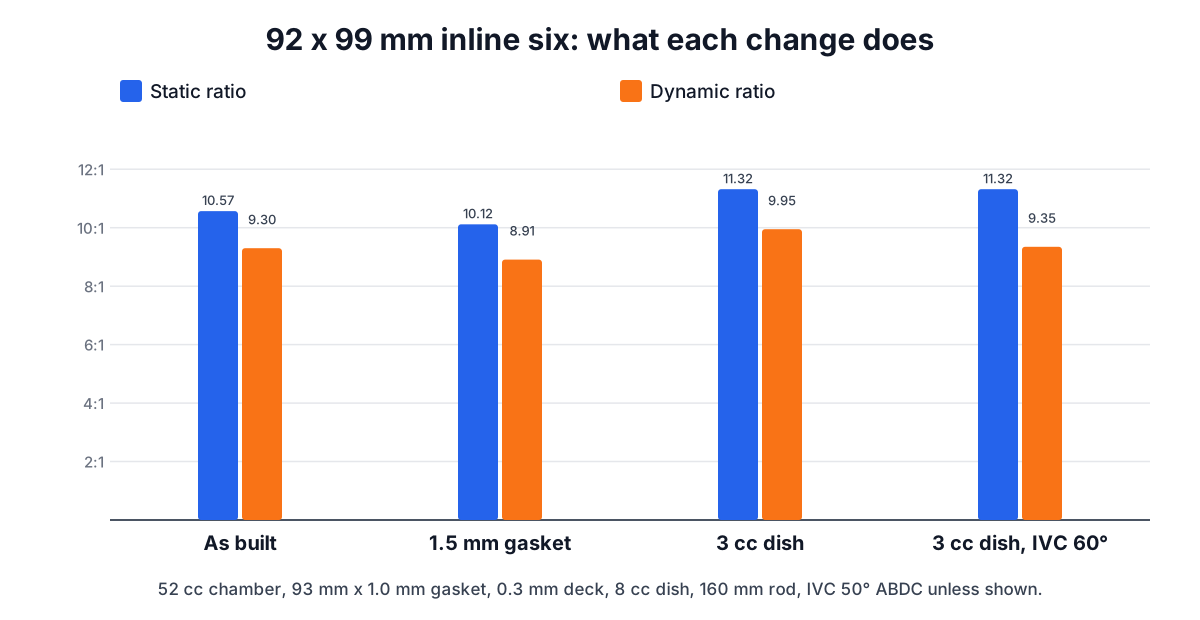
A few patterns stand out:
- Gasket thickness is a coarse adjuster. The extra half millimetre adds 3.40 cc and takes 0.45 of a point off. It also widens the squish gap between piston and head, which can make knock worse even as the ratio falls, so it is a blunt tool for a boost build.
- Piston dish is the clean way to lower compression. Going from 8 to 14 cc brings the six to 9.80:1 without touching squish.
- The cam can cancel a piston change. Smaller-dish pistons lift static compression to 11.32:1, but a cam that closes the intake 10° later brings the dynamic ratio back to 9.35:1, only just above the as-built 9.30.
The calculator works backwards too: for 10:1 on this bottom end the chamber would need to be 56.34 cc, and for 9:1, 65.48 cc.
Dynamic compression in practice
Compression starts when the intake valve closes. The calculator finds the piston position at that crank angle from the stroke and rod length (160 mm here):
x(θ) = r + l − ( r cos θ + √( l² − r² sin² θ ) ), θ = 180° + IVC
At IVC 50° the piston is 85.88 mm from top dead centre, so only that much of the 99 mm stroke compresses the charge. At IVC 60° it is 80.10 mm. That is why dynamic compression, not static, is the better guide when comparing cams on the same short block.
Use the cam's seat timing (advertised duration) for the intake closing angle. The 0.050 in lift figure closes earlier than the valve actually seats and overstates the dynamic ratio.
Reading Australian bowser numbers
The Fuel Quality Standards (Petrol) Determination 2024 sets these minimums:
| Grade | RON minimum | MON minimum | Average of the two |
|---|---|---|---|
| 91 RON grade | 91.0 | 81.0 | 86.0 |
| 95 RON grade | 95.0 | 85.0 | 90.0 |
Petrol may contain up to 10% ethanol by volume under the same Determination. 98 does not appear in the RON and MON rows at all: it is a fuel company's premium product, sold above the 95 minimum.
The last column matters when you read American build advice. US pumps show the anti-knock index, the average of RON and MON, which the octane rating reference puts at 4 to 6 numbers below RON for the same fuel. On the Determination's minimums, Australian 91 averages 86 and 95 averages 90. US regular is typically 87 and premium 91 to 94, according to the US Department of Energy. So:
- a US build "on 87" sits just above the 86 average of the Australian 91 minimums;
- a US build "on 91" asks for more than the 95 grade's minimum average of 90, so 98 is the safer grade to plan around;
- a US "93" build is a 98 build here.
None of that sets a safe ratio. Chamber design, quench, cam timing, ignition timing and boost all move the knock limit. The calculator compares builds; the dyno, with knock monitoring, decides.
Boost and compression
Forced induction raises the pressure in the cylinder when the intake closes, so the real squeeze is much higher than either ratio suggests. That is why boosted builds start from a lower static ratio. On this six, 14 cc dish pistons give 9.80:1 static and 8.63:1 dynamic before boost. Size injectors and fuel system together with the compression change; the injector size calculator works in kW and cc/min.
Mistakes worth avoiding
- The free gasket thickness. Use the compressed figure; on this engine every 0.1 mm is about 0.68 cc.
- Sign errors. A piston above the deck or a domed piston takes volume away; enter them as negatives.
- Old chamber volumes. A head that has been skimmed or had valve seat work has a different chamber. Measure it with a burette.
- Mixing US octane numbers into an Australian build. Convert first, as above.
- Forgetting registration. Raising compression or adding forced induction on a registered car is an engine modification; check with your state registration authority whether it needs engineering certification.
For bore, stroke and displacement, see the engine displacement guide. The US edition of this guide works the same method in inches on a small block V8.
Frequently asked questions
What octane is 91 in Australia?
At least 91.0 RON and 81.0 MON under the Fuel Quality Standards (Petrol) Determination 2024. The 95 grade must be at least 95.0 RON and 85.0 MON. 98 is a premium product sold above those minimums.
Is Australian 98 the same as US 93?
Roughly. US pumps show the average of RON and MON, 4 to 6 numbers below RON. A US 93 sits in about the same place as Australian 98, and US 91 sits between Australian 95 and 98.
How much does a thicker head gasket lower compression?
On a 92 x 99 mm six with a 93 mm gasket bore, going from 1.0 to 1.5 mm adds 3.40 cc per cylinder and lowers static compression from 10.57:1 to 10.12:1.
What compression ratio should I run for boost?
There is no single number, but boosted builds usually start from a lower static ratio than naturally aspirated ones. On the six, 14 cc dish pistons give 9.80:1 static. Plan the ratio, boost level, fuel and tune together.
Why do two engines with the same static ratio need different fuel?
Because the cam changes when compression starts. On the six with 3 cc dish pistons, closing the intake at 50° gives 9.95:1 dynamic and at 60° gives 9.35:1, on the same 11.32:1 static ratio.
Sources and further reading
- Fuel Quality Standards (Petrol) Determination 2024, Federal Register of Legislation. RON and MON minimums for 91 and 95; up to 10% ethanol.
- Octane rating, Wikipedia. RON, MON and the anti-knock index.
- Selecting the right octane fuel, US Department of Energy. US regular and premium grades.
- Compression ratio, Wikipedia.
- Internal Combustion Engines (course 2.61), MIT OpenCourseWare. Compression ratio and knock.
Open the Compression Ratio Calculator
More Automotive
Every tool in the Automotive section, free and in your browser.