
Level vs Decreasing Term vs Whole of Life Cover (UK)
Level and decreasing term, whole of life and over-50s cover compared in pounds, the return each pays, and why a policy in trust matters for Inheritance Tax.
By Redbison Dev · · 10 min read
United Kingdom edition. UK edition in pounds: level and decreasing term, whole of life and over-50s plans as the FCA describes the UK market, and writing a policy in trust for Inheritance Tax in the 2026 to 2027 tax year. US edition
A 35-year-old in England with a £250,000 repayment mortgage and two children usually chooses between three UK policies: level term that pays the same £250,000 whenever in the term a claim arises, decreasing term that falls roughly in step with the mortgage, and whole of life that pays out whenever death comes. The first two are pure protection and pay nothing if you outlive them. Whole of life always pays, which makes it a tool for an Inheritance Tax bill rather than for protecting a mortgage, and its return depends on how long you live: in the illustration below, 2.99% a year if death comes at 85.
Premiums in this edition are illustrations built for the arithmetic, not quotes. Prices depend on age, health, smoking and the insurer, so get your own and put them through the same calculators.
What the UK market sells
The FCA's description of the UK pure protection market (MS24/1.3, September 2025) sets out the products; its January 2026 interim report (MS24/1.4) adds the sales volumes and commission figures used below:
| Policy | How the payout behaves | What you get back if you outlive it |
|---|---|---|
| Level term assurance | The sum assured stays the same for the whole term | Nothing |
| Decreasing term assurance | Falls over the term, "commonly used in conjunction with mortgage repayments" | Nothing |
| Increasing term, family income benefit | Rises over time, or pays a monthly income for the rest of the term | Nothing |
| Whole of life (medically underwritten) | Pays on death whenever it happens, while premiums are paid | Nothing while alive; the payout is certain |
| Guaranteed-acceptance over-50s plan | A fixed sum with no health questions, after a waiting period of usually 12 or 24 months | Nothing while alive |
Pure protection products, the FCA says, "have no savings or investment element"; if you stop paying, "the policy will lapse and no benefit will be payable, regardless of how long the policy was held". Policies that put part of the premium into a fund, such as unit-linked whole of life, sit outside its study as investment products.
Return-of-premium term, common in the US and India, does not appear in the FCA's description of UK protection products: term cover here is bought purely as insurance.
In 2024 insurers sold about 1.4 million term policies against 0.2 million whole of life policies, and those were mostly guaranteed over-50s plans; around 36,000 were underwritten whole of life (FCA, from ABI data).
Level or decreasing: match the cover to the debt
A £250,000 repayment mortgage at 4.5% over 25 years costs £1,389.58 a month in the Mortgage Calculator, and the balance falls slowly at first:
| After | Mortgage still owed |
|---|---|
| 5 years | £219,645 |
| 10 years | £181,646 |
| 15 years | £134,080 |
| 20 years | £74,536 |
| 25 years | £0 |
Decreasing term is cheaper than level because the insurer's exposure shrinks: say £14 a month against £20 for level cover in this illustration. Two checks before choosing it:
- The schedule. A decreasing policy reduces the cover on a set schedule. If your balance falls more slowly than that schedule, for example because your rate is higher than the one the policy assumes, a claim in the later years can leave a gap. Compare the schedule with the balances in your own amortisation table.
- What else the payout must do. Decreasing term clears the mortgage and nothing more. If the family also needs to replace income while the children are at school, level term or family income benefit on top does that job; the £6 a month difference here buys £250,000 rather than £74,536 of cover in year 20.
An interest-only mortgage does not shrink, so it needs level cover.
Whole of life: the return depends on when you die
Say whole of life for £250,000 costs £180 a month (£2,160 a year) from age 35, paid for life. Its payout is certain, so the question is what it returns. Paste the yearly premiums at the start of each year and the £250,000 at the end of the year of death into the NPV and IRR Calculator:
| Death at | Premiums paid | Return on the premiums |
|---|---|---|
| 75 | £86,400 | 4.64% a year |
| 85 | £108,000 | 2.99% a year |
| 95 | £129,600 | 1.99% a year |
The alternative is level term to 60 at £20 a month and the other £160 into a stocks and shares ISA, then the full £180 a month into the ISA once the term ends. Gains in an ISA are tax-free, and the 2026 to 2027 allowance is £20,000 a year. Run it through the Annuity Calculator (monthly deposits at the start of each month, growth of deposits), carrying the pot at 60 forward as the starting balance:
| ISA value | At 4% a year | At 6% a year |
|---|---|---|
| Age 60 | £82,535 | £111,433 |
| Age 75 | £194,682 | £326,077 |
| Age 85 | £316,832 | £622,910 |
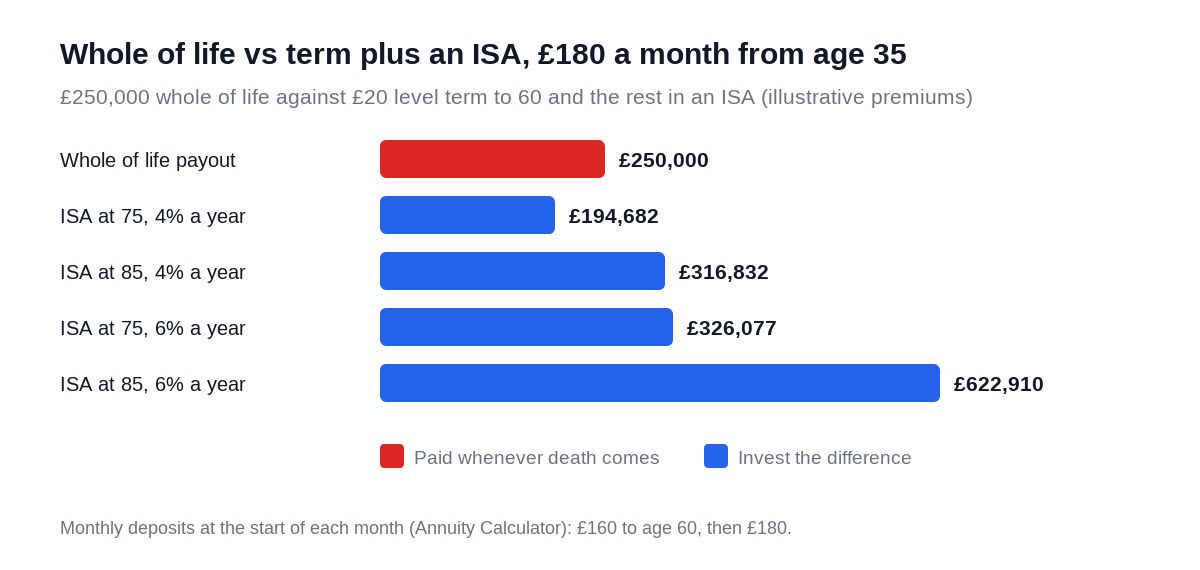
At 4%, investing wins if you live past about 80 and loses if you die in your 70s; at 6% it is ahead by 75. Whole of life also removes the risk that the ISA is spent, or that markets fall just before it is needed. That certainty is what you pay for, and it is worth most when the bill on death is certain too.
Over-50s plans: when premiums overtake the payout
A guaranteed-acceptance plan paying £4,000 for £20 a month has taken more in premiums than it will pay out after 200 months, 16 years and 8 months. Start at 62 and you cross that line at 78. The FCA's interim report found these plans pay the highest commission of any protection product, and that insurers have changed designs to limit poor outcomes, such as premium caps after which you stop paying but keep the cover. Check whether a plan has a cap and when it applies, and that the waiting period refunds premiums rather than paying nothing if death comes early. For most people with savings, putting the £20 a month into an easy-access account builds the same £4,000 within the 200 months without the risk of paying in more.
A policy in trust for Inheritance Tax
The tax. Inheritance Tax is 40% of the estate above the threshold. The nil rate band is £325,000, fixed until 5 April 2031, and the residence nil rate band adds up to £175,000 when a home passes to children or grandchildren. A widow or widower can use a late spouse's unused bands as well.
Worked example. A widowed parent leaves £1,400,000, including a £600,000 home, to the children:
- allowances of £1,000,000 (two nil rate bands of £325,000 and two residence bands of £175,000). The two residence bands are worth the full £350,000 only because the home, worth £600,000 here, passes to direct descendants and is worth at least £350,000, and because the estate is under £2 million, above which the residence band tapers away;
- £400,000 taxable;
- £160,000 of Inheritance Tax.
In trust or not. A £160,000 whole of life policy can pay that bill, but only if it is written in trust. HMRC's manual is plain: if the person who died owned the policy on their own life, "the proceeds will form part of their free estate". Owned outright, the £160,000 payout lifts the estate to £1,560,000 and the bill to £224,000, so a third more cover is needed just to pay tax on the cover. Written in trust for the children, the payout belongs to the trust, sits outside the estate and is paid to the trustees.
The premiums. Each premium is a gift to the trust. HMRC treats regular premiums paid from surplus income as normal expenditure out of income, and its own manual uses a policy in trust as the example of an exempt pattern of giving. Otherwise the £3,000 annual exemption covers up to that amount a year.
Couples with this problem can insure the second death, when the bill falls, on a joint-life policy. Trust wording and the choice between trust types have tax consequences of their own, so take advice from a solicitor or a regulated financial adviser before signing.
This is general information, not a recommendation of any policy or insurer. Check that any adviser or firm is on the FCA register before you buy.
Tools for this job
- Mortgage Calculator: the balance a decreasing term policy has to keep up with.
- NPV and IRR Calculator: the return a whole of life or over-50s plan pays on its premiums.
- Annuity Calculator: what the premium difference grows to in an ISA.
- Compound Interest Calculator: a lump sum's growth, such as an ISA pot left to grow after the term ends.
- Insurance Review Checklist: the policies a household should check each year, trusts included.
- Estate Planning Checklist: the will and trusts that the policy has to fit.
The time value of money explains why an IRR over 40 years and one over 50 are not directly comparable, and how UK mortgages work covers the debt the term policy protects.
Frequently asked questions
Should I choose level or decreasing term life insurance for a mortgage?
Decreasing term suits a repayment mortgage when its cover schedule falls no faster than your balance, which depends on the interest rate it assumes. Level term costs more but pays the full sum in any year, so it also suits an interest-only mortgage or a family that needs income replaced as well as the debt cleared.
Is whole of life insurance worth it in the UK?
It is worth most when a bill on death is certain, such as Inheritance Tax on an estate above the nil rate bands. As savings it is modest: a £250,000 policy at £180 a month from age 35 returns about 3% a year on premiums if death comes at 85, and less the longer you live.
Why should a life insurance policy be written in trust?
If you own a policy on your own life, HMRC counts the payout as part of your estate, where it can face 40% Inheritance Tax and adds to the bill it was meant to pay. Written in trust, the payout goes to the trustees for your chosen beneficiaries outside the estate. Premiums paid regularly from surplus income can be exempt gifts.
Can you get return of premium life insurance in the UK?
It is not a mainstream UK product: term cover is sold as pure protection, which the FCA describes as having no savings or investment element, and a lapsed policy pays nothing back. Plans that build a cash value are unit-linked or investment-linked whole of life policies, which the FCA treats as investment products.
Are over-50s life insurance plans good value?
Often not. They accept everyone without health questions, but the FCA found they carry the highest commission of any protection product, and the fixed premiums can exceed the payout: £20 a month for £4,000 passes the payout after 16 years and 8 months. Look for a premium cap and compare with saving the same amount.
Sources and further reading
- Structure of the UK pure protection market for retail customers (MS24/1.3), Financial Conduct Authority, September 2025. Level, decreasing and increasing term, family income benefit, whole of life and over-50s plans.
- Market study into the distribution of pure protection products: interim report (MS24/1.4), Financial Conduct Authority, January 2026. Policy volumes, commission and over-50s value.
- Inheritance Tax thresholds and interest rates, HM Revenue and Customs. The £325,000 nil rate band to 5 April 2031 and the £175,000 residence nil rate band.
- Inheritance Tax, GOV.UK. The 40% rate and passing unused thresholds to a spouse or civil partner.
- IHTM20012: life policies and Inheritance Tax, HMRC Inheritance Tax Manual. Proceeds of a policy owned on your own life form part of the estate.
- IHTM14242: normal expenditure out of income, pattern of gifts, HMRC Inheritance Tax Manual. Premiums on a policy in trust as an exempt pattern of giving.
- Gifts and the annual exemption, GOV.UK. The £3,000 annual exemption and regular gifts from income.
- Individual Savings Accounts, GOV.UK. The £20,000 allowance for the 2026 to 2027 tax year.