
Term vs ULIP vs Endowment vs TROP: Life Cover in India
Pure term, ULIP, endowment and TROP compared on premium, cover and money back: the real return on a TROP refund, 10(10D) premium limits, 80C and surrender rules.
By Redbison Dev · · 10 min read
India edition. India edition in rupees: term, ULIP, endowment and money-back, and TROP plans under IRDAI rules, with the 10(10D) and 80C limits as carried into the Income-tax Act, 2025. US edition
An agent offers a 30-year-old three ways to spend on life insurance: ₹1 crore of pure term cover to age 60 for ₹12,000 a year, the same cover as a term return of premium (TROP) plan for ₹30,000 a year that refunds every premium at 60, or an endowment plan at ₹1,00,000 a year for 20 years with ₹10 lakh of cover and a maturity cheque. Only the first is pure insurance. The other two are a term plan plus a savings product, and the savings part can be measured: in these illustrations the TROP refund earns 3.12% a year on the extra premium and the endowment 3.72% on everything you pay, while the same money in a monthly SIP at 10% would be worth far more after tax.
All premiums and maturity values here are illustrations made up for the arithmetic, not quotes from any insurer. Your own figures are in the benefit illustration and Customer Information Sheet the insurer must give you; type those into the same calculators.
Four products, three questions: premium, cover, money back
| Plan | What you pay | Cover | What comes back if you survive |
|---|---|---|---|
| Pure term | Lowest premium | High: ₹1 crore here | Nothing |
| TROP (term with return of premium) | Two to three times the term premium (₹30,000 against ₹12,000 here) | Same as term | The premiums you paid, at the end of the term |
| Endowment or money-back (non-linked) | High: ₹1,00,000 a year here | Low: often 10 times the annual premium, the minimum for a tax-free maturity, ₹10 lakh here | Sum assured plus bonuses, in one cheque (endowment) or in instalments (money-back) |
| ULIP (unit linked) | Usually high; part of each premium buys fund units after charges | At least the sum assured, and the death benefit can never be below 105% of premiums paid | The fund value, which rises and falls with the market |
The cover column is the one agents skip. A family that needs ₹1 crore and buys the endowment instead is underinsured by ₹90 lakh while paying eight times the premium. Decide the cover first, then ask what the extra premium earns.
What a TROP refund really earns
A TROP refund feels free because every rupee comes back. It is not: the extra ₹18,000 a year (₹30,000 minus ₹12,000) is a 30-year investment whose only payout is ₹9,00,000 at 60. Stop paying early and you get only a surrender value, usually far below the premiums paid; die during the term and your family gets the ₹1 crore either way, with nothing extra for the higher premiums. Its return is an internal rate of return. Paste these flows, thirty extra premiums at the start of each year and the refund at the end, into the NPV and IRR Calculator:
-18000, -18000, -18000, -18000, -18000, -18000, -18000, -18000, -18000, -18000, -18000, -18000, -18000, -18000, -18000, -18000, -18000, -18000, -18000, -18000, -18000, -18000, -18000, -18000, -18000, -18000, -18000, -18000, -18000, -18000, 900000
The IRR is 3.12% a year, and only if you pay all 30 premiums and are alive at 60. Now invest the same ₹18,000 as a ₹1,500 monthly SIP for 30 years in the SIP Calculator (instalments at the start of the month, annual rate ÷ 12):
| Where the extra ₹18,000 a year goes | Value at 60 | After 12.5% tax on gains above ₹1.25 lakh |
|---|---|---|
| Extra premiums into the TROP plan | ₹5,40,000 paid | |
| TROP refund (3.12% a year) | ₹9,00,000 | ₹9,00,000 (exempt) |
| SIP at 7% | ₹18,40,631 | ₹16,93,677 |
| SIP at 10% | ₹34,18,988 | ₹30,74,739 |
| SIP at 12% | ₹52,94,871 | ₹47,16,137 |
The tax column is a worst case: it treats all the gains as long-term gains on an equity fund sold in one year, at the 12.5% rate above the ₹1.25 lakh yearly exemption enacted by the Finance (No. 2) Act, 2024 (explained in the Budget 2024-25 memorandum) and carried into the Income-tax Act, 2025, before surcharge and cess. Spread the redemptions over a few years and each year gets its own ₹1.25 lakh.
TROP still has two honest uses. It forces the saving, and for a buyer who would otherwise spend the ₹1,500 a month, ₹9 lakh is better than nothing. And the refund is tax-free as long as the policy meets the exemption conditions below. Read the policy's surrender schedule before buying: stop paying in year 12 and what you get back is whatever that schedule says.
Endowment and money-back: what the maturity cheque returns
Take the endowment illustration: ₹1,00,000 a year for 20 years, ₹10 lakh of cover, and a maturity value of ₹30,00,000 (guaranteed sum assured plus bonuses that are not guaranteed). Paste twenty -100000 flows followed by 3000000 into the NPV and IRR Calculator and the return is 3.72% a year on the whole premium. The bonus part rests on assumptions: IRDAI has insurers illustrate ULIPs at assumed returns of 4% and 8% a year, and a participating plan's bonuses are not guaranteed either. Run the IRR on each column of your own illustration and treat the higher one as a scenario, not a promise.
The alternative is the ₹1 crore term plan at ₹12,000 a year plus the remaining ₹88,000 as a ₹7,333 monthly SIP for the same 20 years:
| Over 20 years | Endowment | Term ₹1 crore + SIP |
|---|---|---|
| Life cover | ₹10 lakh | ₹1 crore |
| Paid in | ₹20,00,000 | ₹2,40,000 premium + ₹17,59,920 in the SIP |
| At the end, at 7% | ₹30,00,000 | ₹38,42,238 (₹35,97,573 after tax) |
| At the end, at 10% | ₹30,00,000 | ₹56,14,855 (₹51,48,614 after tax) |
| At the end, at 12% | ₹30,00,000 | ₹73,26,752 (₹66,46,523 after tax) |
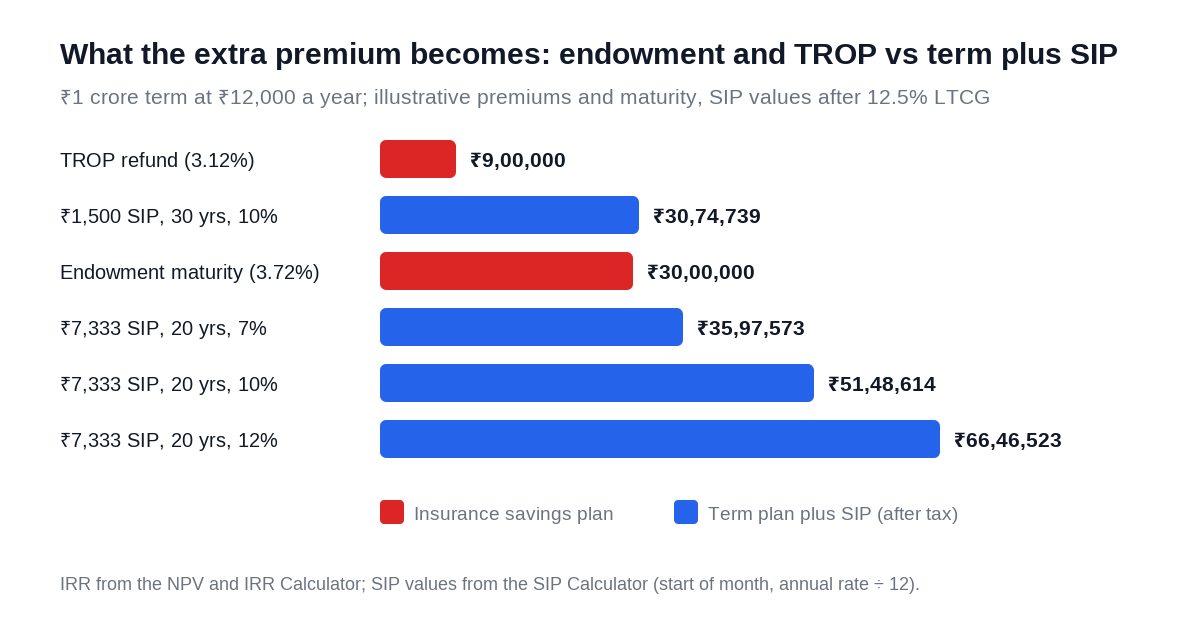
The SIP carries market risk and the endowment does not carry much of it, so the fair comparison for a cautious saver is a debt fund, the PPF or an FD, not 12% equity. Even at 7%, term plus investing comes out ahead here and leaves the family ₹90 lakh better protected throughout.
ULIPs: charges and the five-year lock-in
A ULIP puts each premium, after charges, into fund units you choose. The charges a benefit illustration must account for include premium allocation, mortality (the cost of the cover, which rises with age), policy administration, fund management, and surrender or discontinuance charges, as the heads in IRDAI's product filing format list them. IRDAI's policyholder site adds that discontinuance charges are capped both as a percentage and in rupees, and that insurers must spread charges over the lock-in rather than front-load them.
Under IRDAI's Master Circular on Life Insurance Products of 12 June 2024:
- Lock-in. Linked products have a 5-year lock-in, during which nothing is paid out except on death or another covered event.
- Stopping early. If you stop paying within the lock-in, the fund value less the capped discontinuance charge moves to a discontinued policy fund, the cover stops, and the money is paid only when the lock-in ends. That fund earns a guaranteed minimum of 4% a year, with only the fund management charge deducted.
- Death benefit. The specimen benefit table sets it at the higher of the sum assured or fund value, and never less than 105% of premiums paid.
A ULIP held for 10 or 15 years with low-cost funds can work; one surrendered in year three is where most ULIP losses come from. Compare its charges with a direct mutual fund plan using the Compound Interest Calculator at two returns a percentage point apart.
Tax: the 80C deduction and the 10(10D) limits
From 1 April 2026 the Income-tax Act, 2025 replaced the 1961 Act. The rules for life insurance carried over with new numbers: section 80C became section 123 with Schedule XV, and section 10(10D) became Schedule II, serial number 2, read with section 11.
Deduction for premiums. Premiums on your own life, your spouse's or your children's count towards the ₹1,50,000 limit that also covers EPF, PPF, ELSS and home loan principal. Only the part of each year's premium up to 10% of the "actual capital sum assured" counts for policies issued from 1 April 2012 (15% for a person with a specified disability or disease; 20% for older policies). For tax year 2026-27, under the Income-tax Act, 2025, the default new regime in section 202 computes income without the Chapter VIII deductions that include section 123, so premiums save no tax unless you opt for the old regime. The same was true under the 1961 Act: for returns for AY 2026-27, the e-filing portal lists 80C only under the old regime.
Exemption for the payout. A death claim is exempt. A maturity, survival or surrender payout is exempt only if:
| Policy issued | Condition for the payout to be tax-free |
|---|---|
| 1 April 2003 to 31 March 2012 | Premium no more than 20% of the sum assured in any year |
| 1 April 2012 to 31 March 2013 | Premium no more than 10% of the sum assured in any year |
| 1 April 2013 onwards | Premium no more than 10% of the sum assured (15% for a disabled or specified-disease life) |
| ULIP issued from 1 February 2021 | The same, and total premium on all such ULIPs no more than ₹2,50,000 in any tax year |
| Non-linked plan issued from 1 April 2023 | The same, and total premium on all such policies no more than ₹5,00,000 in any tax year |
In the example, the endowment's ₹1,00,000 premium is exactly 10% of its ₹10 lakh sum assured and well under ₹5 lakh, so its ₹30 lakh maturity is exempt; one rupee more of premium and the whole maturity would be taxable. The TROP's ₹30,000 against ₹1 crore passes easily. The ₹2.5 lakh and ₹5 lakh aggregate limits do not apply to a policy issued from 1 April 2025 by an insurance office in an International Financial Services Centre (IFSC).
Above the limits, the payout is taxable, and the Budget 2025-26 memorandum explains how: a ULIP that loses the exemption is treated as a capital asset and its gain taxed as capital gains, while a non-linked policy's payout is taxed as income from other sources. A keyman policy never qualifies.
Free look and surrender
- Free look. You have 30 days from receiving the policy document to read it and cancel if the terms are not what you were sold (Master Circular, para 5). Use it: compare the benefit illustration with what you were told, and run the IRR before the 30 days run out.
- Surrender of non-linked plans. The special surrender value becomes payable after the first policy year once a full year's premium is paid, or immediately for single-premium and short (under five years) premium terms. It must be at least the expected present value of the paid-up sum assured and benefits, discounted at no more than the 10-year G-Sec yield plus 0.5% (para 26.4). The benefit illustration shows the guaranteed and special surrender values year by year.
- Policy loans. Every non-linked savings plan with a surrender value must offer a loan against it (para 27), which is usually cheaper than surrendering when you need cash for a short time.
This is general information, not advice on any policy or insurer. If you already hold an endowment or ULIP, work out its surrender value and IRR from here before stopping it; a SEBI-registered investment adviser can run the comparison with your own figures.
Tools for this job
- NPV and IRR Calculator: the return a TROP refund, an endowment maturity or a ULIP illustration pays on what you put in.
- SIP Calculator: what investing the difference grows to, month by month, with the Indian SIP convention.
- Compound Interest Calculator: the cost of a higher charge or a lower return over decades.
- Annuity Calculator: yearly premiums or deposits invested at the start of each year.
- Insurance Review Checklist: the yearly check of every policy a household holds, nominees included.
- Estate Planning Checklist: the will and nominations a payout has to fit.
SIP vs lump sum covers the investing side, and retirement corpus planning shows where the money saved on premiums fits.
Frequently asked questions
Is a TROP plan better than pure term insurance?
Only if you would otherwise not save the difference. In an illustration with ₹12,000 term and ₹30,000 TROP premiums for ₹1 crore over 30 years, the ₹9 lakh refund returns 3.12% a year on the extra ₹18,000. The same ₹1,500 a month in a SIP at 10% grows to about ₹34 lakh before tax.
Are endowment and money-back maturity amounts tax-free?
Yes, if the premium is at most 10% of the sum assured in every year and, for non-linked policies issued from 1 April 2023, total premiums on all such policies are no more than ₹5 lakh in any tax year. Above that limit the payout is taxed as income from other sources. Death claims are always exempt.
What is the ₹2.5 lakh limit on ULIPs?
For ULIPs issued from 1 February 2021, maturity or surrender proceeds are exempt only if total premiums on all such ULIPs stay within ₹2,50,000 in any tax year, besides the 10% premium to sum assured rule. A ULIP over the limit is treated as a capital asset and its gain taxed as capital gains. Death benefits stay exempt.
Can I surrender a ULIP before five years?
You can stop, but the money stays locked. The fund value less a capped discontinuance charge moves to a discontinued policy fund earning at least 4% a year, the cover ends, and the proceeds are paid only when the five-year lock-in ends, unless the policyholder dies first.
How long is the free-look period for life insurance in India?
Thirty days from the date you receive the policy document, under IRDAI's Master Circular on Life Insurance Products of 12 June 2024. Within that window you can review the terms and conditions and cancel the policy if any of them do not suit you.
Sources and further reading
- Master Circular on Life Insurance Products, 12 June 2024, Insurance Regulatory and Development Authority of India. Free look, lock-in, discontinued policy fund, special surrender value and policy loans.
- Unit Linked Products, IRDAI policyholder site. Charge caps, the lock-in and illustrations at 4% and 8%.
- Schedule II, Income-tax Act, 2025, Income Tax Department. The exemption for sums received under a life insurance policy and its conditions.
- Section 202, Income-tax Act, 2025, Income Tax Department. The new tax regime for tax year 2026-27 and the deductions it excludes.
- Return applicable and deductions, AY 2026-27, Income Tax e-filing portal. The ₹1,50,000 limit and old-regime deductions.
- Memorandum explaining the Finance Bill, 2025, Ministry of Finance. How ULIP and non-ULIP proceeds above the Schedule II limits are taxed.
- Memorandum explaining the Finance (No. 2) Bill, 2024, Ministry of Finance. The 12.5% long-term capital gains rate and the ₹1.25 lakh exemption.
- Income Tax Act 2025 gets President's assent, effective 1 April 2026, All India Radio News. The new Act's start date.