
Discounting and NPV in the UK: Green Book, ISAs, CAGR
Present value, NPV and IRR the UK way: the Green Book's 3% real rate and its step-down after year 30, real versus nominal, and ISA growth worked in pounds.
By Redbison Dev · · 9 min read
United Kingdom edition. UK edition in pounds, built on HM Treasury's October 2026 Green Book discounting guidance (3.00% real for years 1 to 30, then 2.50% and 2.25%), the 2026 to 2027 ISA allowance and the Bank of England's 2% inflation target. US edition
A pound today is worth more than a pound next year, and in the UK there is an official answer to "how much more" for public spending: HM Treasury's Green Book discounts real costs and benefits at 3.00% a year for the first 30 years of a proposal, 2.50% for years 31 to 75 and 2.25% for years 76 to 125 (the October 2026 guidance). At 3.00%, £1 million arriving in 20 years is worth £553,676 today. Households face the same arithmetic with a different rate: £20,000 put into an ISA at the start of each year for ten years grows to £264,136 if it earns 5% a year, a figure that depends entirely on that assumed 5%.
This edition works in pounds with the Present and Future Value Calculator, the NPV Calculator (UK), the CAGR Calculator and the ROI Calculator. It explains the maths and the Treasury conventions; it is not financial advice. The US version is here.
Where the UK discount rate comes from
The Green Book calls its rate the Social Time Preference Rate (STPR). The supplementary guidance builds it in two parts: a risk-free rate of 2.00% (the Ramsey formula estimate of 1.875%, nudged up after comparing it with real gilt yields, which it notes were around 2% in June 2026) plus a systematic risk premium of 1.00%. The sum is 3.00%.
Until autumn 2026 the headline rate was 3.50%. HM Treasury's response to the Green Book Discount Rate Review 2026 says the Chancellor confirmed in September 2026 that it would fall to 3.00% for years 1 to 30, with the later bands cut from 3.00% to 2.50% and from 2.50% to 2.25%. So any business case written before then needs re-running before its options are compared with new ones.
Three rules in the guidance catch people out:
- One rate for everything. Practitioners should not use different discount rates for different types of proposal, environmental ones included. If something becomes more valuable over time, that goes into the forecast benefits, not the rate.
- Real terms only. The STPR is a real rate. Strip out general inflation first, then discount. Adding inflation to the discount rate is, in the guidance's words, mathematically incorrect.
- No discounting of the past. Costs already incurred are not inflated by discounting backwards.
The Annex A discount factors, and checking them
A discount factor is 1 ÷ (1 + r)^t. At 3.00% the factor for year 10 is 0.7441 and for year 30 is 0.4120, which is what Annex A prints. Multiply each year's real cost or benefit by its factor and add them up; that is all an NPV is.
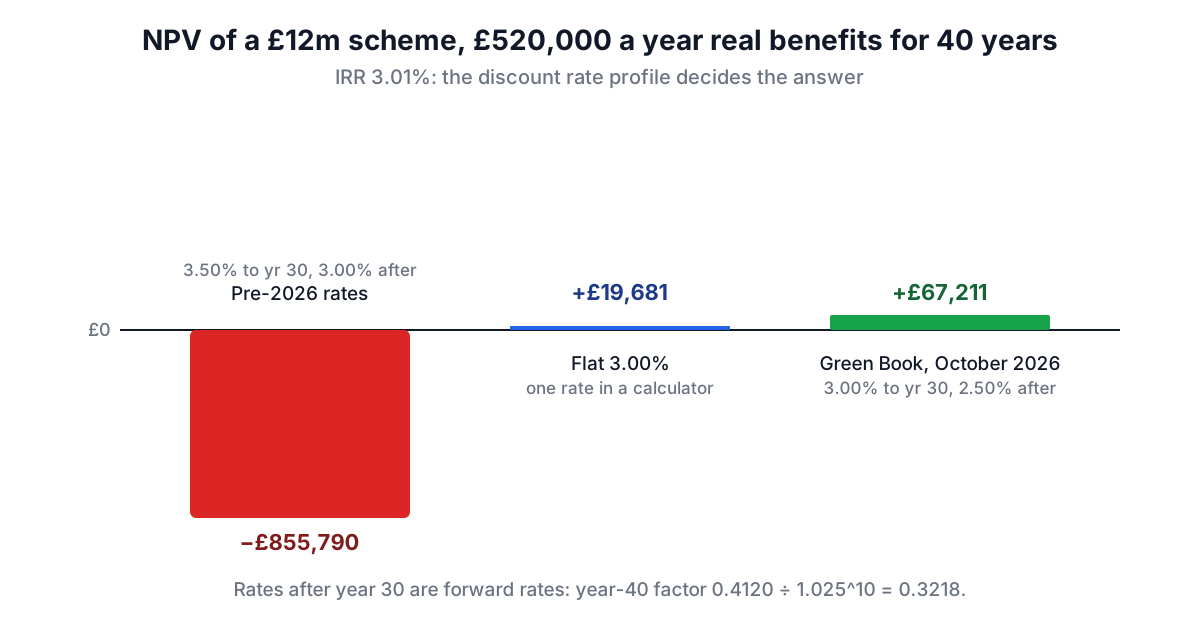
Beyond year 30 the rates are forward rates. The factor for year 31 is the year-30 factor divided by 1.025, giving 0.4019, and the year-40 factor is 0.4120 ÷ 1.025^10 = 0.3218. The guidance is explicit that a 40-year appraisal uses 3.00% to year 30 and then 2.50%, not 2.50% throughout.
Worked example: a 40-year scheme under three rate profiles
Take a flood defence that costs £12 million now and avoids £520,000 a year of damage in real terms for 40 years. Enter -12000000 then forty years of 520000 in the NPV calculator:
| Discounting | NPV |
|---|---|
| Pre-2026 Green Book (3.50% to year 30, 3.00% after) | -£855,790 |
| Flat 3.00% for all 40 years (one rate in the calculator) | £19,681 |
| Current Green Book (3.00% to year 30, 2.50% after) | £67,211 |
The IRR is 3.01%, a whisker above the new rate, so the decision is driven almost entirely by the discount rate rather than the engineering. That is the case for showing sensitivity alongside the central figure. It also shows the cost of a shortcut: the calculator applies one rate, so for anything over 30 years either use the Annex A factors for the later years or run years 1 to 30 in the tool and discount years 31 onwards separately. Here the shortcut understates the NPV by £47,530.
Health benefits
The 2026 changes also dropped the separate 1.50% health discount rate. Instead, future real health effects are uprated by 2% a year and then discounted at the STPR. A health benefit worth £100,000 at current prices arriving in year 10 counts as £100,000 × (1.02 ÷ 1.03)^10 = £90,705, where the old 1.50% rate gave £86,167.
Real and nominal rates in practice
The Bank of England's target is 2% CPI inflation. If you have nominal forecasts, convert either the cash flows or the rate, never both and never by adding:
nominal = (1 + real) × (1 + inflation) − 1
        = 1.03 × 1.02 − 1 = 5.06%, not 5%
For a private firm the Green Book rate is usually the wrong benchmark anyway. A company should discount at its own cost of capital, which reflects what its lenders and shareholders require. The NPV Calculator reports IRR and MIRR so you can see how much room a project has above whichever rate applies.
ISAs: future value of a yearly allowance
GOV.UK sets the ISA allowance at £20,000 for the 2026 to 2027 tax year. Suppose you use it in full each year for ten years and the account earns 5% a year after charges (an assumption for the arithmetic, not a forecast):
| Timing of the £20,000 | Value after 10 years |
|---|---|
| Start of each tax year (6 April) | £264,136 |
| £1,666.67 at the start of each month, 5% compounded monthly | £259,882 |
| End of each tax year (5 April) | £251,558 |
Paying in on 6 April rather than the following 5 April is worth £12,578 over the decade, because every payment gets one more year of growth. In the Present and Future Value Calculator that is the switch between payments at the start (annuity due) and the end (ordinary annuity).
CAGR and ROI on a UK portfolio
A stocks and shares ISA that went from £48,000 to £71,500 over six years with no money added or taken out has a CAGR of 6.87%. Dividing the 49% gain by six years says 8.16%, which overstates it because it ignores compounding. If you paid in along the way, CAGR from the two balances mixes your contributions with growth; use the money-weighted approach in the UK guide to time-weighted and money-weighted returns instead.
Annualised ROI follows the same rule: (1 + total return)^(1 ÷ years) − 1. A fund platform's "total return since purchase" of 49% means very different things over three years and over twelve.
For how compounding frequency and AER interact on UK savings accounts, see the UK compound interest guide, and for what inflation does to cash, the UK inflation and savings guide.
Frequently asked questions
What is the Green Book discount rate?
It is the Social Time Preference Rate, 3.00% a year in real terms for years 1 to 30 of a proposal, 2.50% for years 31 to 75 and 2.25% for years 76 to 125, under HM Treasury's October 2026 supplementary guidance on discounting. It was 3.50% for the first 30 years before that.
How do I use the Green Book discount factors for a project longer than 30 years?
Treat the rates as forward rates. Use 3.00% up to year 30, then divide by 1.025 for each further year up to year 75. The year-40 factor is 0.3218, not 1 ÷ 1.025^40. A single-rate calculator can handle the first 30 years; add the later years using the Annex A factors.
Should I add inflation to the Green Book rate?
No. The guidance says the STPR applies only to real values and that adding inflation to the discount rate gives a mathematically incorrect result. Convert costs and benefits to real terms first, then discount at 3.00%.
Is it better to pay into an ISA at the start or end of the tax year?
At any positive return, earlier is better because the money compounds for longer. £20,000 a year for ten years at an assumed 5% grows to £264,136 when paid in each April and £251,558 when paid in at the end of each year.
Why did the Green Book stop using a 1.5% health discount rate?
HM Treasury's 2026 response replaced it with uprating future real health effects by 2% a year and discounting at the standard rate, which it describes as giving mathematically equivalent appraisals.
Sources and further reading
- Green Book supplementary guidance: discounting (October 2026), HM Treasury. STPR derivation, paragraphs 3.1 to 3.13 and the Annex A discount factors.
- Green Book Discount Rate Review 2026: HM Treasury response, HM Treasury. The cut from 3.50% to 3.00% and the end of the health discount rate (Box 1.A).
- The Green Book: appraisal in central government, GOV.UK. Updated 28 October 2026.
- Individual Savings Accounts, GOV.UK. The £20,000 allowance for the 2026 to 2027 tax year.
- Inflation and the 2% target, Bank of England.
- 16.2 Net Present Value (NPV) Method, OpenStax. NPV as a capital budgeting rule.
Open the Present and Future Value Calculator
More Calculators
Every tool in the Calculators section, free and in your browser.
- Investment Calculator
- Compound Interest Calculator
- Simple Interest Calculator
- Interest Calculator
- EMI Calculator
- Retirement Calculator
- Time-Weighted Return Calculator
- Savings Goal Calculator
- Inflation Calculator
- CAGR Calculator
- ROI Calculator
- Present and Future Value Calculator
- NPV and IRR Calculator
- 401(k) Calculator
- Roth IRA Calculator
- APY and CD Calculator
- SIP Calculator
- Annuity Calculator
- Bond Price and Yield Calculator
- Currency Converter
- Dividend Calculator
- Stock Average Calculator
- RMD Calculator