
Cutting Speed, RPM, Feed and Machining Time, Worked in mm
Find RPM with N = 1000V / πD, then feed in mm/min, metal removal rate and machining time for drilling, turning and milling with HSS and carbide.
By Redbison Dev · · 11 min read

India edition. Written for Indian ITI, polytechnic and tool-room practice: metric throughout, HSS drills and lathe tools in mild steel, stepped-pulley drills and lathe speed steps, machining time, and the cutting speed, feed and RPM tasks in the DGT Fitter curriculum. US edition
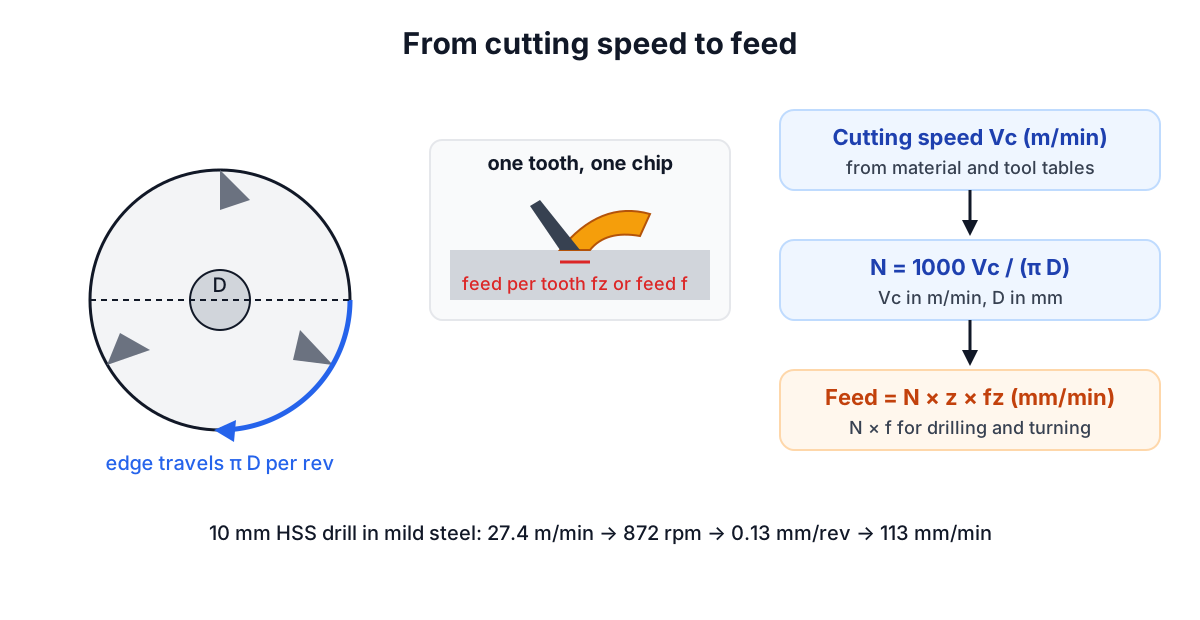
Spindle speed comes from N = 1000 x V ÷ (π x D), with cutting speed V in metres per minute and the drill, cutter or job diameter D in millimetres. A 10 mm HSS drill in mild steel at 27.4 m/min runs at 872 rpm, and at a feed of 0.13 mm per revolution it advances 113 mm a minute. The DGT Fitter curriculum asks trainees to choose cutting speed, feed and RPM for different materials when drilling and to compare HSS and carbide lathe tools, and these are the same sums. The Cutting Speed and RPM Calculator opens on that drill. This guide works the formulas through drilling, turning and milling, adds machining time, and shows what to do when the machine only has fixed speed steps.
The formulas, with units
| What you want | Formula | Units |
|---|---|---|
| Spindle speed | N = 1000 x V ÷ (π x D) | rpm; V in m/min, D in mm |
| Cutting speed from a known speed | V = π x D x N ÷ 1000 | m/min |
| Feed rate, drilling and turning | F = f x N | mm/min; f in mm/rev |
| Feed rate, milling | F = fz x z x N | mm/min; fz in mm per tooth, z teeth |
| Metal removal rate, turning | Q = V x t x f | cm³/min; depth of cut t and f in mm |
| Metal removal rate, drilling | Q = D x f x V ÷ 4 | cm³/min |
| Machining time | T = L ÷ F | min; length L in mm |
The 1000 converts metres to millimetres. In turning, D is the job diameter, not the tool. In drilling and milling it is the tool.
Starting cutting speeds
The calculator's presets are cautious values for plain tools. In metric they are:
| Material | HSS | Carbide |
|---|---|---|
| Aluminium | 91.4 m/min | 243.8 m/min |
| Brass, free-cutting | 45.7 m/min | 137.2 m/min |
| Mild steel | 27.4 m/min | 106.7 m/min |
| Alloy steel, annealed | 21.3 m/min | 76.2 m/min |
| Stainless steel | 18.3 m/min | 61.0 m/min |
| Grey cast iron | 24.4 m/min | 76.2 m/min |
Carbide runs about four times faster than HSS in mild steel because it keeps its hardness at much higher cutting temperatures. A tool maker's figure for a coated drill or a particular insert grade takes priority over any table.
Drilling
Example 1, a 10 mm drill in mild steel. V = 27.4 m/min, f = 0.13 mm/rev:
- N = 1000 x 27.4 ÷ (3.1416 x 10) = 872 rpm
- F = 872.2 x 0.13 = 113.4 mm/min
- a 25 mm deep hole takes 25 ÷ 113.4 = 0.22 min, about 13 seconds of cutting, before approach and clearing chips
Example 2, the tap drill for M10. The 8.5 mm drill for an M10 x 1.5 thread at the same speed runs at 1,026 rpm and 133 mm/min. Smaller drills run faster at the same cutting speed.
Example 3, a 20 mm drill on a pillar drill. At 27.4 m/min and 0.25 mm/rev: 436 rpm and 109 mm/min. Doubling the diameter halves the RPM. A big drill is usually piloted with a smaller one first so the chisel edge does not have to push through solid metal.
On a pillar or bench drill with stepped pulleys, always take the step below the calculated RPM. The same 10 mm HSS drill in aluminium at 91.4 m/min wants 2,909 rpm, so on a drill whose top step is lower than that, use the top step and keep the feed per revolution.
Turning
Example 4, a 50 mm mild steel bar, HSS against carbide. Feed 0.2 mm/rev, depth of cut 1.5 mm:
| Tool | V | N | Feed | MRR |
|---|---|---|---|---|
| HSS | 27.4 m/min | 174 rpm | 34.9 mm/min | 8.22 cm³/min |
| Carbide | 107 m/min | 681 rpm | 136.2 mm/min | 32.1 cm³/min |
MRR for HSS is 27.4 x 1.5 x 0.2 = 8.22 cm³/min. The carbide tip takes the same chip about four times as fast. This is the HSS against carbide comparison the curriculum asks for, worked out.
Example 5, machining time for a 200 mm length. T = L ÷ (f x N):
- HSS at 174 rpm: 200 ÷ 34.9 = 5.73 min
- carbide at 681 rpm: 200 ÷ 136.2 = 1.47 min
When the lathe only has fixed speeds
A centre lathe with a gearbox offers a set of speeds, not every RPM. Suppose the two nearest steps to 174 rpm are 140 and 220 rpm. The cutting speed at each is V = π x D x N ÷ 1000:
- 140 rpm gives 22.0 m/min, under the preset, and a feed of 28 mm/min (7.14 min for the 200 mm length)
- 220 rpm gives 34.6 m/min, 26% above the preset for plain HSS
Take 140 rpm, the step below. A blunt or burnt HSS tool costs more time to regrind than the extra 1.4 minutes of cutting. As the job diameter is turned down, recheck: the same 27.4 m/min at 30 mm needs 291 rpm.
Milling
For milling the feed is per tooth. Example 6, a 100 mm, 18-tooth HSS side and face cutter on a horizontal milling machine, in mild steel at 27.4 m/min with 0.05 mm per tooth, cutting 6 mm deep and 20 mm wide:
- N = 1000 x 27.4 ÷ (π x 100) = 87 rpm
- F = 0.05 x 18 x 87.2 = 78.5 mm/min
- MRR = 6 x 20 x 78.5 ÷ 1000 = 9.42 cm³/min
On a CNC machining centre with a small carbide end mill and a light radial step, the chip gets thinner than the programmed feed per tooth. The calculator's chip thinning option corrects for it; see the original guide for the geometry.
Signs to read at the machine
- The drill squeals or the chips turn blue with HSS: the speed is too high. Drop to the next step.
- Long, unbroken chips in turning: the feed is too low for the tool's chip breaker. Increase feed before speed.
- Chatter: reduce overhang, depth of cut or width, rather than the speed alone.
- A deep hole: withdraw the drill now and then to clear chips, and slow down once the hole is deeper than about three diameters.
Metalworking fluids can cause skin and lung problems with long exposure, so use guards, keep fluid clean and avoid breathing mist. Never hold emery cloth by hand against a revolving job.
Tools for this job
- Cutting Speed and RPM Calculator: RPM, feed, metal removal rate and chip thinning for drilling, turning and milling.
- Tap Drill Size Calculator (India): the drill size before tapping a thread.
- Pulley and Belt Calculator: the speeds a stepped-pulley drill can give.
- Torque and Power Calculator: whether the spindle has the power for the cut.
Frequently asked questions
What is the formula for RPM from cutting speed?
N = 1000 x V ÷ (π x D), with V in m/min and D in mm. For a 10 mm drill at 27.4 m/min, N = 27,400 ÷ 31.42 = 872 rpm.
How do I calculate machining time in turning?
T = L ÷ (f x N). Turning 200 mm of a 50 mm bar at 0.2 mm/rev and 174 rpm takes 200 ÷ 34.9 = 5.73 minutes.
Which speed step should I choose on a lathe or drill?
The step just below the calculated RPM. For a 50 mm bar wanting 174 rpm, choose 140 rpm (22.0 m/min) over 220 rpm (34.6 m/min).
Why is carbide run faster than HSS?
Carbide keeps its hardness at higher cutting temperatures, so it can take a higher cutting speed for the same tool life. In the presets carbide runs at 107 m/min in mild steel against 27.4 m/min for HSS, about four times faster.
Is the diameter in the formula the tool or the job?
In turning it is the job diameter. In drilling and milling it is the drill or cutter diameter.
Sources and further reading
- Competency based curriculum: Fitter (CTS, NSQF level 4), Directorate General of Training, Ministry of Skill Development and Entrepreneurship. Drill cutting speed, feed and RPM for different materials; lathe cutting speed and feed for HSS and carbide.
- Milling formulas and definitions, Sandvik Coromant. Spindle speed, table feed and removal rate in metric.
- Drilling formulas and definitions, Sandvik Coromant. Penetration rate, removal rate and machining time for drilling.
- Machinery's Handbook, 32nd Edition, Industrial Press. The speed tables behind the HSS presets.
- Ill health from metalworking and water-mix wash fluids, Health and Safety Executive (UK). Skin and lung risks from metalworking fluids.
Open the Speeds and Feeds Calculator
More Mechanical
Every tool in the Mechanical section, free and in your browser.
- Torque and Power Calculator
- Gear Ratio Calculator
- Pulley and Belt Calculator
- Bolt Torque Calculator
- Spring Calculator
- Stress and Strain Calculator
- Bearing Life Calculator
- Hydraulic Cylinder Calculator
- Tap Drill Size Calculator
- Speeds and Feeds Calculator
- ISO Fits & Tolerances Calculator
- Bolt Circle Calculator
- Shaft Torsion Calculator
- Shaft Diameter Calculator
- Shaft Key Size Calculator