
Cutting Speeds and Feeds in Metric: m/min to RPM and mm/min
Spindle speed from cutting speed in m/min and table feed in mm/min for milling, drilling and turning, with chip thinning, small-mill limits and HSE safety.
By Redbison Dev · · 11 min read

United Kingdom edition. Written for UK workshops in metric: cutting speed in m/min, feed per tooth in mm and table feed in mm/min, as UK tool catalogues and CNC controls use them, with 6082 aluminium and mild steel examples, bench-mill spindle limits and HSE guidance on lathes and metalworking fluids. US edition
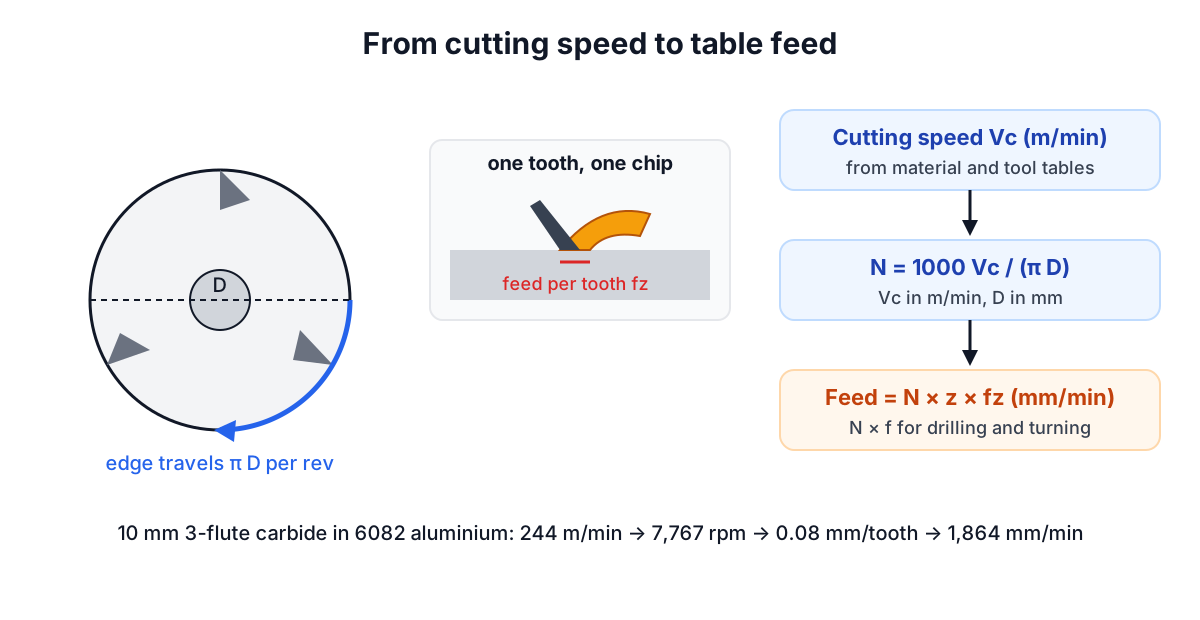
To turn a cutting speed in metres per minute into spindle speed, use n = 1000 x Vc ÷ (π x D) with D in millimetres; then table feed in mm/min is n x number of teeth x feed per tooth. A 10 mm three-flute carbide end mill in 6082 aluminium at 244 m/min runs at 7,767 rpm and, at 0.08 mm a tooth, feeds at 1,864 mm/min. UK tooling catalogues, insert boxes and CNC controls all work in these units, so the UK version of the Cutting Speed and Feed Calculator opens in metric. This guide works through the formulas with that cutter and with the jobs a UK workshop does most: a light finishing pass, a cut on a small bench mill, a tapping drill and a bar on the lathe.
The two numbers from the catalogue
Every cutter maker gives two figures for each material group:
- Cutting speed, Vc, in m/min. How fast the cutting edge moves through the material. It sets the temperature at the edge and so the tool life, which is why it is quoted for the material and tool grade, not as an rpm.
- Feed, in mm. For milling, feed per tooth fz, the chip each edge takes. For drilling and turning, feed per revolution f.
The standard metric formulas turn those into machine settings. Sandvik Coromant's milling and drilling pages, listed in the sources, set out the spindle speed, feed and milling removal rate; the turning removal rate multiplies cutting speed in m/min by depth of cut and feed in mm, which gives cm³/min directly:
| Quantity | Formula | Units |
|---|---|---|
| Spindle speed | n = Vc x 1000 ÷ (π x D) | rpm, with Vc in m/min and D in mm |
| Milling table feed | vf = fz x n x z | mm/min |
| Drilling and turning feed | vf = f x n | mm/min |
| Milling removal rate | Q = ap x ae x vf ÷ 1000 | cm³/min |
| Turning removal rate | Q = Vc x ap x f | cm³/min |
A shop shortcut is n ≈ 318 x Vc ÷ D, which is the same formula with 1000 ÷ π worked out.
The calculator's starting speeds
The presets are cautious figures for plain tools, chosen to be safe on a first part rather than fast. Converted to metric:
| Material (UK examples) | HSS Vc | Carbide Vc | Feed per tooth, 12.7 mm carbide end mill |
|---|---|---|---|
| Aluminium 6082, 6061 | 91.4 m/min | 243.8 m/min | 0.102 mm |
| Free-cutting brass (CZ121) | 45.7 m/min | 137.2 m/min | 0.076 mm |
| Mild steel (such as EN3 or 070M20) | 27.4 m/min | 106.7 m/min | 0.051 mm |
| Alloy steel, annealed (such as 709M40 in the annealed condition) | 21.3 m/min | 76.2 m/min | 0.046 mm |
| Stainless 304, 316 | 18.3 m/min | 61.0 m/min | 0.038 mm |
| Grey cast iron | 24.4 m/min | 76.2 m/min | 0.064 mm |
Coated carbide on a rigid CNC machining centre often runs well above these. Start here, then move towards the figure on the insert box or in the cutter catalogue as the cut proves stable. The feed per tooth scales with diameter: a 6 mm cutter starts at about half the 12.7 mm figure.
Worked examples
1. Slotting and side milling 6082
A 10 mm three-flute carbide end mill at 244 m/min: n = 1000 x 244 ÷ (π x 10) = 7,767 rpm.
- Slot, 5 mm deep, full width: vf = 7,767 x 3 x 0.08 = 1,864 mm/min, removing 93.2 cm³/min.
- Side milling, 1 mm radial step at 10 mm depth: the cutter touches only a short arc, so each chip is thinner than the programmed feed. The chip thinning factor D ÷ (2 x √(D x ae − ae²)) is 1.667 at a 10% step. To keep a real 0.08 mm chip, the calculator programmes 0.133 mm a tooth: 3,107 mm/min and 31.07 cm³/min.
Run that side cut at 1,864 mm/min without the correction and the edge rubs, which glazes aluminium and wears cutters fast in stainless. This is the arithmetic behind adaptive and trochoidal toolpaths in CAM: a small step, the full flute length, and a much higher feed than a slot.
2. A small cutter on a 4,000 rpm bench mill
Many hobby and small-workshop mills top out around 4,000 rpm. Take a 6 mm three-flute carbide end mill in mild steel at 107 m/min, 0.025 mm a tooth, a 0.6 mm radial step and 6 mm depth:
- ideal speed 5,677 rpm, so the machine runs at its 4,000 rpm limit
- real cutting speed 75.4 m/min
- chip thinning factor 1.667, so 0.042 mm programmed a tooth
- feed 500 mm/min instead of 710 mm/min, removing 1.8 cm³/min
Keep the feed per tooth and accept the lower feed rate. Raising fz to "make up" for the missing rpm puts a thicker chip on a small, fragile cutter that is already running slow.
3. Drilling for a tap
The 8.5 mm tapping drill for an M10 x 1.5 thread, HSS, in mild steel at 27.4 m/min and 0.13 mm a revolution: 1,026 rpm and 133 mm/min. The 6.8 mm drill for M8 x 1.25 at 0.10 mm/rev: 1,283 rpm and 128 mm/min. On a pillar drill with belt steps, take the nearest step below the figure, never above.
4. Turning a 50 mm bar, and why CNC lathes use constant surface speed
A 50 mm mild steel bar with a carbide insert at 107 m/min, 0.2 mm/rev and 1.5 mm depth of cut: 681 rpm, 136 mm/min and 32.1 cm³/min. With an HSS tool at 27.4 m/min the same bar runs at 174 rpm and removes 8.2 cm³/min, a quarter of the carbide rate.
As the diameter comes down, the speed must rise to hold 107 m/min: 1,703 rpm at 20 mm and 3,406 rpm at 10 mm. A CNC lathe does this automatically in constant surface speed mode, which is why the program also sets a maximum spindle speed. With a 3,000 rpm ceiling, a 10 mm diameter runs at 3,000 rpm and the real cutting speed falls to 94.2 m/min. Set the ceiling to suit the chuck and the workholding, not just the spindle.
Reading the cut
- Powdery or discoloured aluminium chips: too thin a chip. Raise the feed, or switch on chip thinning for light steps.
- Long, stringy steel chips when turning: the feed is below what the insert's chip breaker needs. Raise the feed per rev before touching the speed.
- Blue chips with HSS: the edge is too hot. Lower Vc. With carbide in steel, straw to blue chips are normal.
- Chatter: a rigidity problem. Shorten the stick-out (beyond about three diameters cutters deflect), take a lighter step, or move the spindle speed a little away from the resonance.
Safety in UK workshops
Two HSE points apply to the cuts above. First, HSE says hand-held emery cloth on a rotating lathe workpiece is never acceptable, because the cloth can snag and wrap round the work, taking the hand with it; clamp a loop of cloth in a holder on the tool post for outside work. Second, HSE warns that metalworking fluids can cause dermatitis and lung disease such as occupational asthma, and that health surveillance should be in place where exposure to fluid or mist cannot be prevented. Higher spindle speeds throw more mist, so guards and extraction matter as much as the numbers.
Tools for this job
- Cutting Speed and Feed Calculator (UK): rpm, table feed, chip thinning and removal rate for milling, drilling and turning in metric.
- Tapping Drill Size Calculator (UK): the drill size for the thread you are tapping.
- Torque and Power Calculator: whether the spindle has the torque for the cut at that rpm.
- Pulley and Belt Calculator (UK): the speeds a belt-driven pillar drill or mill can actually give.
The original speeds and feeds guide covers the same maths in SFM and inches for imperial tooling.
Frequently asked questions
How do I convert cutting speed in m/min to rpm?
n = 1000 x Vc ÷ (π x D), with Vc in m/min and D in mm. A 10 mm cutter at 244 m/min runs at 7,767 rpm. The shortcut 318 x Vc ÷ D gives the same answer to within a fraction of a percent.
What feed rate in mm/min should I use for a 10 mm end mill in aluminium?
At 7,767 rpm with three flutes and 0.08 mm a tooth, 1,864 mm/min for a slot. For a 1 mm finishing step, apply chip thinning and feed at about 3,107 mm/min to keep the same chip.
My mill only reaches 4,000 rpm. Should I raise the feed per tooth?
No. Run at 4,000 rpm and keep the feed per tooth. The feed rate drops in proportion and so does the removal rate, but the cutter is safe.
What rpm should I use to drill mild steel with an 8.5 mm HSS drill?
About 1,026 rpm at a cautious 27.4 m/min, with 0.13 mm per revolution, or 133 mm/min. Use the next belt step below that on a pillar drill.
Why does my CNC lathe need a maximum spindle speed with constant surface speed?
Because holding a fixed m/min at a small diameter asks for very high rpm: 3,406 rpm at 10 mm for 107 m/min. The maximum protects the chuck, the jaws and the work.
Sources and further reading
- Milling formulas and definitions, Sandvik Coromant. Metric spindle speed, table feed, removal rate and the side-milling feed correction.
- Drilling formulas and definitions, Sandvik Coromant. Spindle speed, penetration rate and removal rate for drilling.
- Using emery cloth on metalworking lathes, Health and Safety Executive. Why hand-held emery cloth on a rotating lathe is never acceptable.
- Ill health from metalworking and water-mix wash fluids, Health and Safety Executive. Dermatitis, occupational asthma and health surveillance.
- Machinery's Handbook, Industrial Press. The source of the shop speed tables behind the HSS presets.
Open the Speeds and Feeds Calculator
More Mechanical
Every tool in the Mechanical section, free and in your browser.
- Torque and Power Calculator
- Gear Ratio Calculator
- Pulley and Belt Calculator
- Bolt Torque Calculator
- Spring Calculator
- Stress and Strain Calculator
- Bearing Life Calculator
- Hydraulic Cylinder Calculator
- Tap Drill Size Calculator
- Speeds and Feeds Calculator
- ISO Fits & Tolerances Calculator
- Bolt Circle Calculator
- Shaft Torsion Calculator
- Shaft Diameter Calculator
- Shaft Key Size Calculator