
SIP or Lump Sum: Which Is Better for Mutual Funds?
SIP versus lump sum in rupees: how each maturity value is worked out, when a lump sum wins, STP as the middle path, and how tax applies to each instalment.
By Redbison Dev · · 6 min read

India edition. Written for mutual fund investors in India: rupee examples in lakh and crore, the nominal and effective SIP conventions Indian calculators use, STP from a liquid fund, per-instalment LTCG and STCG under current rules, ELSS lock-in and SEBI and AMFI context. US edition
Put ₹6 lakh into an equity fund in one go, and at a steady 10% a year it grows to ₹15,56,245.48 in ten years. Invest the same ₹6 lakh as a ₹5,000 monthly SIP over those ten years and, at the same 10%, it reaches ₹10,32,760.10. On paper the lump sum wins by more than ₹5 lakh. That number answers a narrow question: what happens if you already have the money on day one and markets rise steadily. Most SIP investors in India are in a different position, and once you account for that, the choice looks different.
This edition explains how both figures are calculated, what the comparison leaves out, where a systematic transfer plan (STP) fits, and how capital gains tax treats each instalment. Every figure comes from the lump sum calculator or the SIP calculator. Mutual fund returns are market-linked and not guaranteed; this is arithmetic, not a recommendation for any scheme.
How a SIP maturity value is calculated
Each SIP instalment buys units on its own date and then grows for the months that remain. Indian SIP calculators add up those pieces with the future value of an annuity due, because the instalment is invested at the start of each month:
FV = P × [((1 + i)^n − 1) / i] × (1 + i)

P = monthly instalment in rupees
i = monthly rate
n = number of instalments
The catch is the monthly rate. Indian calculators use one of two conventions:
| ₹10,000 a month for 10 years at 12% | Monthly rate | Maturity |
|---|---|---|
| Nominal: 12% / 12 (most SIP calculators) | 1.0000% | ₹23,23,390.76 |
| Effective: (1.12)^(1/12) − 1 (some fund house calculators) | 0.9489% | ₹22,40,358.90 |
| Nominal, instalment at month end | 1.0000% | ₹23,00,386.89 |
All three invest ₹12 lakh, yet the answers differ by up to ₹83,032 because "12%" means slightly different things. The effective convention makes 12% exactly 12% a year, which is how a fund's CAGR is reported; the nominal one works out to 12.68% a year. When your figure does not match a fund house illustration, check the convention before anything else. The SIP calculator lets you switch under Calculation convention.
How a lump sum is calculated
A one-time investment compounds for the full term. The lump sum calculator compounds yearly, the same arithmetic as the CAGR on a factsheet:
Maturity = Amount × (1 + annual rate)^(months / 12)
₹6,00,000 at 10% for 120 months is 6,00,000 × 1.1^10 = ₹15,56,245.48. A ₹12 lakh lump sum at 12% for ten years becomes ₹37,27,017.85.
Why the lump sum ends higher in a rising market
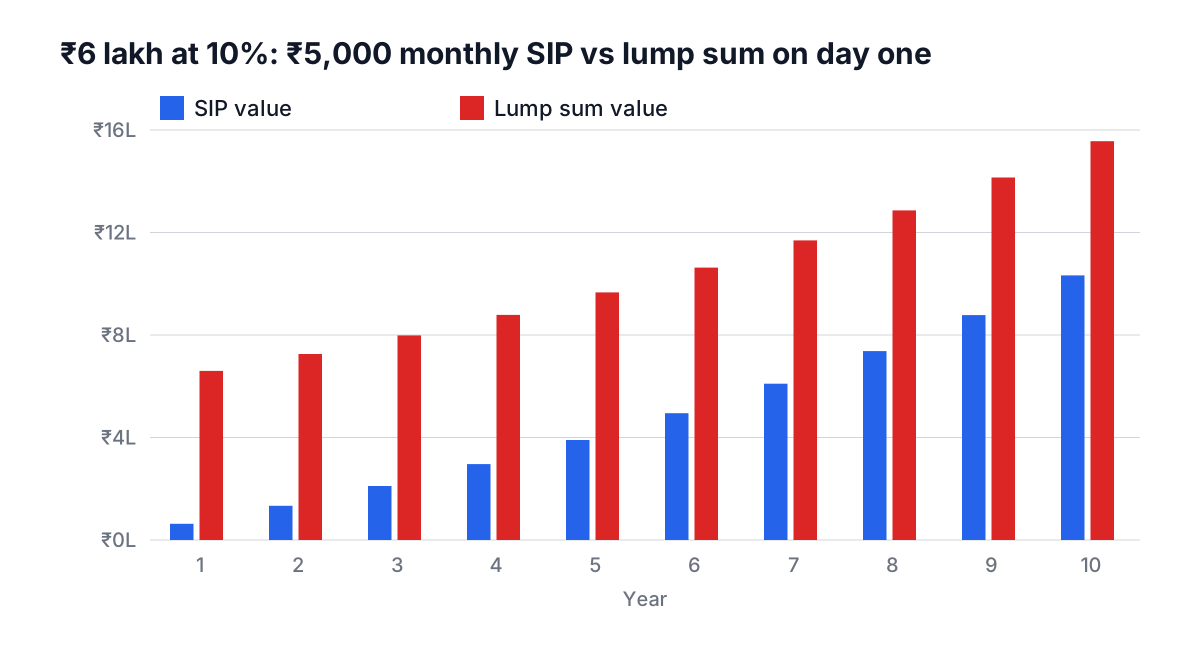
| Year | SIP invested so far | SIP value | ₹6 lakh lump sum value |
|---|---|---|---|
| 1 | ₹60,000 | ₹63,351.41 | ₹6,60,000.00 |
| 3 | ₹1,80,000 | ₹2,10,650.01 | ₹7,98,600.00 |
| 5 | ₹3,00,000 | ₹3,90,411.91 | ₹9,66,306.00 |
| 7 | ₹4,20,000 | ₹6,09,791.69 | ₹11,69,230.26 |
| 10 | ₹6,00,000 | ₹10,32,760.10 | ₹15,56,245.48 |
The reason is time in the market. The whole ₹6 lakh lump sum works for 120 months; the average SIP rupee works for about 60. With a positive, steady return, more time always wins. That is compound interest, not a flaw in SIPs.
What the comparison leaves out
Most SIPs are funded from salary. A ₹5,000 SIP is usually what is left each month after EMIs and expenses. The real alternative is not a ₹6 lakh lump sum you do not have; it is investing that ₹5,000 later, or not at all. For that investor the useful question is what the habit becomes, and the SIP calculator answers it, including a yearly step-up: ₹10,000 a month at 12% for ten years with a 10% step-up each April reaches ₹33,74,326.26 on ₹19,12,490.95 invested.
Returns are not steady. Equity NAVs swing from year to year, and a lump sum takes the first year's swing on the whole amount. If the ₹6 lakh fell 20% in the first year and then earned 10% a year, it would end at ₹11,31,814.89 after ten years instead of ₹15,56,245.48. A SIP running through the same fall keeps buying, and buys more units while the NAV is low.
Rupee cost averaging. A fixed instalment buys more units when the NAV is low and fewer when it is high:
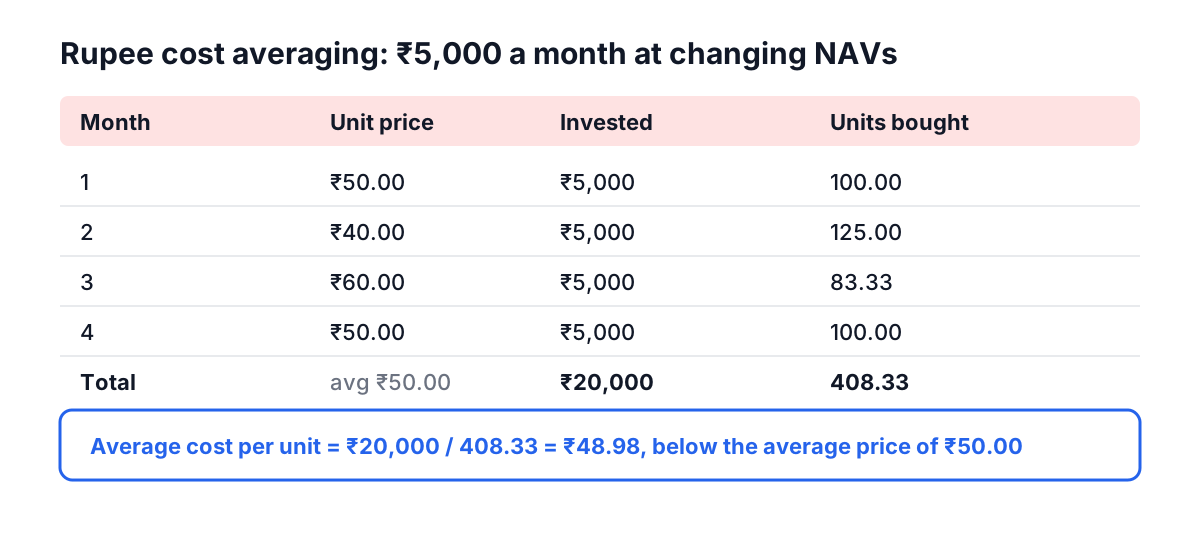
Your average cost per unit (₹48.98 here) is the harmonic mean of the NAVs, which is never above their simple average (₹50). The gain is real but modest, and it does nothing in a market that only rises.
The middle path for a bonus or windfall: STP
If you do have a lump sum, such as an annual bonus, a maturing FD or the proceeds of a property sale, many investors in India park it in a liquid or debt fund and set up a systematic transfer plan (STP) that moves a fixed amount into an equity fund each month, within the same fund house. It limits how much is exposed to a fall in any one month, at the cost of keeping part of the money out of equity for a while.
With ₹6 lakh and a steady 10% a year in the equity fund, the calculators give:
| How the ₹6 lakh enters equity | Value of the equity holding after 10 years |
|---|---|
| All on day one | ₹15,56,245.48 |
| STP of ₹1,00,000 a month over 6 months | ₹15,27,706.10 |
| STP of ₹50,000 a month over 12 months | ₹14,93,793.01 |
The STP figures are the SIP value after the transfers, then grown as a lump sum for the rest of the ten years. The 12-month STP gives up ₹62,452.47 in a steadily rising market. The liquid fund narrows that gap: the money waiting in it averages about ₹2.75 lakh over the year, which at an assumed 6.5% earns roughly ₹17,900 before tax. A shorter STP costs less, which is why six months is common. If the market falls during the transfer period, the STP comes out ahead; nobody knows in advance which it will be.
Tax: each SIP instalment is its own purchase
For an equity-oriented fund, the Income Tax Department's rules for units transferred on or after 23 July 2024 are:
- Long-term (held more than 12 months): 12.5% on gains above ₹1,25,000 a year across all your equity sales.
- Short-term (held 12 months or less): 20%.
A lump sum has one purchase date, so after a year all of it is long-term. A SIP has a new purchase date every month, and fund houses redeem the oldest units first. Redeem a ₹10,000 SIP in full after ten years at 12% and the value is ₹23,23,391, a gain of ₹11,23,391. Units from the last 12 instalments are still short-term: about ₹8,093 of short-term gain taxed at 20% (₹1,619) and ₹11,15,297 of long-term gain, taxed at 12.5% above ₹1,25,000 (₹1,23,787), before cess and surcharge, if nothing else uses the exemption that year.
For a ₹12 lakh lump sum that grows to ₹37,27,017.85 over ten years, the whole gain of ₹25,27,017.85 is long-term: ₹3,00,252.23 at 12.5% above the exemption if redeemed in one year. In both cases, spreading redemptions over two or more financial years uses the ₹1,25,000 exemption more than once.
ELSS works the same way, with a lock-in. Each ELSS instalment is locked in for three years from its own date, so a 12-month ELSS SIP is fully free only three years after the last instalment. ELSS counts towards the ₹1,50,000 deduction only in the old regime, now in section 123 of the Income-tax Act, 2025 (section 80C of the 1961 Act).
A practical way to decide
- Money from salary: start a SIP at an amount you can keep paying, and step it up with each increment. The lump sum comparison does not apply to you.
- A windfall you will not need for 7 years or more: the maths favours investing it now; an STP over a few months is the usual compromise if a fall soon after investing would make you sell.
- Money needed in under 3 to 5 years: neither equity route is a good fit; compare an FD or debt fund in the FD interest calculator.
- Test lower returns. ₹10,000 a month for ten years gives ₹23,23,391 at 12% but ₹18,41,657 at 8%. Plan around the lower figure.
If your situation involves several goals, existing EPF and PPF, and tax in both regimes, a SEBI-registered investment adviser can look at the whole picture.
Tools for this job
- Lump sum calculator: a one-time investment, with SIP mode to compare the same total.
- SIP calculator: step-up SIPs, the SIP needed for a goal and the effective-rate convention.
- PPF calculator and FD interest calculator: guaranteed-rate options for money that should not swing.
- Investment returns calculator: the XIRR on your actual SIP instalments and NAVs.
The India compound interest guide covers FD, RD and PPF compounding, and the US edition of this guide has the same maths without Indian tax rules.
Frequently asked questions
Is SIP better than lump sum in the long run?
Not in general. With the same money available on day one and a rising market, a lump sum usually ends higher because all of it is invested for longer. A SIP fits money that arrives monthly and spreads purchases across NAV levels, which helps when markets fall early. Compare both with the same total and the same return.
Why does my SIP calculator show a different value from the fund house?
Usually the rate convention. Most calculators divide the annual return by 12, while some fund house calculators use the effective monthly rate, so 12% means exactly 12% a year. For ₹10,000 a month over ten years the two differ by about ₹83,000. Instalment timing (start or end of the month) changes the result too.
Should I invest my bonus as a lump sum or through STP?
If the money is for a goal at least seven years away and you would not sell after a fall, investing at once has more time in the market. An STP from a liquid fund over a few months reduces the risk of investing just before a fall, at a small cost if markets rise steadily: about ₹28,500 over ten years on ₹6 lakh with a six-month STP at 10%.
How is tax calculated when I redeem a SIP?
Each instalment has its own purchase date, and the oldest units are redeemed first. For equity-oriented funds, units held over 12 months give long-term gains taxed at 12.5% above ₹1,25,000 a year; units held 12 months or less give short-term gains taxed at 20%. A full redemption usually has some short-term gain from the latest instalments.
Can I do a lump sum in ELSS for the tax deduction?
Yes, in the old regime, within the combined ₹1,50,000 limit now under section 123 of the Income-tax Act, 2025. A lump sum is locked in for three years from its date; SIP instalments are each locked in for three years from their own dates. The new regime gives no deduction for ELSS.
Sources and further reading
- Tax on long-term capital gains, Income Tax Department. 12.5% above ₹1,25,000 for equity-oriented fund units transferred on or after 23 July 2024.
- Tax on short-term capital gains, Income Tax Department. 20% on STT-paid equity fund units; 12-month holding period.
- Section 123 of the Income-tax Act, 2025, ClearTax. The old section 80C deduction under the new Act, old regime only.
- What is Systematic Investment Plan (SIP)?, Association of Mutual Funds in India.
- Investor education, Securities and Exchange Board of India. Mutual funds and market risk.
- Systematic Transfer Plan, Nippon India Mutual Fund. How an STP moves money between schemes of one fund house.
- 6.6 Methods of Savings, OpenStax. Future value of regular deposits.
Open the Investment Calculator
More Calculators
Every tool in the Calculators section, free and in your browser.
- Investment Calculator
- Compound Interest Calculator
- Simple Interest Calculator
- Interest Calculator
- EMI Calculator
- Retirement Calculator
- Time-Weighted Return Calculator
- Savings Goal Calculator
- Inflation Calculator
- CAGR Calculator
- ROI Calculator
- Present and Future Value Calculator
- NPV and IRR Calculator
- 401(k) Calculator
- Roth IRA Calculator
- APY and CD Calculator
- SIP Calculator
- Annuity Calculator
- Bond Price and Yield Calculator
- Currency Converter
- Dividend Calculator
- Stock Average Calculator
- RMD Calculator