
How to Calculate Engine CC from Bore and Stroke
Calculate engine cc from bore and stroke in mm for cars and bikes, and see how close an engine sits to the 1200 cc, 1500 cc and 350 cc GST lines.
By Redbison Dev · · 9 min read
India edition. Indian edition in mm and cc, with Indian engine sizes and the engine-capacity lines in the GST rates effective 22 September 2025: 1200 cc petrol and 1500 cc diesel small cars, and 350 cc motorcycles. US edition
Engine cc is the volume the pistons sweep, and you can calculate it from three figures in any brochure: bore, stroke and the number of cylinders. cc = 0.7854 × bore² × stroke × cylinders, with bore and stroke in centimetres. A petrol four with a 73 mm bore and a 71.5 mm stroke comes to 1,197 cc. In India that number is more than a spec-sheet line: it is on the RC, it sets which GST rate a new car or bike pays, and a few cc either side of 1200, 1500 or 350 can change the price by lakhs.
This edition works through Indian engine sizes with the Engine CC Calculator, in millimetres and cc. The US version of this article, which works in inches and American V8s, is here.
The formula, step by step
When the crank turns half a revolution, the piston moves from top dead centre (TDC) to bottom dead centre (BDC) and sweeps out a cylinder. Its diameter is the bore; its height is the stroke.
cc per cylinder = 0.7854 × bore(cm)² × stroke(cm)
engine cc       = cc per cylinder × cylinders
0.7854 is π ÷ 4. If the brochure gives millimetres, divide each by 10 first, or use millimetres and divide the answer by 1,000. The small space left above the piston at TDC is not part of engine cc; it decides compression ratio instead.
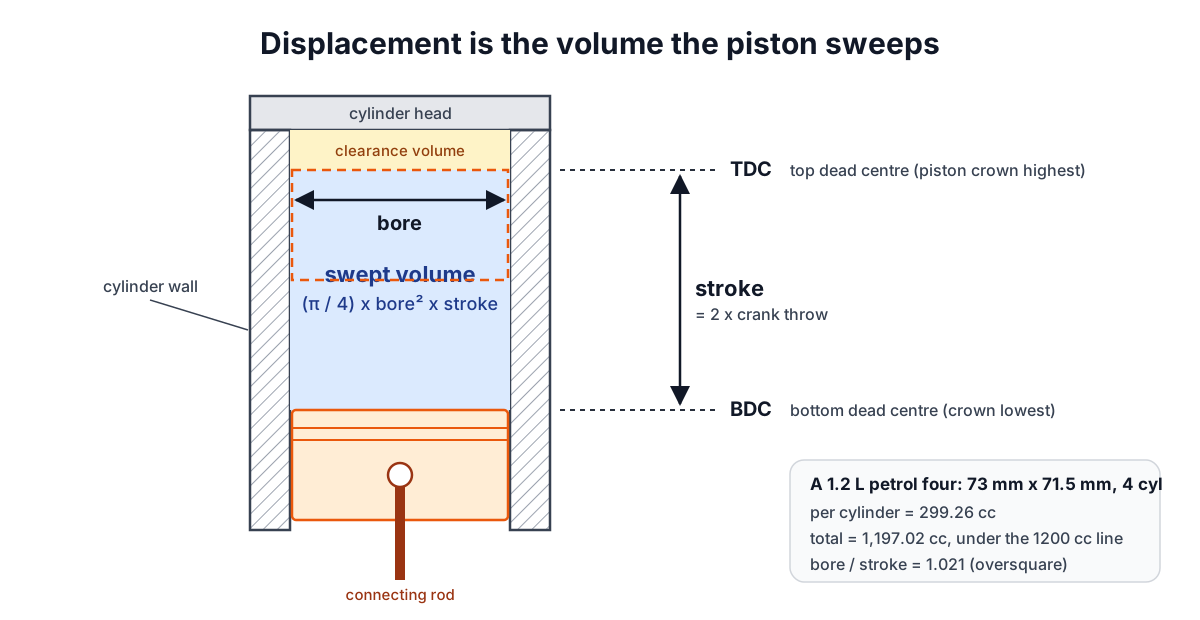
Stroke is twice the crank throw, set by the crankshaft. Connecting rod length does not change it.
Why cc decides the GST rate
The GST rates that took effect on 22 September 2025 draw their lines by engine capacity and length. The GST Council's FAQ on the 56th Council decisions says:
| Vehicle | Engine capacity | Length | GST |
|---|---|---|---|
| Small car, petrol, LPG or CNG | up to 1200 cc | up to 4000 mm | 18% |
| Small car, diesel | up to 1500 cc | up to 4000 mm | 18% |
| Mid-size and large cars | over 1500 cc, or over 4000 mm long | 40% | |
| Motorcycle | up to and including 350 cc | 18% | |
| Motorcycle | over 350 cc | 40% |
FAQ 34 settles the edge case riders ask about: a motorcycle of exactly 350 cc is in the 18% slab, because the 40% rate applies only to motorcycles exceeding 350 cc.
One gap is worth knowing. A petrol car between 1201 and 1500 cc that is under 4 m long is not a small car under FAQ 26, but FAQ 27 only describes cars over 1500 cc or over 4000 mm. The FAQ does not state that band's rate, so check the rate notification or the maker's price list rather than assuming.
To see what a slab is worth, take a car whose price before GST is ₹6,00,000. At 18% the GST is ₹1,08,000; at 40% it would be ₹2,40,000, a difference of ₹1,32,000 on the same car. That is why a few cc either side of the line matter.
Worked example 1: the 1.2 litre that is 1,197 cc
Take a 1.2 litre petrol four with a 73 mm bore and a 71.5 mm stroke, an illustrative engine (use the figures in your own brochure or service manual). In the calculator, enter 73, 71.5 and 4 cylinders:
- Per cylinder: 0.7854 × 7.3² × 7.15 = 299.26 cc.
- Total: 299.26 × 4 = 1,197.02 cc, 2.98 cc under 1200.
- Bore/stroke: 73 ÷ 71.5 = 1.021, just oversquare.
- Switch "Solve for" to Bore, target 1200 cc, stroke 71.5 mm: 73.09 mm.
That leaves about 0.09 mm of bore. If you rebuild one of these engines with 0.5 mm oversize pistons, the calculator shows 1,213.47 cc. GST is charged when a vehicle is first sold, so a rebuild does not change the tax already paid, but it does change the engine's capacity, which is part of the vehicle's registered particulars and of the insurance proposal. Tell your insurer and ask your RTO whether the RC needs an endorsement.
Worked example 2: a 350 that is really 349
Royal Enfield lists the Classic 350's single-cylinder engine at a 72 mm bore and an 85.8 mm stroke, 349 cc:
- 0.7854 × 7.2² × 8.58 = 349.34 cc.
- Bore/stroke: 72 ÷ 85.8 = 0.839, clearly undersquare (long stroke).
- Bore for exactly 350 cc at that stroke: 72.07 mm.
So the engine is 0.66 cc inside the 18% slab. A 0.5 mm oversize piston after a rebore takes it to 354.20 cc. Compare a 650 parallel twin of 78 mm × 67.8 mm × 2 cylinders = 647.95 cc, oversquare at 1.150, and on the 40% side of the line.
The long stroke of the 350 is what gives it the low-rpm thump riders like. Its mean piston speed at 6,100 rpm, where Royal Enfield quotes its peak power, is 2 × 0.0858 × 6,100 ÷ 60 = 17.45 m/s, a comfortable figure for a road engine.
Worked example 3: diesel at the 1500 cc line
Diesel small cars may go up to 1500 cc. Take an illustrative 1.5 litre diesel four of 75 mm × 84.5 mm:
- 0.7854 × 7.5² × 8.45 × 4 = 1,493.24 cc.
- Bore/stroke: 0.888, undersquare, as most diesels are.
- Bore for 1500 cc at an 84.5 mm stroke: 75.17 mm.
The engine is 6.76 cc under the diesel limit. Whether a particular car is a small car also depends on its length: the same engine in a model over 4000 mm long falls in the 40% slab.
For contrast, a 1.5 litre petrol four of 74 mm × 85 mm is 1,462.29 cc. As a petrol engine it is over 1200 cc, so cars using it are not small cars under the FAQ definition, whatever their length.
Commuter bikes and rebores
Small commuter singles are rebored too. Hero MotoCorp lists the Splendor+ at 97.2 cc with a 50.0 mm × 49.5 mm bore and stroke, which works out to 97.19 cc, nearly square at 1.010.
Two points for a rebore:
- Capacity grows with the square of the bore. On a 72 mm single, a 0.5 mm oversize adds 4.86 cc; on the 73 mm four, it adds 16.45 cc in total across four cylinders.
- Oversize pistons usually come in steps such as +0.25, +0.50 and +0.75 mm. Enter the step in the overbore field to see each result before the workshop bores the block.
Bore/stroke ratio and what it tells you
- Oversquare (above 1): bore bigger than stroke. The 650 twin (1.150) and the 1.2 litre four (1.021). These rev freely and leave room for larger valves.
- Square (about 1): the Splendor+ (1.010).
- Undersquare (below 1): the Classic 350 (0.839), the 1.5 petrol (0.871) and the 1.5 diesel (0.888). Long-stroke engines tend to give good pulling power at low rpm.
These are tendencies. Valve timing, porting and turbocharging matter as much as the ratio.
Common mistakes
- Taking the badge as the cc. "1.2" is 1,197 cc here and "350" is 349.34 cc. The brochure's exact figure, or the bore and stroke, is what counts.
- Mixing mm and cm. 0.7854 × 73² × 71.5 without dividing by 1,000 gives 299,256, not 299.26.
- Adding the combustion chamber volume. That is for compression ratio.
- Assuming a rebore changes the GST paid. GST was charged on the new vehicle; the rebuild matters for the RC particulars and insurance, not for the tax already collected.
Tools for this job
- Engine CC Calculator: cc from bore and stroke, overbore effect, and the bore or stroke that hits 1200, 1500 or 350 cc.
- Compression Ratio Calculator: what a rebore, thinner gasket or skimmed head does to compression. See also static and dynamic compression ratio.
- Horsepower Calculator: cc tells you size, not power.
- Unit Converter: cc to litres or cubic inches for imported manuals.
Frequently asked questions
Is a 350 cc motorcycle in the 18% or the 40% GST slab?
18%. The GST Council's FAQ 34 says the 40% rate applies only to motorcycles exceeding 350 cc, so a bike of 350 cc or less is in the 18% slab. The Classic 350's single, 349.34 cc from its 72 × 85.8 mm bore and stroke, is inside it.
Why is a 1.2 litre car engine 1197 cc?
Because the arithmetic of its bore and stroke lands just under the 1200 cc line for petrol small cars. A 73 mm bore and 71.5 mm stroke over four cylinders gives 1,197.02 cc, with less than 0.1 mm of bore to spare.
Does reboring my bike change its cc on paper?
It changes the real capacity: a 72 mm bore taken to 72.5 mm moves a 349.34 cc engine to 354.20 cc. The RC shows the original figure, so speak to your RTO and insurer before a rebuild that changes the capacity.
Which matters for GST on a car, cc or length?
Both. A petrol car must be up to 1200 cc and up to 4000 mm long to be a small car at 18%; a diesel up to 1500 cc and 4000 mm. Exceeding either test takes it out of the small-car definition.
Sources and further reading
- Frequently Asked Questions on the decisions of the 56th GST Council, GST Council. FAQ 26 (small cars), FAQ 27 (over 1500 cc or 4000 mm at 40%), FAQs 33 and 34 (motorcycles at 350 cc); effective 22 September 2025.
- Press release on the GST rate FAQs, Press Information Bureau. The same FAQs as published by the Ministry of Finance.
- Classic 350, Royal Enfield. Specifications: bore × stroke 72 mm × 85.8 mm, 349 cc, peak power at 6,100 rpm.
- Splendor+, Hero MotoCorp. Specifications: 97.2 cc, bore × stroke 50.0 mm × 49.5 mm.
- SI Units: Length, National Institute of Standards and Technology. Exact inch-to-millimetre conversion for imported manuals.
- Internal Combustion Engines (course 2.61), MIT OpenCourseWare. Engine geometry and piston speed.
- Engine displacement, Wikipedia. Swept volume and how it is quoted.
Open the Engine Displacement Calculator
More Automotive
Every tool in the Automotive section, free and in your browser.