
How Many Solar Panels for a House in Pakistan?
Size solar from the units on your bill, with PVGIS sun hours for Lahore, Karachi and Islamabad, the monsoon dip, and NEPRA net billing and the load cap.
By Redbison Dev · · 11 min read
Pakistan edition. Pakistani edition that starts from monthly units on a DISCO bill, uses PVGIS sun hours for Lahore, Karachi and Islamabad on south-facing panels, and applies the NEPRA (Prosumer) Regulations 2026: net billing, the sanctioned-load cap, three-phase connections and the 25 kW threshold. US edition
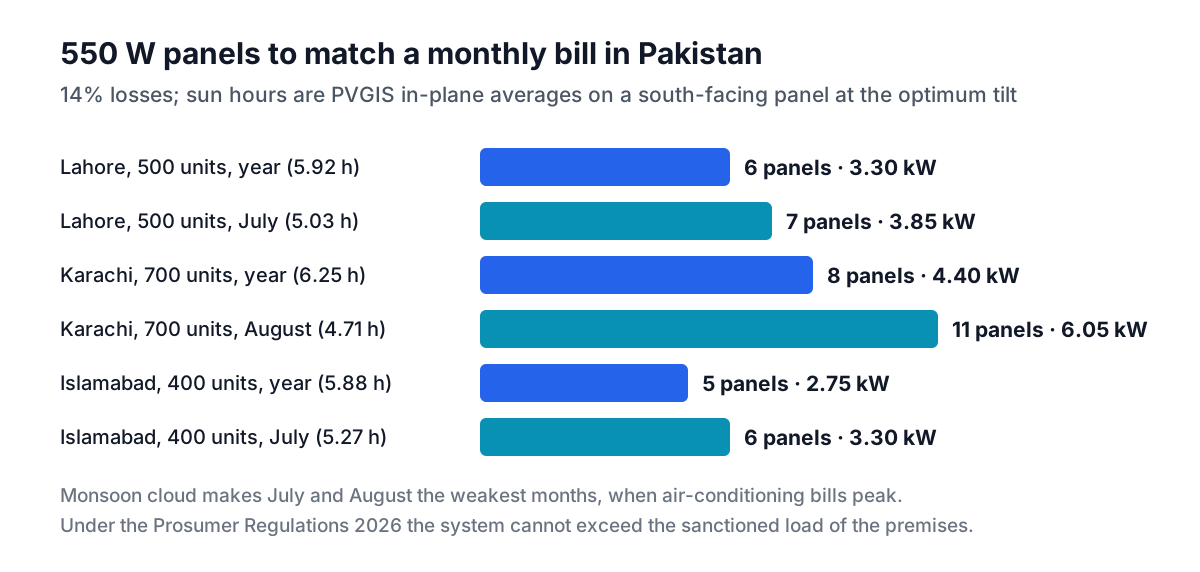
A house using 500 units a month in Lahore, about 16.4 kWh a day, needs six 550 W panels (3.30 kW) to produce that much over a year, using PVGIS sun hours and 14% losses. To match the same use in the weaker monsoon months of July and August (5.03 and 5.01 sun hours) it needs seven (3.85 kW). In Karachi, a 700-unit summer bill needs eight panels on the yearly average and eleven in August. The Solar Panel Calculator does the sum; the decisions around it in Pakistan are which month you size for, and how much the sanctioned load and NEPRA's net billing rules let you install.
Step 1: units per day from your bill
Your LESCO, K-Electric, IESCO or other DISCO bill shows units (kWh) for the month and often a twelve-month history. Divide by 30.4 for a daily figure:
500 units a month / 30.42 = 16.44 kWh a day
Size on the months you want to cover. Summer bills with air-conditioning can be far higher than winter ones, and the late summer months are also when the panels face the monsoon.
Step 2: sun hours for your city
Peak sun hours are the daily solar energy on a tilted panel, in kWh/m², the same as hours of full 1,000 W/m² sunshine. The European Commission's PVGIS tool gives them for any location in Pakistan. For south-facing panels at the optimum tilt (PVGIS 5.2, ERA5 data, 2005 to 2020; pick version 5.2 in the tool to reproduce them):
| City | Tilt | Yearly average | Weakest month | Strongest month |
|---|---|---|---|---|
| Lahore | 34° | 5.92 h | 5.01 h (August) | 6.81 h (April) |
| Karachi | 28° | 6.25 h | 4.71 h (August) | 7.15 h (March) |
| Islamabad | 35° | 5.88 h | 5.27 h (July) | 6.66 h (May) |
The pattern differs from Europe and North America, where winter is the weak season. In Pakistan the dip is July and August, when monsoon cloud arrives while hot, humid weather keeps fans and air-conditioners running. Karachi loses about a quarter of its average sun in August. Winter sun in Lahore and Islamabad is close to the yearly figure, though winter smog and fog can cut output on some days.
Step 3: array size and panels
The calculator divides daily use by sun hours and by what is left after losses (wiring, dust, inverter and heat), then rounds up to whole panels:
array kW = daily kWh / (sun hours x (1 - losses))
Lahore:  16.44 / (5.92 x 0.86) = 3.23 kW -> 6 x 550 W = 3.30 kW
| Case | Units a month | Sun hours | Array needed | Panels | Daily output |
|---|---|---|---|---|---|
| Lahore, year | 500 | 5.92 | 3.23 kW | 6 (3.30 kW) | 16.8 kWh |
| Lahore, July | 500 | 5.03 | 3.80 kW | 7 (3.85 kW) | 16.7 kWh |
| Karachi, year | 700 | 6.25 | 4.28 kW | 8 (4.40 kW) | 23.7 kWh |
| Karachi, August | 700 | 4.71 | 5.68 kW | 11 (6.05 kW) | 24.5 kWh |
| Islamabad, year | 400 | 5.88 | 2.60 kW | 5 (2.75 kW) | 13.9 kWh |
| Islamabad, July | 400 | 5.27 | 2.90 kW | 6 (3.30 kW) | 15.0 kWh |
Heat matters more here than the 14% default suggests. Panels lose output as they get hotter, and PVGIS's own estimate for Lahore is 4.42 kWh a day per kW installed, about 25% below the 5.92 sun hours. Setting losses to 25% in the calculator gives 3.70 kW, or seven panels, for the Lahore house. On a flat, hot rooftop with little airflow under the panels, the higher figure is the safer one.
Step 4: the limits NEPRA sets
The NEPRA (Prosumer) Regulations, 2026 replaced the 2015 net metering regulations, and they shape the size before the maths does:
- Sanctioned load cap. Regulation 3(2): the capacity "shall not exceed the sanctioned load of the applicant's premises". A house with a 5 kW sanctioned load can connect at most 5 kW: nine 550 W panels make 4.95 kW, so the Karachi August design of 6.05 kW would need a higher sanctioned load first.
- Three-phase connection. An applicant is defined as a "3 phase 400V or 11 kV" consumer, so a single-phase house needs a three-phase connection before it can apply.
- Approval route. Since the August 2026 amendment, a system of 25 kW or below needs no concurrence from NEPRA; the distribution company gives its approval. The fee notification charges no NEPRA fee at 25 kW or less.
- Term. The agreement with the DISCO runs for five years from commissioning and can be renewed for further five-year terms.
Step 5: what net billing means for sizing
Under regulation 14, each 30-day billing cycle is settled in two parts: units the DISCO supplies to you are billed at the applicable tariff, and units you export are credited at the national average energy purchase price. If your exports are worth more than your imports, the balance is carried to the next bill or paid quarterly.
The practical effect: a unit of solar you use yourself saves the full tariff, while a unit you export earns the lower purchase price. That argues for sizing close to your daytime use, running pumps, washing machines and inverter ACs while the sun is up, and not oversizing for export. Compare the two rates on your own bill before deciding between the yearly-average and the monsoon-month design.
A battery for load shedding
If you want backup during load shedding, size the battery for the essential loads only. For 5 kWh a day of fans, lights, fridge and router, with half a day of storage and a 95% inverter:
| Battery | Depth of discharge | Energy needed | Capacity | MPPT current with margin |
|---|---|---|---|---|
| 48 V lithium (LiFePO4) | 90% | 2.92 kWh | 60.9 Ah | 28.6 A |
| 24 V lead-acid (tubular) | 50% | 5.26 kWh | 219.3 Ah | 57.3 A |
Two 550 W panels (1.10 kW) recharge it on Lahore's yearly sun hours. Lead-acid needs nearly twice the stored energy for the same usable backup because only half its capacity should be used, and 24 V doubles the controller current compared with 48 V for the same array.
Common mistakes
- Sizing on April sun. Karachi's March and April figures are about 50% higher than August's; a system that looks generous in spring can fall short when the AC load peaks.
- Ignoring the sanctioned load. It caps the installed capacity under the 2026 regulations, so check it on your bill before you get quotes.
- Leaving panels dusty. Dust from construction, roads and dry seasons cuts output between rains; plan for regular cleaning.
- Comparing quotes by panel count. Compare installed kW and the inverter rating instead.
Tools for this job
- Solar Panel Calculator: array kW, panel count, battery Wh and Ah and controller current from your units and sun hours.
- Electricity Cost Calculator: the cost of each appliance at your tariff.
- Battery Runtime Calculator: how long a battery runs a given load.
- The US solar panel sizing guide uses PVWatts and US load lists.
Frequently asked questions
How many solar panels do I need for 500 units a month?
About six 550 W panels (3.30 kW) in Lahore on the yearly average sun hours with 14% losses, or seven to cover July and August. With a more cautious 25% loss figure for hot rooftops, seven panels cover the yearly average. Your own sun hours and bill history give the final answer.
How many sun hours does Pakistan get?
PVGIS gives yearly averages of 5.92 hours in Lahore, 6.25 in Karachi and 5.88 in Islamabad on south-facing panels at the optimum tilt. The weakest months are July and August, when monsoon cloud brings Karachi down to 4.71 hours.
Can I install more solar than my sanctioned load?
Not for a grid-connected prosumer system. The NEPRA (Prosumer) Regulations, 2026 say the system capacity shall not exceed the sanctioned load of the premises. Apply to your distribution company to increase the sanctioned load first.
What is the difference between net metering and net billing?
The 2026 Prosumer Regulations repealed the 2015 Net Metering Regulations. Imported units are now billed at the applicable tariff and exported units credited at the national average energy purchase price, so the two are valued separately. Prosumers with agreements under the 2015 regulations moved to the same net billing from the next billing cycle, but are billed at the national average power purchase price instead until their agreement expires (regulation 21).
Do I need NEPRA approval for a 10 kW home system?
No. Since the August 2026 amendment, systems of 25 kW or below are approved by the distribution company without NEPRA concurrence, and there is no NEPRA fee at that size.
Sources and further reading
- NEPRA (Prosumer) Regulations, 2026, National Electric Power Regulatory Authority. Applicant definition, sanctioned-load cap, five-year agreements, net billing and the repeal of the 2015 regulations.
- Amendment, S.R.O. 1330(I)/2026, NEPRA. Distribution company approval for systems of 25 kW or below.
- Fee for prosumers, S.R.O. 709, NEPRA. No fee at 25 kW or less.
- NEPRA Performance Standards (Distribution) Rules, 2005, NEPRA. Nominal 400/230 V supply and load-shedding rules.
- Photovoltaic Geographical Information System (PVGIS), European Commission Joint Research Centre. Solar irradiation and PV output for any location.
Open the Solar Panel Calculator
More Electrical
Every tool in the Electrical section, free and in your browser.