
How Many Solar Panels Do I Need in South Africa?
Size panels, inverter battery and MPPT current from the kWh on your bill, with PVGIS sun hours for Johannesburg, Cape Town and Durban and Eskom's SSEG rules.
By Redbison Dev · · 11 min read
South Africa edition. South African edition that starts from monthly kWh on an Eskom or municipal account, uses PVGIS sun hours for Johannesburg, Cape Town and Durban on north-facing panels, sizes a 48 V battery for a hybrid system and explains Eskom's small-scale embedded generation registration. US edition
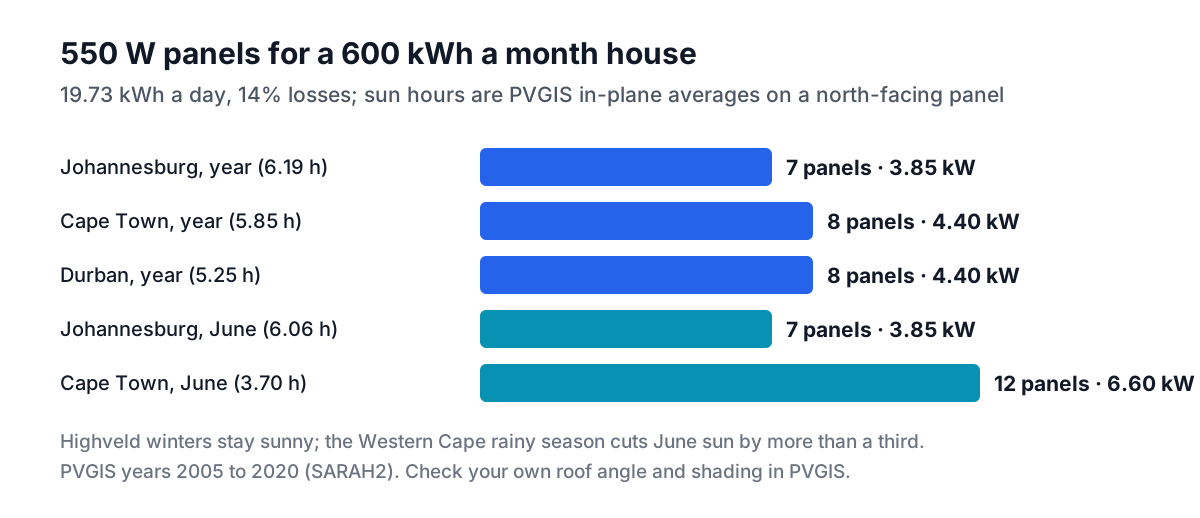
A house using 600 kWh a month, about 19.7 kWh a day, needs seven 550 W panels (3.85 kW) in Johannesburg to produce that much energy over a year, and eight (4.40 kW) in Cape Town or Durban. To match the same use in a Cape Town June it would need twelve. Those figures come from the Solar Panel Calculator with 14% system losses and sun hours from the European Commission's PVGIS database. The panels follow your kWh, your town and the season you want to cover.
This edition works through the sizing chain in South African terms: kWh from the municipal or Eskom bill, north-facing roofs, hybrid inverters with batteries, and the registration Eskom requires.
Step 1: daily kWh from your bill
Your account or prepaid history shows units (kWh) per month. Divide by 30.4 days for the daily figure:
600 kWh a month / 30.417 = 19.73 kWh a day
Use a year of bills if you have them. Winter months with heaters and longer geyser heat-ups can be higher; the calculator accepts kWh per day, per month or per year.
Step 2: sun hours for your town
Peak sun hours are the solar energy falling on a tilted panel in a day, in kWh/m², which equals hours of full 1,000 W/m² sun. The calculator does not guess them; you enter them. The free PVGIS tool from the EU's Joint Research Centre covers all of South Africa with satellite data. For north-facing panels at a good tilt, 2005 to 2020 averages from PVGIS 5.2 (pick version 5.2 in the tool to reproduce them; Cape Town is shown at 34°, a little steeper than its 30° optimum):
| Town | Tilt | Yearly average | June | Best month |
|---|---|---|---|---|
| Johannesburg | 31° | 6.19 h | 6.06 h | 7.10 h (September) |
| Cape Town | 34° | 5.85 h | 3.70 h | 7.39 h (February) |
| Durban | 32° | 5.25 h | 5.02 h | 5.98 h (February) |
Two things in this table matter for design. Highveld winters are dry and sunny, so a Gauteng system produces almost as much in June as in the yearly average. Cape Town's winter rain cuts June sun by 37%, so a system sized on the yearly average will import more from the grid, or run the battery lower, from May to August. Durban has the least sun of the three across the year but the most even spread.
In the southern hemisphere panels should face north. East- or west-facing roofs still work, at a lower yield; run your own roof's angle and direction in PVGIS.
Step 3: array size and panel count
The calculator divides daily use by sun hours and by the share left after losses (cabling, dust, inverter and heat), then rounds up to whole panels:
array kW = daily kWh / (sun hours x (1 - losses))
Johannesburg: 19.73 / (6.19 x 0.86) = 3.71 kW -> 7 x 550 W = 3.85 kW
| Case | Sun hours | Array needed | Panels | Daily output |
|---|---|---|---|---|
| Johannesburg, year | 6.19 | 3.71 kW | 7 (3.85 kW) | 20.5 kWh |
| Cape Town, year | 5.85 | 3.92 kW | 8 (4.40 kW) | 22.1 kWh |
| Durban, year | 5.25 | 4.37 kW | 8 (4.40 kW) | 19.9 kWh |
| Cape Town, June | 3.70 | 6.20 kW | 12 (6.60 kW) | 21.0 kWh |
The 14% loss default is a starting point. PVGIS's own estimate for a Johannesburg system, which includes the drop in output when panels run hot, is 4.81 kWh per day per kW installed, about 22% below the 6.19 sun hours. If you set losses to 22%, the same house needs 4.09 kW, or eight panels. For a conservative design on a hot roof, use the higher figure.
Matching energy over a day is not the same as running the house on solar. Panels produce around midday, while many homes use the most in the morning and evening, so a grid-tied system without a battery exports or wastes some of its midday output unless you shift loads such as the geyser and pool pump into the day.
Step 4: the battery in a hybrid system
Many home systems here are hybrids: panels, an inverter and a battery that keeps essential circuits running when the grid is off. Size the battery for the essential loads, not the whole house. For 8 kWh a day of essentials (lights, fridge, Wi-Fi, TV, a few plugs) and half a day of storage on a 48 V lithium iron phosphate battery at 90% depth of discharge with a 95% inverter:
battery = 8,000 Wh x 0.5 day / (0.90 x 0.95) = 4,678 Wh, about 97.5 Ah at 48 V
panels  = 8 / (6.19 x 0.86)                 = 1.50 kW -> 3 x 550 W
In a Cape Town winter, the same essentials need five panels (2.75 kW) to recharge the battery each day. A battery sized for half a day covers an evening and an outage of a few hours; for longer outages, add autonomy days in the calculator and watch the battery size double.
The MPPT controller current is the array's watts divided by the battery voltage: 1,650 W / 48 V = 34.4 A, or 43 A with a 25% margin. For the 3.85 kW whole-house array it would be 80.2 A, or about 100 A with the margin, which is why larger systems use an inverter with more than one MPPT input.
Step 5: register it
Grid-tied and hybrid systems connected to Eskom's network must be registered even if they never export. Eskom's small-scale embedded generation page says customers under 100 kVA register with Eskom "even if they do not export electricity", and the application needs:
- a valid Certificate of Compliance signed by a registered person;
- an NRS 097-2-1 type test certificate for the inverter, from the supplier;
- an Embedded Generation Installation test report.
Fully off-grid systems with no connection to Eskom's network do not need registration, but Eskom asks for a declaration and proof of independence. The application form sets out the inverter, isolation and anti-islanding requirements, and the wiring must comply with SANS 10142-1. Eskom's tariff booklet for 2026/27 notes that residential customers with grid-tied generation must be on a time-of-use tariff, Homeflex. If your electricity comes from a municipality, it runs its own approval process; ask it before you install.
Common mistakes
- Sizing on summer sun in the Cape. A system sized on February sun can fall about half short in June; one sized on the yearly average falls about a third short.
- Counting panels, not kWh. Two quotes with the same number of panels can differ by 20% in output if one uses 450 W panels and the other 550 W.
- A battery for the whole house. Backing up the geyser, oven and kettle multiplies the battery size; put them on non-essential circuits.
- Ignoring shade. A tree or a neighbour's double storey across part of the roof cuts output more than the area suggests. PVGIS includes terrain shading but not your neighbour's roof.
Tools for this job
- Solar Panel Calculator: array kW, panel count, battery Wh and Ah and MPPT current from your kWh and sun hours.
- Water Heating Time Calculator: the geyser's kWh, often the largest load to shift into solar hours.
- Electricity Cost Calculator: what each appliance costs at your c/kWh rate.
- The US solar panel sizing guide uses PVWatts and US load lists.
Frequently asked questions
How many solar panels do I need for 600 kWh a month?
About seven 550 W panels (3.85 kW) in Johannesburg and eight (4.40 kW) in Cape Town or Durban, using PVGIS yearly sun hours and 14% losses. To cover the same use in a Cape Town June you would need about twelve. Use your own bills and roof in the calculator.
How many sun hours does South Africa get?
It depends on the town and month. PVGIS gives a yearly average of 6.19 hours for Johannesburg, 5.85 for Cape Town and 5.25 for Durban on north-facing panels at a good tilt. Cape Town drops to 3.70 hours in June, while Johannesburg stays above 6.
What size battery do I need for load shedding?
Size it for the essential loads and the hours you want to cover. For 8 kWh a day of essentials and half a day of storage, a 48 V lithium battery needs about 4.7 kWh (97.5 Ah) at 90% depth of discharge and a 95% inverter. The geyser and stove are often left off the backup circuit.
Do I need to register my solar system with Eskom?
Yes, if it is connected to Eskom's network, even if it never exports. Eskom asks for a Certificate of Compliance, an NRS 097-2-1 inverter certificate and an installation test report. Fully off-grid systems are exempt but need a declaration. Municipal customers follow their municipality's process.
Which way should solar panels face in South Africa?
North, at a tilt of about 30° to 35° (PVGIS puts the optimum near 31° in Johannesburg and 30° in Cape Town). East and west roofs produce less but spread output across the morning and afternoon, which can suit a household that uses more power then.
Sources and further reading
- Photovoltaic Geographical Information System (PVGIS), European Commission Joint Research Centre. In-plane solar irradiation and PV output for any location PVGIS 5.2 (SARAH2 satellite data, 2005 to 2020).
- Small-scale embedded generators, Eskom. Registration under 100 kVA even without export, the documents needed and the off-grid declaration.
- SSEG application form, Eskom. NRS 097-2-1 inverter compliance, isolation and anti-islanding to SANS 10142-1.
- Tariffs and charges booklet 2026/2027, Eskom. Homeflex time-of-use tariff for residential customers with grid-tied generation.
- Management of certificates of compliance for electrical installations, Eskom. Grid-tied and hybrid systems registered even if non-exporting.
Open the Solar Panel Calculator
More Electrical
Every tool in the Electrical section, free and in your browser.