
Borehole and Irrigation Pump Power: kW, Head and Rand Cost
Work out borehole, booster and irrigation pump kW from flow and head, cost it on Eskom Landrate or Homelight, and check suction lift on the Highveld.
By Redbison Dev · · 11 min read
South Africa edition. Written for South African pumps: borehole, booster and farm irrigation duties in L/s and metres, running costs at Eskom's 2026/27 Landrate and Homelight prices, and the suction lift lost to altitude on the Highveld. US edition
A South African pump question usually has two parts: what kW motor do I need, and what will it cost in rand? For a farm borehole delivering 1.5 L/s (5.4 m³/h) against 60 m of total head with a 55% efficient pump, the shaft needs 1.60 kW, so the next IEC motor is 2.2 kW. The motor draws 2.00 kW, and 1 500 hours a year on Eskom's Landrate costs about R 10 722 in energy charges before the daily charges. This edition works through those numbers with the Pump Power and Running Cost Calculator (South Africa), then looks at the things that catch people out locally: the pumping water level in a borehole, the daily charges on a rural supply, and suction lift at Highveld altitudes.
From litres per second to kilowatts
Pump curves and borehole yield tests give flow in L/s or m³/h and head in metres. The power the water receives is:
P_water (W) = ρ × g × Q × H
with ρ = 998.2 kg/m³ for water at about 20 °C, g = 9.80665 m/s², Q in m³/s and H in metres. Two efficiencies then take you back to the meter:
P_shaft = P_water / η_pump
P_input = P_shaft / η_motor
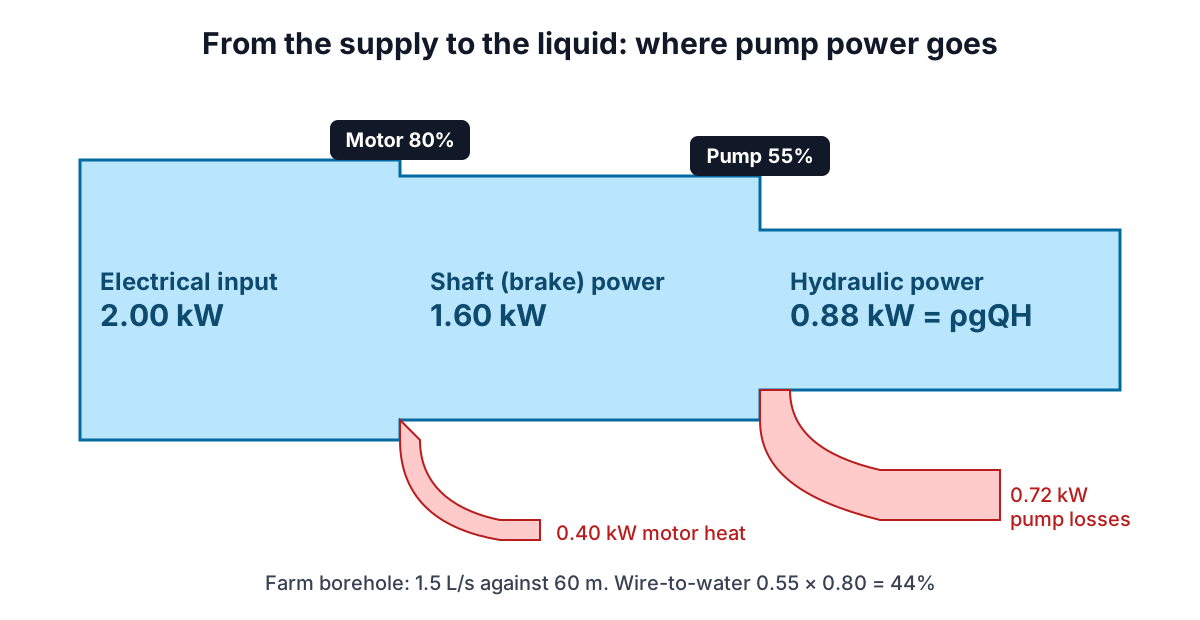
For the borehole: 998.2 × 9.80665 × 0.0015 × 60 = 0.88 kW in the water. A 55% pump needs 1.60 kW at the shaft and an 80% motor draws 2.00 kW. Only 0.55 × 0.80 = 44% of what you pay for reaches the water.
Total head for a borehole, a booster and an irrigation line
Head is the height of water the pump must add, in metres. For water, 10 m is about 1 bar. How you add it up depends on the job.
Borehole. Measure from the pumping water level, not the rest level. The water in a borehole draws down while the pump runs, and the yield test report gives the level at the tested rate. Then add the height from the borehole collar to the top of the tank or the highest outlet, and the friction in the rising main and delivery pipe. A borehole with a pumping water level 42 m down, a tank stand 12 m above the collar and 6 m of friction needs 42 + 12 + 6 = 60 m.
Pressure booster. Height of the highest tap above the pump, friction, and the pressure you want at that tap, less any pressure the supply reliably gives on the suction side. If the booster draws from a plastic storage tank, the suction starts at atmospheric pressure and the municipal pressure counts for nothing.
Irrigation. Static lift from the dam or river to the highest block, friction in the mainline (from the Pipe Pressure Drop Calculator), and the operating pressure the sprinklers, drippers or centre pivot need at the far end, converted to head.
Choosing the motor
The calculator rounds the shaft power up to the next IEC 60072 rating (…, 0.75, 1.1, 1.5, 2.2, 3, 4, 5.5, 7.5 kW …). Borehole pumps are sold as matched pump and submersible motor sets, so the maker's curve for the model at your flow and head settles the final choice. For surface pumps, check the curve at the highest flow the system can reach, because a centrifugal pump's power climbs with flow: an irrigation line with a burst or a block switched off can let the pump run out along its curve and overload a motor sized at the duty point. Round up once; a further margin on top of an already rounded-up motor adds cost without adding anything the duty needs.
The bigger loss is often in the pump. In the borehole example the pump wastes 0.72 kW and the motor 0.40 kW. A pump running at 65% at the same duty would need 1.36 kW at the shaft (a 1.5 kW motor), draw 1.69 kW, and use 2 541 kWh a year instead of 3 003, saving about R 1 650 a year at Landrate prices.
What it costs on Eskom tariffs
kWh a year = P_input (kW) × hours
energy cost = kWh × price per kWh
Eskom's tariff booklet for 1 April 2026 to 31 March 2027 gives the prices for its direct (non-local authority) customers. Rural supplies up to 100 kVA are on Landrate; urban homes supplied by Eskom on Homelight. All figures below include VAT.
| Tariff | Supply | c/kWh charges | Daily charges |
|---|---|---|---|
| Landrate 1 | up to 16 kVA single-phase, 32 kVA dual-phase or 25 kVA three-phase | energy 279.34, ancillary 0.52, network demand 77.12: total 356.98 | R 77,80 network capacity, R 30,65 service and administration, R 4,73 generation capacity |
| Landrate 4 | 16 kVA single-phase | energy 458.64, ancillary 0.52, network demand 77.12: total 536.28 | R 57,43 network capacity, R 3,11 generation capacity |
| Homelight 60A | urban residential | 343.61 | none |
Enter the price in rand per kWh with a decimal point: 356.98 c/kWh is 3.5698.
| Example | Shaft | Motor | Input | kWh a year | Energy cost a year |
|---|---|---|---|---|---|
| Farm borehole, 1.5 L/s at 60 m, pump 55%, motor 80%, 1 500 h on Landrate 1 | 1.60 kW | 2.2 kW | 2.00 kW | 3 003 | R 10 722 |
| Irrigation, 10 L/s at 40 m, pump 70%, motor 90%, 2 000 h on Landrate | 5.59 kW | 7.5 kW | 6.22 kW | 12 430 | R 44 374 |
| House booster, 0.5 L/s at 25 m, pump 40%, motor 75%, 500 h on Homelight 60A | 0.31 kW | 0.37 kW | 0.41 kW | 204 | R 701 |
Two things to watch on a farm account:
- Daily charges are separate. On Landrate 1 they add up to R 113,18 a day, about R 41 311 a year, payable whether the pump runs or not. Leave them out of the c/kWh figure; they matter when you decide whether a pump justifies its own supply point.
- Supply size limits the motor. A Landrate 1 three-phase supply is 25 kVA. The 7.5 kW irrigation motor fits, but several pumps starting together, or a pump plus a cold room, can exceed it. Rural supplies from 16 kVA can instead be on Ruraflex, a time-of-use tariff with peak, standard and off-peak periods, where scheduling irrigation into off-peak hours changes the cost per kWh.
Municipal customers pay their council's tariff; take the c/kWh rate from your bill or prepaid slip. If the pump runs from a solar array or a generator during load-shedding, cost the energy from that source instead.
Suction lift on the Highveld
Submersible borehole pumps sit below the water, so they rarely cavitate. Surface centrifugal pumps lifting from a dam, river or reservoir do, and altitude makes it worse. NPSH available is:
NPSHa = (p_atm − p_vapour) / (ρ g) + z_s − h_loss
The Highveld lies roughly between 1 500 m and 2 100 m above sea level, covering almost all of Gauteng and the Free State. Atmospheric pressure falls with height; the standard-atmosphere formula p = 101 325 × (1 − 2.25577 × 10⁻⁵ × h)^5.25588 gives about 84.6 kPa at 1 500 m and 82.0 kPa at 1 750 m.
Take a surface pump 4 m above the dam surface (a 4 m suction lift), 0.8 m of suction loss, water at 20 °C:
| Site | Atmospheric pressure | NPSHa |
|---|---|---|
| Sea level | 101.3 kPa | 5.31 m |
| 1 500 m | 84.6 kPa | 3.60 m |
| 1 750 m | 82.0 kPa | 3.34 m |
A pump that works at the coast with a 4 m lift may cavitate on the same lift in Gauteng. Compare NPSHa with the pump's NPSHr at the highest flow, lower the pump towards the water, and keep the suction pipe short and generously sized.
Tools for this job
- Pump Power and Running Cost Calculator (South Africa): flow and head to kW, IEC motor size and cost in rand. Enter 1.5 L/s, 60 m, 55%, 80%, 1 500 h and 3.5698 to repeat the borehole example.
- Pipe Pressure Drop Calculator: friction head in the rising main or irrigation mainline.
- Three-Phase Power Calculator: motor current on a 400 V supply.
- Background on the friction side: Darcy-Weisbach and Colebrook.
Drilling, yield testing and the pump selection itself belong with a borehole contractor and the pump supplier; this guide covers the sums you can check yourself.
Frequently asked questions
What size pump motor do I need for a borehole?
The next standard IEC size above the shaft power, calculated from the tested yield and the total head from the pumping water level. For 1.5 L/s at 60 m with a 55% pump the shaft needs 1.60 kW, so a 2.2 kW motor. Check the maker's curve for the matched pump and motor set at your duty.
How much does it cost to run a borehole pump on Landrate?
Multiply the kWh the calculator shows by 356.98 c/kWh, the Landrate 1 to 3 energy, ancillary and network demand charges including VAT from 1 April 2026. A pump drawing 2.00 kW for 1 500 hours uses 3 003 kWh, about R 10 722. Daily charges are billed on top.
Why does my pump lose suction in Gauteng when it worked at the coast?
Atmospheric pressure is lower at altitude, about 84.6 kPa at 1 500 m against 101.3 kPa at sea level, so a surface pump has less pressure pushing water up the suction pipe. With a 4 m lift and 0.8 m of suction loss, NPSH available drops from 5.31 m to 3.60 m.
Should I measure borehole head from the rest water level?
No. Use the pumping water level at your planned flow, from the yield test, because the level drops while the pump runs. Using the rest level understates the head and the power.
Sources and further reading
- Tariffs and Charges Booklet 2026/2027, Eskom. Landrate supply sizes and charges (page 37), Homelight energy charges, Ruraflex structure; non-local authority prices from 1 April 2026.
- Highveld, Wikipedia. Altitude range of roughly 1 500 m to 2 100 m and the provinces it covers.
- Air pressure at altitude, The Engineering ToolBox. The standard-atmosphere pressure formula used for the altitude table.
- IEC 60034-30-1: Efficiency classes of line operated AC motors (IE code), International Electrotechnical Commission. Motor efficiency classes.
- Improving Pumping System Performance: A Sourcebook for Industry, US Department of Energy and Hydraulic Institute. Pump efficiency, NPSH and energy cost over a pump's life.
Open the Pump Power Calculator
More Fluid Mechanics
Every tool in the Fluid Mechanics section, free and in your browser.