
Pump Power, Head and Motor Size in kW: A UK Guide
Size a UK booster or process pump in kW, check the IE2, IE3 and IE4 motor rules, the 12 L/min notification rule and running cost at the price cap.
By Redbison Dev · · 11 min read

United Kingdom edition. Written for UK buildings and plant: kW and IEC motor sizes, the GB Ecodesign motor efficiency classes, the water fittings rules on boosters, the 7 m minimum mains head and running costs in pounds at the Ofgem price cap. US edition
A UK pump is sized in kilowatts from three numbers: the flow in litres per second, the head in metres and the pump's efficiency at that duty. A booster set for a small block of flats moving 2.5 L/s against 30 m with a 60% pump needs 1.22 kW at the shaft, which rounds up to a 1.5 kW IEC motor, and that motor must be at least IE3 under the GB Ecodesign rules. This edition follows the same chain as the Pump Power Calculator (UK), with the British rules that decide what you can fit and how much it costs in pounds.
The formula, in the units British data sheets use
UK pump curves give flow in L/s or m³/h and head in metres of water; motor plates give output in kW. The power the water receives is:
P_water (W) = ρ × g × Q × H
with ρ in kg/m³, g = 9.80665 m/s², Q in m³/s and H in metres. Two efficiencies take you back to the meter:
P_shaft = P_water / η_pump
P_input = P_shaft / η_motor
For the flats booster (water at about 20 °C, 998.2 kg/m³): 998.2 × 9.80665 × 0.0025 × 30 = 0.73 kW of water power. A 60% pump needs 1.22 kW at the shaft and an 85% motor draws 1.44 kW. Only about half the electricity, 0.60 × 0.85 = 51%, ends up in the water.
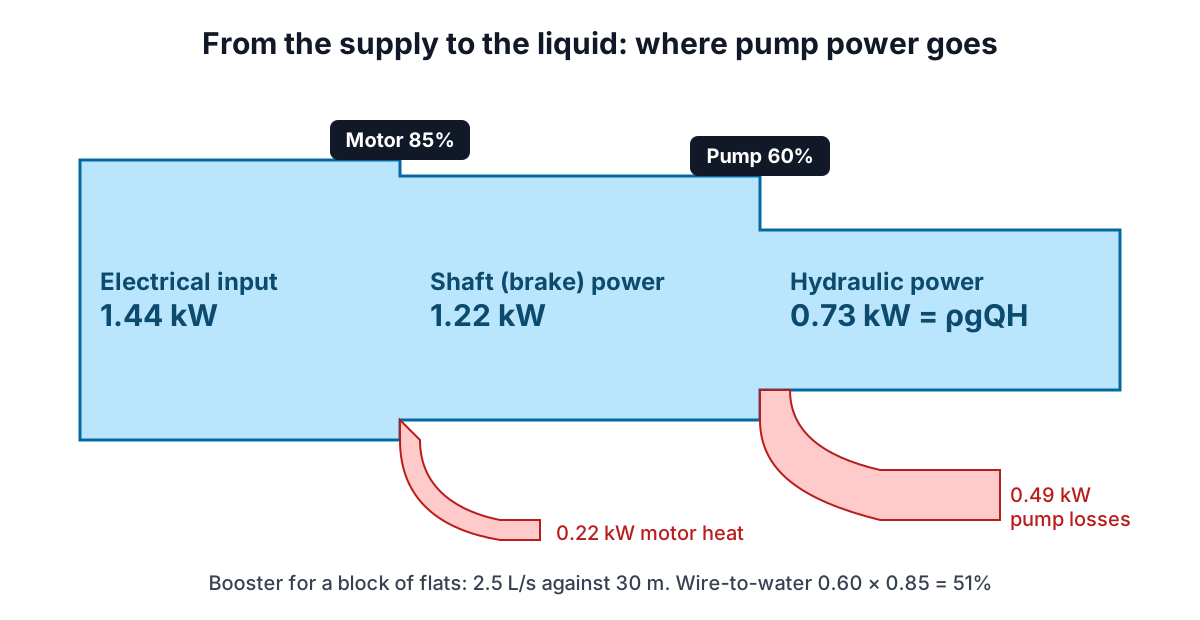
The bigger loss is in the pump, not the motor. Small booster pumps rarely reach the efficiencies of large process pumps, so take the figure from the maker's curve at your duty point.
Building up the head for a UK block
Head is metres of the liquid you are pumping. For water, 1 bar is 10.2 m, so a 30 m booster adds about 2.9 bar. A total head for a building booster is usually:
- the height of the highest outlet above the pump;
- friction in the riser, branches and fittings, from the Pipe Pressure Drop Calculator;
- the pressure you want left at that outlet, as head;
- less any useful pressure on the suction side.
That last line is where British practice matters. Many booster sets draw from a break cistern rather than straight from the main, and then the suction starts at atmospheric pressure, so the mains pressure counts for nothing. A set that boosts directly can take some credit for the incoming supply, but only for the pressure you can count on. In England the wholesaler must keep at least 7 m of static head in the communication pipe, and owes the customer £50 when it falls short for an hour or more on two occasions within 28 days (regulation 17G). In Wales regulation 10 sets the same 7 m for Welsh water undertakers, with a £25 payment. Seven metres is a floor, not a design figure, and it says nothing about flow.
For the flats example: top outlet 14 m above the pump, 6 m of friction, and 10 m (about 1 bar) at the top tap, from a break cistern. H = 14 + 6 + 10 = 30 m.
Boosting off the mains: the 12 L/min rule
Before you fit a pump to a domestic supply, check the water fittings rules. In England and Wales the Water Supply (Water Fittings) Regulations 1999 list "a pump or booster drawing more than 12 litres per minute, connected directly or indirectly to a supply pipe" among the installations that need notice to the water undertaker, and the work must not start without its consent (regulation 5). Twelve litres a minute is only 0.2 L/s, so almost any useful house or flats booster is caught. The undertaker can attach conditions to its consent, which you must follow. Scotland and Northern Ireland have their own byelaws and regulations; ask Scottish Water or NI Water.
Choosing the motor and its efficiency class
The calculator rounds the shaft power up to the next IEC 60072 rating (…, 0.55, 0.75, 1.1, 1.5, 2.2, 3, 4 kW …). Then the GB Ecodesign rules decide the minimum efficiency class. Schedule 16 of the Ecodesign for Energy-Related Products and Energy Information Regulations 2021 sets:
| Motor | Minimum class | From |
|---|---|---|
| Three-phase, 0.75 kW to 1,000 kW, 2, 4, 6 or 8 poles | IE3 | 1 July 2021 |
| Three-phase, 0.12 kW to below 0.75 kW, 2, 4, 6 or 8 poles | IE2 | 1 July 2021 |
| Single-phase, 0.12 kW and above | IE2 | 1 July 2023 |
| Three-phase, 75 kW to 200 kW, 2, 4 or 6 poles | IE4 | 1 July 2023 |
| Variable speed drives for 0.12 kW to 1,000 kW motors | IE2 drive losses | 1 July 2021 |
So the flats booster's 1.5 kW three-phase motor must be IE3, while a 0.55 kW house booster needs IE2. The same schedule exempts some motors, and two of the exemptions matter for pumps: motors fully immersed in a liquid (most submersible borehole and drainage pump motors) and motors integrated into a product so that they cannot be tested separately. A class on the plate is a minimum; enter the efficiency printed on the data sheet, which depends on size and poles.
Rounding up once is enough. A centrifugal pump's power rises with flow, so check the curve at the highest flow the system could reach (for a booster, the moment several flats open taps at once) and choose a motor that is not overloaded there. Add a margin on top of the rounded-up motor only if that check fails.
Running cost in pounds
kWh a year = P_input (kW) × hours
cost a year = kWh × unit rate
For a house on a standard variable tariff, use the Ofgem price cap. From 1 October to 31 December 2026 the average capped electricity unit rate for Direct Debit customers is 26.32p per kWh, with a 54.83p daily standing charge (Ofgem). The standing charge is paid whether the pump runs or not, so leave it out. The communal supply of a block of flats is often on a business contract with its own rate; the calculator's default of 25p per kWh is an assumption to replace with the rate on that bill.
| Example | Shaft | Motor | Input | kWh a year | Cost a year |
|---|---|---|---|---|---|
| Flats booster, 2.5 L/s at 30 m, pump 60%, motor 85%, 2,000 h at 25p | 1.22 kW | 1.5 kW, IE3 | 1.44 kW | 2,879 | £720 |
| Same duty with a 72% pump | 1.02 kW | 1.1 kW, IE3 | 1.20 kW | 2,399 | £600 |
| House booster, 1 L/s at 25 m, pump 45%, motor 80%, 1,000 h at 26.32p | 0.54 kW | 0.55 kW, IE2 | 0.68 kW | 680 | £179 |
The second row is the point of the exercise. A pump selected to run near its best efficiency point at the real duty saves 480 kWh and about £120 a year, and it also drops the motor a size. Over a booster's life that is worth more than chasing an extra point of motor efficiency. In a building, demand swings through the day, so ask the supplier whether a set with variable speed drives would serve better than a larger fixed-speed pump; by the affinity laws, power falls with the cube of speed on a friction-dominated system.
Suction and NPSH: hot water is the UK trap
Cold mains water rarely gives cavitation trouble. Heating and hot water systems do. NPSH available is the suction pressure margin above the vapour pressure, as head:
NPSHa = (p_atm − p_vapour) / (ρ g) + z_s − h_loss
Take an open (vented) tank at sea level, the pump inlet 1 m above the water surface and 0.4 m of suction loss. The calculator's water table gives a vapour pressure of 2.34 kPa at 20 °C and 47.4 kPa at 80 °C:
- at 20 °C, NPSHa = 8.7 m, plenty for a small pump;
- at 80 °C, NPSHa = 4.3 m, which may be below the NPSH required by a pump running towards the right of its curve;
- at 80 °C with the tank surface 2 m above the inlet instead, NPSHa = 7.3 m.
Put pumps on hot water below the tank, keep suction pipes short and wide, and compare NPSHa with the NPSHr curve at the highest flow, not at the duty point.
Tools for this job
- Pump Power Calculator (UK): the whole chain from flow and head to IEC motor size and cost in pounds. Enter 2.5 L/s, 30 m, 60%, 85%, 2,000 h and £0.25 to repeat the flats example.
- Pipe Pressure Drop Calculator: friction head for the riser and branches.
- Three-Phase Power Calculator: motor current on a 400 V supply once you know the input power.
- For the friction side, see Darcy-Weisbach and Colebrook; for static pressure, hydrostatic pressure at depth.
Pump selection for a building with fire-fighting, drinking water and backflow duties is a job for a building services engineer and the pump supplier; this guide covers the sums, not the design sign-off.
Frequently asked questions
Do I need permission to fit a booster pump to my water supply?
In England and Wales, a pump or booster drawing more than 12 litres per minute connected directly or indirectly to a supply pipe needs notice to the water company and its consent before work starts, under regulation 5 of the Water Supply (Water Fittings) Regulations 1999. Most useful boosters exceed 12 L/min, so contact your water company first.
What motor efficiency class does a new pump motor need in Great Britain?
Under Schedule 16 of the Ecodesign Regulations 2021, three-phase motors from 0.75 kW to 1,000 kW need IE3, smaller three-phase motors and single-phase motors from 0.12 kW need IE2, and three-phase motors from 75 kW to 200 kW with 2, 4 or 6 poles need IE4. Motors fully immersed in liquid, such as most submersible pump motors, are exempt.
How many metres of head is 1 bar?
About 10.2 m of water at 20 °C, so a pump adding 30 m of head raises water pressure by about 2.9 bar. For other liquids divide by the density: the same head gives more pressure in a denser liquid.
What mains water pressure can I count on when sizing a booster?
In England the minimum the water company must keep in the communication pipe is 7 m of static head, about 0.7 bar, with £50 compensation per qualifying failure; Wales has the same 7 m minimum, with £25. Design on the pressure measured at your property at peak times, and on none at all if the booster draws from a break cistern.
Sources and further reading
- The Ecodesign for Energy-Related Products and Energy Information Regulations 2021, Schedule 16, legislation.gov.uk. IE2, IE3 and IE4 requirements for motors and IE2 losses for variable speed drives, with exemptions.
- The Water Supply (Water Fittings) Regulations 1999, regulation 5, legislation.gov.uk. Notice and consent for pumps or boosters drawing more than 12 litres per minute.
- The Water Supply and Sewerage Services (Customer Service Standards) Regulations 2008, regulation 17G, legislation.gov.uk. The 7 m minimum static head and £50 payments in England.
- The Water Supply and Sewerage Services (Customer Service Standards) Regulations 2008, regulation 10, legislation.gov.uk. The same 7 m minimum and £25 payments in Wales.
- Energy price cap: standing charges and unit rates by region, Ofgem. 26.32p per kWh and 54.83p a day for Direct Debit electricity, 1 October to 31 December 2026.
- IEC 60034-30-1: Efficiency classes of line operated AC motors (IE code), International Electrotechnical Commission. Definitions of the IE classes.
- Improving Pumping System Performance: A Sourcebook for Industry, US Department of Energy and Hydraulic Institute. Pump efficiency, NPSH and life-cycle energy cost.
Open the Pump Power Calculator
More Fluid Mechanics
Every tool in the Fluid Mechanics section, free and in your browser.