
How to Read Your 401(k) Fee Disclosure (US)
What the 404(a)-5 participant fee notice must show, where plan, individual and fund fees hide, and what 0.25% versus 1% costs a 401(k) over 25 years.
By Redbison Dev · · 11 min read
The 401(k) fee disclosure is the notice US plans must send under Department of Labor regulation 29 CFR 2550.404a-5, and three of its numbers decide what you pay: the dollar amount of plan fees on your quarterly statement, any individual fees for things like loans, and each fund's total annual operating expenses. That last one usually costs the most. On a $120,000 balance with $800 a month going in for 25 years at a 7% gross return, the ETF Investment Simulator puts the ending balance at $1,219,902 with funds that cost 0.25% a year and $1,057,525 with funds that cost 1.00%. That is a $162,377 gap from a difference of three quarters of a percentage point.
The notice is often a dense PDF titled "participant fee disclosure" or "annual notice", and the parts that matter take about ten minutes to read.
What the plan has to send you, and when
| What | When | Where in 29 CFR 2550.404a-5 |
|---|---|---|
| How the plan works, how to give investment instructions, and the plan's administrative and individual fees | Before you can first direct your investments, then at least annually | (c)(1), (c)(2)(i), (c)(3)(i) |
| Dollar amounts of administrative and individual fees actually charged to your account, with what they paid for | At least quarterly, usually on your account statement | (c)(2)(ii), (c)(3)(ii) |
| The comparative chart of every investment option: returns, benchmarks, expense ratios, fund-level fees and restrictions | Before you first invest, then at least annually | (d)(1), (d)(2) |
"Annually" has a precise meaning here. Paragraph (h)(1) defines it as at least once in any 14-month period, so a notice that arrives in March one year and April the next is on time. "Quarterly" means at least once in any 3-month period ((h)(2)). If you have not seen a comparative chart in more than 14 months, ask the plan administrator for it; the chart itself must say how to get a free paper copy ((d)(2)(i)(C)).
Three kinds of 401(k) fees, and where each one shows up
The Department of Labor's booklet A Look at 401(k) Plan Fees groups fees the same way the notice does:
- Plan administration fees pay for recordkeeping, accounting, legal and trustee services, plus extras such as call centers, online access and educational tools. If they are charged to accounts, the quarterly statement shows your dollar share and what it paid for.
- Individual service fees apply only when you use a feature. The regulation's examples include fees for processing a plan loan or a qualified domestic relations order, investment advice, a brokerage window, sales loads, redemption and transfer fees, and optional annuity riders ((c)(3)(i)(A)).
- Investment fees are the expense ratios of the funds. The DOL calls them "by far the largest component" of plan costs. You never see a bill for them: they come out of the fund's returns before the price you see is set.
That last point is why a quarterly statement can show "$0 in fees" for someone paying 1% a year. The statement reports fees deducted from your account; the expense ratio is deducted inside the fund.
Revenue sharing: admin fees paid from fund fees
Some plans pay recordkeeping out of the funds' expense ratios instead of charging accounts directly, through revenue sharing, 12b-1 fees or sub-transfer agent fees. When that happens, the quarterly statement must say that some administrative expenses were paid from the funds' operating expenses ((c)(2)(ii)(C)). If you see that sentence, a low or zero administrative fee line is not the full story: part of a fund's expense ratio is paying for plan services, which is one reason the same index strategy can cost more inside one plan than another.
How to read the comparative chart
The chart is the part worth your time. Paragraph (d)(2) requires it to be "designed to facilitate a comparison", so every option sits in one table. Work across each row:
- Total annual operating expenses, as a percentage. This is the expense ratio. For a mutual fund, the regulation defines it as the expenses before waivers and reimbursements ((h)(5)(i)), so it can be higher than the net figure a fund advertises after a temporary waiver.
- The same cost per $1,000 invested ((d)(1)(iv)(A)(3)). 0.25% shows as $2.50 per $1,000; 1.00% shows as $10.00. Multiply by your balance in thousands for a yearly dollar figure: $10.00 per $1,000 on $120,000 is about $1,200 this year, growing with the balance.
- Shareholder-type fees charged directly against your investment, such as redemption fees, plus any restrictions on moving money in or out ((d)(1)(iv)(A)(1)).
- Average annual total return over 1, 5 and 10 calendar years, next to a broad-based market index ((d)(1)(ii)(A), (d)(1)(iii)). A fund that trails its benchmark by about its fee every year is doing what an index fund does; one that trails by much more is not.
- Fixed-return options (stable value, guaranteed accounts) show a rate and term instead of an expense ratio ((d)(1)(ii)(B)). Their costs are built into the rate, so you cannot compare them on the fee column.
The chart must also say that fees are "only one of several factors" and that their cumulative effect "can substantially reduce the growth" of your account ((d)(1)(iv)(A)(4) and (5)), and give a web address for each fund's details and a glossary ((d)(1)(v), (vi)).
Two checks worth making on every chart. First, if you were enrolled automatically, find the default investment your money went to (a target-date fund, for example) and compare its cost with the plan's other broad options. Second, check whether the same index (an S&P 500 fund, say) appears more than once at different costs, for example an institutional share class and a retail one.
What a fee difference costs over 25 years
Take a 40-year-old with $120,000 in the plan who contributes $800 a month and expects a 7% gross return until 65. To repeat this in the ETF Investment Simulator:
- switch on Use Custom Returns and set Expected Annual Return to 7%;
- keep Reinvest Dividends on (any dividend yield then gives the same total);
- enter Initial Investment 120,000, Monthly Contribution 800, Investment Period 25 years;
- set Contribution Increase and Annual Salary Growth to 0;
- enter the Expense Ratio from your chart, then change it and compare.
| Total annual operating expenses | Balance after 25 years | Fees paid | Lower than with no fee |
|---|---|---|---|
| 0.00% | $1,279,734 | $0 | $0 |
| 0.25% | $1,219,902 | $31,848 | $59,832 |
| 0.50% | $1,163,019 | $61,771 | $116,715 |
| 1.00% | $1,057,525 | $116,254 | $222,209 |
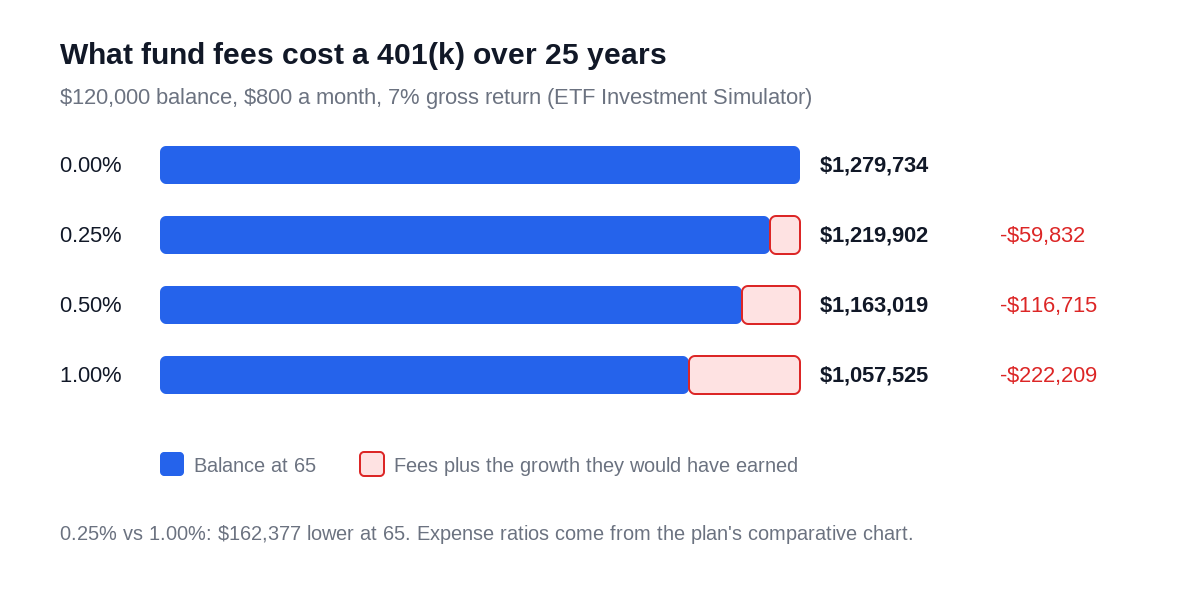
Moving from 0.25% to 1.00% costs $162,377 by 65, almost twice the $84,406 of extra fees paid, because the fee money also stops growing. The simulator charges the fee on each year's average balance, with contributions spread through the year, which is close to how a fund accrues its expense ratio daily.
The same function reproduces the DOL's own example. Its booklet takes $25,000, no further contributions, 35 years and a 7% return, and finds $227,000 with 0.5% in fees and $163,000 with 1.5%, a 28% smaller balance. With an initial investment of 25,000, a monthly contribution of 0 and a 35-year period, the simulator gives $226,556 and $162,846.
These are constant-return projections. Real returns vary; the fee is charged in bad years as well as good.
What you can do about high fees
You cannot negotiate your plan's fees, but you choose among its options. In order of effort:
- Pick the cheaper option for the same job. If the menu has a broad index fund at 0.04% next to an actively managed large-cap fund at 0.85%, the comparative chart has just shown you the trade-off in dollars per $1,000.
- Check the individual fees before using a feature. A plan loan, a brokerage window or a managed-account service each carries its own charge, and the notice lists it.
- Ask the plan administrator how administrative fees are allocated (per head or as a percentage of balance) and whether revenue sharing is credited back to accounts. The plan must give you the administrator's contact details on the chart ((d)(2)(i)(A)).
- Think twice before a rollover sold on fees. When a broker recommends moving a 401(k) to an IRA, Regulation Best Interest applies: the rule covers "account recommendations" (17 CFR 240.15l-1(a)(1)), and the SEC's adopting release (Release 34-86031) says these include recommendations to roll over a workplace retirement plan account to an IRA. Compare the IRA's all-in cost, including any advisory fee, with the plan's comparative chart before agreeing.
Who this does not fit: the regulation applies only to plans covered by ERISA's Title I. Governmental plans, including government 457(b) and public-school 403(b) plans, and church plans that have not elected in are excluded by ERISA section 4(b) (29 U.S.C. 1003(b)), and a 403(b) where the employer only forwards voluntary salary deferrals falls outside ERISA under the DOL's safe harbor (29 CFR 2510.3-2(f)). Those plans may disclose fees differently, and if your plan is a defined benefit pension there are no participant-directed investments to compare. For a decision that turns on taxes or an employer stock holding, a fee-only adviser or tax professional is worth paying for.
Tools for this job
- ETF Investment Simulator: enter your balance, contributions and the expense ratios from your comparative chart to see what a fee difference costs by retirement.
- 401(k) Calculator: project the balance with your employer match and raises, then use the simulator for the fee comparison the calculator does not model.
- Compound Interest Calculator: check the growth arithmetic on a single balance when you want to see the formula.
- US Retirement Records Checklist: the official US sites (SSA, Medicare, IRS, PBGC, FINRA) and what to check on each, as a list you can tick.
- Retirement Checklist: the steps from five years out to the year you stop working, including what to do with old plans.
The ETF fees and dividends guide covers the same fee arithmetic for a taxable brokerage account, and the 401(k), IRA and annuity guide explains contribution limits and the employer match. Old plans from former employers send the same notice; find them first with how to find a lost pension or old 401(k), and see the 11 US retirement websites to bookmark for the rest of the official sites.
Frequently asked questions
Why does my 401(k) statement show no fees when my funds charge an expense ratio?
The quarterly statement reports fees deducted from your account, such as recordkeeping charges or a loan fee. A fund's expense ratio is deducted inside the fund before its price is published, so it never appears as a line on your statement. Find it in the comparative chart, as a percentage and as dollars per $1,000 invested.
Is a 1% fee in a 401(k) high?
It costs $10 a year per $1,000 invested, and on the 25-year example above it leaves the balance $162,377 lower than a 0.25% fund would. Whether that is too much depends on what the fund does: compare it with the other options in your own plan's comparative chart for the same asset class, and with the fund's 5- and 10-year returns next to its benchmark.
What is revenue sharing in a 401(k)?
Revenue sharing is when a fund passes part of its expense ratio to the plan's recordkeeper to pay for administration. The plan's direct administrative fee can then look low or zero, while the cost sits inside the funds. Your quarterly statement must say when some administrative expenses were paid this way.
What if I never received a 401(k) fee disclosure?
Ask the plan administrator in writing. The regulation requires the plan-related and investment information before you can first direct your investments and then at least once in any 14-month period. If the plan still does not provide it, the Employee Benefits Security Administration takes participant questions through its benefits advisors at askebsa.dol.gov.
Sources and further reading
- 29 CFR 2550.404a-5, Fiduciary requirements for disclosure in participant-directed individual account plans, eCFR. The rule text, including the 14-month and 3-month definitions and the comparative chart contents.
- A Look at 401(k) Plan Fees, US Department of Labor, Employee Benefits Security Administration. The three fee types and the 35-year fee example reproduced above.
- Regulation Best Interest: The Broker-Dealer Standard of Conduct, Release 34-86031, US Securities and Exchange Commission. The adopting release; it explains that account recommendations include rolling a workplace plan into an IRA.
- 29 U.S.C. 1003, Coverage, Legal Information Institute. ERISA section 4(b), which excludes governmental and most church plans.
- 29 CFR 2510.3-2, Employee pension benefit plan, eCFR. Paragraph (f), the safe harbor for non-ERISA 403(b) programs.
- Ask EBSA, US Department of Labor. Where participants send questions and complaints about plan disclosures.