
Stoichiometry, Limiting Reactant and Percent Yield, Worked Through
One aspirin synthesis carried from grams to moles, the limiting reactant, theoretical yield, leftover excess and percent yield, plus solutions and gases.
By Redbison Dev · · 10 min read
Your lab handout says: react 2.00 g of salicylic acid with 5.00 mL of acetic anhydride, collect the aspirin, dry it and weigh it. The report then asks for the limiting reactant, the theoretical yield and the percent yield. To find the limiting reactant, convert each reactant to moles, divide each by its coefficient in the balanced equation, and pick the smallest result: that reactant runs out first and sets the theoretical yield. The rest of this guide carries that one reaction from grams all the way to percent yield, with every number checked in the Limiting Reactant Calculator and its two companions.
Start with a balanced equation and molar masses
Aspirin (acetylsalicylic acid) forms when salicylic acid reacts with acetic anhydride, giving acetic acid as a by-product:
C7H6O3 + C4H6O3 → C9H8O4 + C2H4O2
Count the atoms and it already balances with every coefficient equal to 1: 11 carbons, 12 hydrogens and 6 oxygens on each side. If you are unsure whether an equation balances, type it into the Stoichiometry Calculator, which balances it for you and shows the coefficients it used. One quirk of this particular reaction is worth knowing: atom counting alone allows more than one independent balance here, because the hydrogen and oxygen counts move in step. The calculator therefore keeps the equation as you typed it when it balances, and asks for coefficients only when it does not.
Next you need molar masses. The Molecular Weight Calculator gives them from the formula using the IUPAC abridged standard atomic weights (C 12.011, H 1.008, O 15.999):
- salicylic acid, C7H6O3: 138.122 g/mol
- acetic anhydride, C4H6O3: 102.089 g/mol
- aspirin, C9H8O4: 180.159 g/mol
- acetic acid, C2H4O2: 60.052 g/mol
The anhydride is a liquid, so you measured a volume. Its density is about 1.08 g/mL at 20 °C (PubChem lists 1.082 g/cm³), so 5.00 mL is 5.00 × 1.08 = 5.40 g.
Step 1: convert grams to moles
A balanced equation counts molecules, and moles are how chemists count molecules in bulk. Grams cannot be compared directly, because a gram of a heavy molecule contains fewer molecules than a gram of a light one.
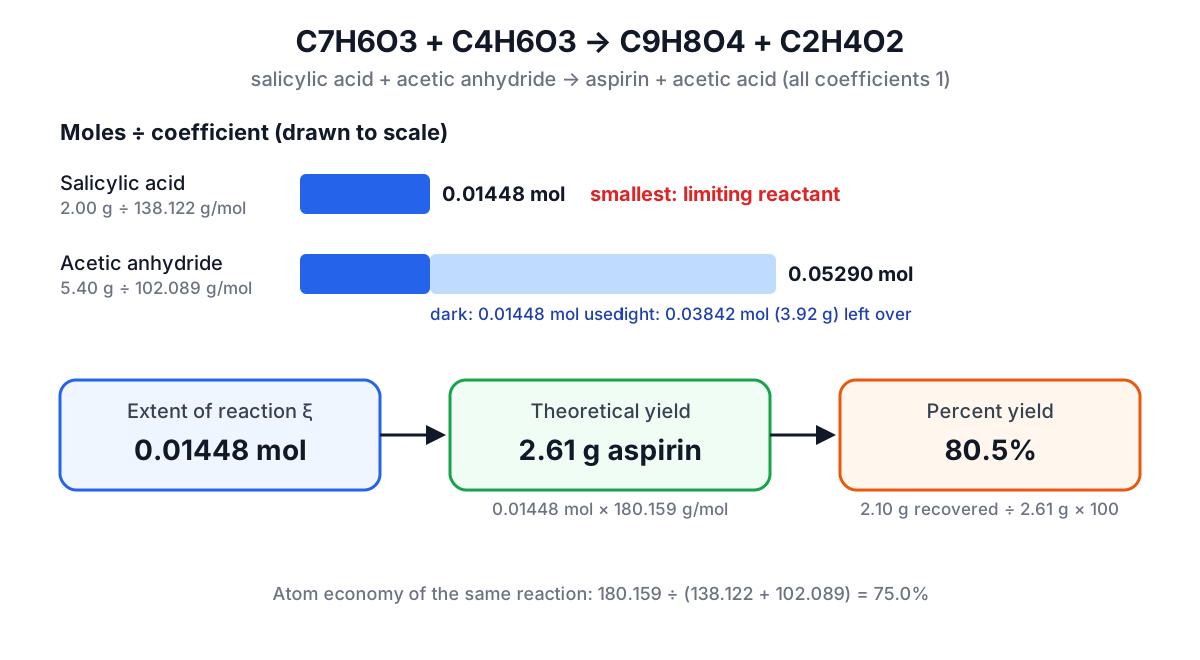
- Salicylic acid: 2.00 g ÷ 138.122 g/mol = 0.01448 mol
- Acetic anhydride: 5.40 g ÷ 102.089 g/mol = 0.05290 mol
In the Limiting Reactant Calculator, choose the aspirin example (or paste the equation), enter 2.00 g for C7H6O3 and 5.40 g for C4H6O3. The comparison table shows these mole values in its first column.
Step 2: find the limiting reactant by dividing by the coefficients
Divide each reactant's moles by its coefficient. The result is the extent of reaction that reactant alone would allow, written ξ (IUPAC defines the extent of reaction as the change in amount of a substance divided by its stoichiometric number). The smallest value wins.
Here both coefficients are 1, so the comparison is just 0.01448 against 0.05290. Salicylic acid gives the smaller number, so it is the limiting reactant, and the whole reaction can only go as far as ξ = 0.01448 mol.
The division matters as soon as the coefficients differ. OpenStax works through 3Si + 2N2 → Si3N4 with 2.00 g of silicon and 1.50 g of nitrogen. Silicon has more moles (0.07121 against 0.05354), so a quick glance says nitrogen runs out first. Divide by the coefficients and silicon allows 0.07121 ÷ 3 = 0.02374 mol of reaction while nitrogen allows 0.05354 ÷ 2 = 0.02677 mol. Silicon limits, as OpenStax concludes. The calculator agrees and also works out what OpenStax does not print: 3.33 g of Si3N4 and 0.170 g of nitrogen left unreacted.
Step 3: theoretical yield and the excess left over
Every product forms ξ times its coefficient, and every reactant is used at ξ times its coefficient. With ξ = 0.01448 mol:
- Aspirin formed: 0.01448 mol × 180.159 g/mol = 2.61 g. This is the theoretical yield.
- Acetic acid formed: 0.01448 mol × 60.052 g/mol = 0.870 g.
- Acetic anhydride used: 0.01448 mol × 102.089 g/mol = 1.48 g, so 5.40 − 1.48 = 3.92 g is left, about 72.6% of what you added.
The calculator shows all of these at once: the theoretical yield of both products and the leftover anhydride in grams, moles and percent. You can check the theoretical yield a second way in the Stoichiometry Calculator: set "I have" to 2.00 g of C7H6O3 and "Find" to C9H8O4 in grams. It gives 2.61 g, with the chain 2.00 g ÷ 138.122 g/mol = 0.01448 mol, × 1/1, × 180.159 g/mol.
That large excess of anhydride is deliberate. Using a cheap reagent in excess pushes the expensive or limiting one closer to full conversion, and the leftover anhydride is destroyed with water during the work-up. The theoretical yield, though, always comes from the limiting reactant. Working it out from the anhydride would give 9.53 g of aspirin, which is impossible with only 2.00 g of salicylic acid.
Step 4: percent yield, and what a number above 100% means
Suppose the dry aspirin weighs 2.10 g. Percent yield is actual ÷ theoretical × 100:
2.10 g ÷ 2.61 g × 100 = 80.5%
In the Percent Yield Calculator, choose "From an equation", paste the reaction, pick C7H6O3 as the limiting reactant with 2.00 g, pick C9H8O4 as the product and enter 2.10 g. It computes the 2.61 g theoretical yield itself and returns 80.5%. If you already know both yields, the "Actual and theoretical" mode takes them directly and can also solve backwards for the actual or theoretical yield.
A yield below 100% is normal: some salicylic acid does not react, some aspirin stays dissolved in the filtrate, and crystals stick to the filter paper. A yield above 100% is a signal to look again. If the same product weighed 2.75 g, the calculator would show 105% and flag it. The usual causes are a product that is still damp, unreacted salicylic acid or other impurities weighed with it, or a weighing slip. Drying the solid to constant mass fixes the first.
The same mode also gives the atom economy, Barry Trost's measure of how much of the reactants' mass ends up in the product you want: 180.159 ÷ (138.122 + 102.089) × 100 = 75.0%. Even a perfect yield of aspirin sends a quarter of the reactant mass out as acetic acid. Percent yield and atom economy measure different things, so a lab can score well on one and badly on the other.
When a reactant is a solution or a gas
Many reactions start from a solution of known molarity, or make a gas you collect by volume. The method is the same; only the conversion to moles changes.
Take zinc dissolving in hydrochloric acid: Zn + 2HCl → ZnCl2 + H2, with 3.00 g of zinc and 50.0 mL of 2.00 M HCl.
- Zinc: 3.00 g ÷ 65.38 g/mol = 0.04589 mol.
- HCl: moles = molarity × litres = 2.00 × 0.0500 = 0.100 mol. The Molarity Calculator does this conversion from concentration and volume.
- Divide by the coefficients: zinc 0.04589 ÷ 1 = 0.04589; HCl 0.100 ÷ 2 = 0.0500. Zinc limits, by a small margin, and 0.00823 mol of HCl is left.
- Hydrogen formed: 0.04589 mol, which is 0.0925 g.
Enter 3.00 g Zn and 0.100 mol HCl in the limiting reactant calculator to see the same result. For the gas volume, the stoichiometry calculator converts moles to litres at 0 °C and 1 bar (22.711 L/mol), giving 1.04 L of hydrogen. Gas in a real lab is rarely at 0 °C, though. At 25 °C and 1 atm, the Ideal Gas Law Calculator gives V = nRT/P = 0.04589 mol × 8.3145 J/(mol·K) × 298.15 K ÷ 101,325 Pa = 0.00112 m³ = 1.12 L. If you collect 1.05 L at those conditions, that is 1.05 ÷ 1.12 = 93.5% of the theoretical amount. The ideal gas law guide explains when the ideal model stops being accurate.
Mistakes that cost marks
- Comparing grams, or comparing moles without the coefficients. The silicon nitride example shows both traps.
- Computing theoretical yield from the excess reactant. It always gives a larger, impossible number.
- Using the wrong molar mass. A hydrate, a salt form or a typo in the formula changes every number downstream. The chemistry calculations guide covers molar mass and hydrates in detail.
- Mixing STP conventions. 22.4 L/mol belongs to 0 °C and 1 atm; 22.7 L/mol to 0 °C and 1 bar. Use whichever your course defines, and neither when the gas is at room temperature.
- Over-reporting digits. Your answer cannot be more precise than your least precise measurement. The calculators round to the significant figures you typed and let you switch to full precision for intermediate steps.
- Treating percent yield as percent error. Percent error compares a measurement with an accepted value; the percent error guide covers it.
Tools for this job
- Stoichiometry Calculator: balance the equation and convert grams, moles, gas litres or particles of one substance into any other.
- Limiting Reactant Calculator: compare two or more reactant amounts to get the limiting reactant, theoretical yields and leftovers.
- Percent Yield Calculator: percent yield from your recovered mass, solving backwards for planning, and atom economy.
- Molecular Weight Calculator: molar mass of any formula, including hydrates, when you want to check a value by hand.
- Molarity Calculator: moles from a solution's concentration and volume, or the reverse.
- Ideal Gas Law Calculator: moles or volume of a gas at any temperature and pressure, not only at STP.
Frequently asked questions
Why do procedures add one reactant in excess on purpose?
An excess of a cheap or easily removed reagent pushes the more valuable reactant towards complete conversion, and in equilibrium reactions it shifts the position of equilibrium towards products. In the aspirin synthesis, the acetic anhydride is in more than threefold molar excess, and the unused portion is hydrolysed during the work-up.
Can I calculate theoretical yield from the reactant in excess?
No. Only the limiting reactant runs out, so only it fixes how much product forms. Working from the excess reactant gives a larger number that the reaction cannot reach: 9.53 g of aspirin from 5.40 g of anhydride, when the 2.00 g of salicylic acid allows only 2.61 g.
How many significant figures should a percent yield have?
The same number as the least precise measurement behind it. With masses of 2.00 g and 2.10 g, three significant figures are justified, so report 80.5%. Keep extra digits during the intermediate steps and round once at the end, otherwise rounding errors pile up.
Does the limiting reactant change if I scale the reaction up?
Not if every amount is scaled by the same factor, because the ratio of moles to coefficients stays the same. It does change if you scale only one reactant, so check again whenever a procedure is adapted with different stock bottles or concentrations.
Sources and further reading
- 4.3 Reaction Stoichiometry, OpenStax, Chemistry 2e. Mole ratios and grams-to-grams problems.
- 4.4 Reaction Yields, OpenStax, Chemistry 2e. Limiting reactant, theoretical and percent yield, including the silicon nitride and copper examples.
- Abridged standard atomic weights, IUPAC Commission on Isotopic Abundances and Atomic Weights. The atomic weights behind every molar mass here.
- Extent of reaction, IUPAC Compendium of Chemical Terminology (Gold Book). Definition of ξ.
- The Atom Economy: A Search for Synthetic Efficiency, B. M. Trost, Science 254 (1991). The paper that introduced atom economy.
- Acetic anhydride, PubChem, National Library of Medicine. Density 1.082 g/cm³ at 20 °C.
- Molar volume of ideal gas (273.15 K, 100 kPa), NIST CODATA. 22.710 954 64 L/mol, exact.
Open the Limiting Reactant Calculator
More Physics & Chemistry
Every tool in the Physics & Chemistry section, free and in your browser.