
AI Voice Clone Scams in Australia: A Family Safe Word Plan
Beat cloned-voice "family emergency" calls with a safe word and a call-back, then report to Scamwatch, your bank and IDCARE on 1800 595 160 if money has gone.
By Redbison Dev · · 10 min read
Australia edition. Australian edition built on Scamwatch (National Anti-Scam Centre, ACCC) advice on AI voice clones and new-number messages, its reporting and police-report routes, and IDCARE's free recovery support. US edition
Scamwatch, run by the National Anti-Scam Centre at the ACCC, puts the risk plainly: scammers can use a few seconds of a voice recording to make an AI clone and call pretending to be friends or family in distress. Its advice is just as plain: always call the person back on their real number, and do not reply to a message from a new number claiming to be them. A family safe word adds one more check before that call-back, and it costs nothing to set up.
If money has already gone, contact your bank straight away and ask it to stop the transactions, then call IDCARE on 1800 595 160 for a free recovery plan, and report the scam to Scamwatch. If anyone is in immediate danger, call 000. The US version of this article, with the FTC and FBI's description of how voices are cloned, is here.
How the calls and messages work
Scamwatch describes scammers working across several channels at once: a social media message, then an email, then a call, all keeping the same false story, and using AI to adapt when you push back. In a family emergency version that means:
- a text or WhatsApp from a "new number" ("my phone's broken, this is my new one"), which Scamwatch says not to reply to; its text scams page says to call the person on the number you already have, or ask a question only they could answer;
- then a call in a voice that sounds right, built from a few seconds of audio;
- a reason you must not ring the old number, and an urgent bank transfer or payment request.
Scamwatch also warns that personal details found online make these messages feel tailored: your suburb, your dog's name, the footy team. Personal does not mean legitimate.
The family plan
- Pick one safe word or phrase per household, in person. Never put it in a text, email or family group chat.
- Ask for it without a hint, and treat "I can't remember, just help me" as a no.
- Hang up and call back on the number saved in your phone, not the new one. If they do not answer, ring another family member.
- Nothing is paid until you have spoken to them on a call you started.
- For calls from "the bank" or "the ATO", follow Scamwatch's advice for any organisation: call back on a number you find yourself on its official website or app.
Choosing a safe word nobody can look up
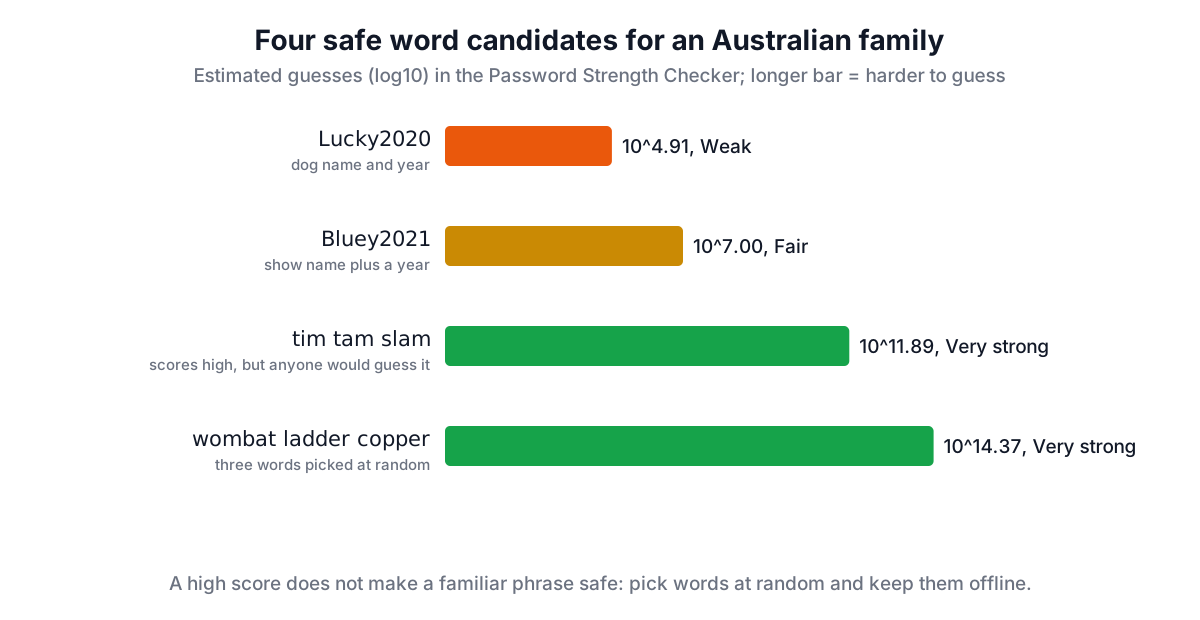
On a call, a scammer gets one or two guesses, so the danger is research rather than computing power. The Password Strength Checker shows how exposed some favourites are:
| Phrase | Guesses (log10) | Score | Problem |
|---|---|---|---|
Lucky2020 (dog's name and year) | 4.91 | 1, Weak | on leaked-password lists, and on your Instagram |
Bluey2021 | 7.00 | 2, Fair | a pet or show name plus a year |
tim tam slam | 11.89 | 4, Very strong | scores high but any Australian would guess it |
wombat ladder copper | 14.37 | 4, Very strong | three unrelated words, picked at random |
A high score is not enough on its own: tim tam slam is something an Australian scammer would try first. Choose words that have nothing to do with each other or with your family, for example by rolling dice against a word list, and add a pet's or child's name to the checker's "words about you" box to see how much any personal word weakens a phrase.
If you have paid: the order that matters
Scamwatch's report page and its AI guidance give most of these steps; changing passwords (step 2) is this guide's own advice:
- Your bank or card provider, now. Tell them it is a scam and ask them to stop any transactions.
- Change passwords on banking, email, government and shopping accounts if you shared anything.
- IDCARE (1800 595 160), Australia and New Zealand's national identity and cyber support service, helps you make a free plan to limit the damage.
- Report to Scamwatch. Reports help it warn others and, with your consent, work with platforms to take down scam ads, websites and contact details.
- Police. If money or personal information was stolen, or someone tried to extort you, Scamwatch links to the Australian Cyber Security Centre's page for making a police report.
Then be ready for the second wave. Scamwatch notes it is very common for victims to be targeted by money recovery scams: someone offering to get your money back for a fee. IDCARE's help is free.
Example: a grandmother transfers A$3,800 after a call from "her grandson" and his "lawyer". Her first call is to the bank's fraud line on the number on her card, within minutes; the second to IDCARE; the Scamwatch report can follow the same day.
Protecting the accounts behind the plan
A scammer who takes over someone's email or messaging app can read the safe word and message the family from a trusted account. Give each account a unique password from the Password Generator, switch on multi-factor authentication, and see the password strength guide for passphrases you have to remember.
Frequently asked questions
Can scammers really copy a voice from a short clip?
Yes. Scamwatch says scammers can use a few seconds of a voice recording to create an AI clone and call pretending to be a friend or family member in distress.
What should I do if I get a "Hi Mum, new number" message?
Do not reply to the new number. Call your child on the number you already have for them, as Scamwatch advises.
Who do I call first if I sent money to a scammer?
Your bank or card provider, to stop the transactions. Then IDCARE on 1800 595 160 for free support, and report to Scamwatch. Call 000 if anyone is in immediate danger.
Someone says they can recover my money for a fee. Is that real?
Treat it as a scam. Scamwatch warns that money recovery scams commonly target people who have already lost money.
Should grandparents have the same safe word?
Yes, one phrase for everyone who might get a call keeps it simple. What matters is that it is said in person and never written in a message.
Sources and further reading
- How scammers use technology and AI, Scamwatch, National Anti-Scam Centre. Voice clones from a few seconds of audio, call-back advice, IDCARE.
- Report a scam, Scamwatch. What reports are used for, 000, police reports and contacting your bank.
- Help someone who's being scammed, Scamwatch. Warning signs and money recovery scams.
- Text or SMS scams, Scamwatch. "New number" messages from family and friends, and calling the existing number.
- IDCARE, national identity and cyber support service.